Picture this. You’re standing in the middle of a city that helped build the modern world, surrounded by more canals than Venice, eating some of the best food in the UK, and paying half of what you’d pay in London for the privilege. That city is Birmingham. And somehow, it still doesn’t get the credit it deserves.
This guide is for anyone planning a visit, whether it’s your first time or you’ve been before and feel like you only scratched the surface. We’ve covered the history, the neighbourhoods, the food, the culture, practical travel tips, and a few things that don’t make it onto the standard tourist lists. By the end of it, you’ll know exactly what you’re going to and why it’s worth the trip.
A Bit of History First (It Actually Matters Here)
Birmingham’s history isn’t background filler. It’s visible in the streets, the canals, and the industries still running today.
The city started as a small market town in the 12th century and stayed that way for hundreds of years. Then the Industrial Revolution arrived and changed everything. By the 18th century Birmingham had become the workshop of the world, producing guns, jewellery, coins, tools, and steam engines in volumes that no other city could match. Matthew Boulton and James Watt built their Soho Manufactory here in 1765. The world’s first steam-powered coins were minted in Birmingham. The industrial infrastructure that powered the British Empire was largely built here.
The canal network followed. The city needed a way to move heavy goods, so they built miles of canals connecting Birmingham to the rest of England. That network is still here, running right through the city centre.
The 20th century brought two world wars, Blitz damage, post-war reconstruction, and waves of immigration from across the Commonwealth. Birmingham’s South Asian community shaped the city’s identity as profoundly as any force in its history. The Balti dish was invented here.
Birmingham also gave the world heavy metal. Black Sabbath formed here in 1968. Ozzy Osbourne, Tony Iommi, Geezer Butler and Bill Ward all grew up within a few miles of each other in Aston. There’s a statue of the band on Broad Street. Yes, really.
Knowing all of this makes the city make sense when you walk around it. The canals aren’t just pretty. The Jewellery Quarter isn’t just a nice place for dinner. They’re evidence of what this place built and what it became.
The Culture of Birmingham
Birmingham is the youngest major city in Europe by population age and one of the most diverse. Over 180 languages are spoken here and that shapes everything, the food, the music, the neighbourhoods, and the way the city feels when you walk around it.
The South Asian community arrived in the 1950s and 60s to work in Birmingham’s factories and foundries. They stayed, built communities, and permanently changed what the city looked and tasted like. The Balti Triangle and the bhangra music scene both came directly from that history.
The Caribbean community settled largely in Handsworth and brought a musical culture that produced Steel Pulse and fed Birmingham’s reggae scene for decades. The Irish community, one of the largest outside Ireland, shaped the city’s working-class identity from the canal-building era onwards.
One thing most visitors miss: J.R.R. Tolkien grew up here. His childhood in Sarehole, now part of Hall Green, and the landscapes of the West Midlands fed directly into Middle-earth. Sarehole Mill, an 18th century watermill he knew as a boy, is still open to visit.
Birmingham’s culture is what happens when different communities build something together over a long time. You feel it everywhere once you know to look for it.
Getting to Birmingham and Getting Around
Flying In
Birmingham Airport handles over 12 million passengers a year and connects to more than 150 destinations across Europe, the Middle East, North America and beyond. It’s about 8 miles east of the city centre, which sounds like a lot but isn’t, because the connections are genuinely good.
The Air-Rail Link is a free automated shuttle that runs between the terminal and Birmingham International railway station. Takes 90 seconds. From the station, trains run into Birmingham New Street in about 10 minutes. It’s one of the most efficient airport-to-city connections in the UK and most people don’t realise how quick it is until they’ve done it.
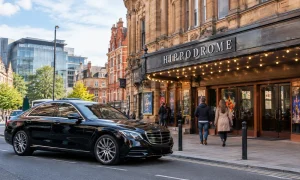
If you’re travelling with luggage, heading somewhere specific, or arriving late at night, a pre-booked chauffeur from Birmingham Airport is the most straightforward option. Your driver meets you in arrivals with a name board, takes the bags, and drops you at your hotel or wherever you’re going. No queuing, no figuring out which train, no stress. For business travellers especially it’s worth building into the budget.
For a complete breakdown of terminals, parking, transport options and what to expect at the airport, the Birmingham Airport guide covers everything you need before you land.
Getting Around the City
The city centre is walkable. Most of the main attractions are within 20 to 30 minutes on foot of each other once you’re in the centre.
For neighbourhoods further out, Moseley, Bournville, the Jewellery Quarter, Digbeth, a taxi or pre-booked car is the easier option. The bus network covers most areas but takes longer and if you’re visiting for a limited time, it’s usually worth paying a bit more for a direct route.
If you’re a business traveller moving between meetings across the city, a chauffeur service in Birmingham removes every variable from the day. Fixed arrival times, someone who knows the roads, and a proper vehicle to work in between stops.
The City Centre
Start here. Even if you only have a day, start here and let the city reveal itself to you in the right order.
Centenary Square
This is the main public square and a good place to get your bearings. The Library of Birmingham sits on the edge of it, the Birmingham Rep theatre is nearby, and on most days there’s something happening, a market, an event, or simply people sitting around in the sun when the weather allows.
Go into the library. Don’t just look at the ground floor. Take the escalators all the way to the Shakespeare Memorial Room, which is on the seventh floor and has one of the finest collections of Shakespeare-related material anywhere in the world. Then carry on up to the rooftop garden. The view over the city from the top stops most people for a moment. It’s free. It takes five minutes to get up there. There’s no good reason not to do it.
The Bullring and Selfridges
The Bullring is the city’s main shopping area and it draws millions of visitors a year, most of them for the Selfridges building. The exterior is covered in around 15,000 aluminium discs and it either looks extraordinary or baffling depending on your taste in architecture. I find it extraordinary. It opened in 2003 and it’s still one of the most distinctive commercial buildings in Europe.
The old Bull Ring market has been on this site since the 12th century. The current market hall, the indoor one on the lower level, still sells fresh food, textiles and all sorts, very much in the tradition of a proper market. Worth walking through even if you’re not buying anything.
Grand Central, directly above New Street station and connected to the Bullring, is the calmer, more upmarket end of the shopping. Better food options, less noise, a John Lewis. Good for a coffee and a sit-down before you head anywhere else.
Birmingham Cathedral
St Philip’s Cathedral is five minutes from the Bullring and almost nobody goes in. That’s genuinely baffling because the Burne-Jones stained glass windows inside are among the finest Pre-Raphaelite works in existence. Four enormous windows, designed by Edward Burne-Jones who was a Birmingham man himself, depicting the Nativity, the Crucifixion, the Ascension and the Last Judgement. If these windows were in a cathedral in France they’d be in every guidebook. They’re here. Free to see. Go in.
The cathedral square outside is one of the quieter spots in the city centre and worth a few minutes just to sit down and take stock.
Broad Street and the Nightlife
Broad Street is Birmingham’s main entertainment strip. Bars, clubs, restaurants, and the Black Sabbath bench where the band’s statue sits. If you want to see that statue, and you’d be surprised how many people do, it’s on the corner of Broad Street and Centenary Square.
In the evening, Broad Street gets lively. It’s not everyone’s scene but it’s the centre of Birmingham’s nightlife and on a Friday or Saturday night the whole street has a particular energy that’s worth seeing even if you don’t join in. The restaurants along here range from reliable chains to some genuinely good independents.
Birmingham’s History Up Close
The Back to Backs
Court 15, Hurst Street. This is a row of back-to-back houses that were built in the 1830s and have been preserved by the National Trust as they were through different eras of Birmingham’s history. One room represents the 1840s. Another the 1930s. Another the 1970s.
Back-to-backs were the dominant housing type for working-class Birmingham families for over a century. Tiny houses sharing walls on all sides with no garden, no through ventilation, sometimes a single outdoor toilet for a whole row. Understanding how people actually lived during Birmingham’s industrial peak changes how you see the city. The tours are led by guides who know the history deeply and the whole experience takes about an hour. Book in advance. It sells out regularly.
Aston Hall
North of the city centre, Aston Hall is a Jacobean mansion built between 1618 and 1635. It survived the Civil War. Charles I stayed here during the Siege of Birmingham in 1643. The long gallery on the top floor has the original plasterwork ceiling from 1635 and it’s one of the best-preserved Jacobean interiors you’ll find anywhere in England open to the public. Free entry. The park around it is large enough for a proper walk.
Blakesley Hall
Less visited than Aston Hall but in some ways more interesting. Blakesley Hall is a timber-framed farmhouse built in 1590, sitting in a suburb called Yardley that barely looks like it has anything to do with 16th century farmhouses. It’s a Tudor building in the middle of a modern residential area and the contrast is disorienting in the best way. Free entry.
The Soho House
Matthew Boulton’s home from 1766 to 1809. This is where the Lunar Society met, a group of Enlightenment thinkers that included James Watt, Erasmus Darwin, Joseph Priestley and Josiah Wedgwood. They met on the Monday nearest the full moon each month so they could ride home by moonlight, which is how they got the name. The ideas discussed in this house contributed directly to the Industrial Revolution and the scientific revolution that accompanied it. The house has been restored and is open to visitors.
The Jewellery Quarter
The Jewellery Quarter deserves its own section because it’s one of the most complete and interesting historic districts in any British city.
It sits about a mile northwest of the city centre and for roughly 200 years it was the centre of the UK’s jewellery trade. At its peak in the early 20th century it produced around 40 percent of all jewellery made in Britain. Over 100 jewellery businesses still operate here today, many of them in the same buildings where the trade has been practised for generations.
The Museum of the Jewellery Quarter is the best starting point. It’s built around the Smith and Pepper jewellery factory, which closed in 1981. When it closed, the owners locked the door and left everything exactly where it was. Tools on the benches, half-finished work in the trays, the machinery still in place. When it was opened as a museum the factory floor was essentially untouched. Walking through it is a genuinely unusual experience. It doesn’t feel staged the way most museum recreations do. It feels like the workers just stepped out for lunch.
Beyond the museum, walk the streets. Vyse Street, Warstone Lane, Spencer Street. The architecture here is different to the rest of Birmingham. Smaller buildings, Victorian workshops, the occasional grand Victorian clock tower. The cemetery on Warstone Lane has catacombs built into the hillside and is one of the stranger and more beautiful green spaces in the city.
The Jewellery Quarter has also become one of Birmingham’s best places to eat and drink over the past decade. The restaurants here draw local regulars rather than tourists, which is always the better sign. Lasan on James Street is consistently regarded as one of the finest Indian restaurants in the country. The Plough on Shadwell Street is a proper pub. The side streets have cocktail bars and coffee shops that are well worth exploring on foot.
Digbeth
Digbeth is about a 10-minute walk south of the city centre, separated by a ring road that makes it feel further than it is. It’s worth the effort to cross it.
The area is still visually industrial. Old brick factories, loading bays, railway arches running overhead. These bones are what make Digbeth what it is, because what’s happened inside them over the past 15 to 20 years is one of the more interesting urban transformations in the UK.
The Custard Factory is the most well-known landmark. Bird’s Custard was made here from the 1960s until 1996. The complex is now a creative hub with independent shops, studios, bars, and event spaces. On weekends something is always happening. The quality varies but the atmosphere is consistently good and the building itself is worth seeing.
The street art on Floodgate Street and the surrounding roads is some of the best in the country. These aren’t the sanitised corporate murals that tend to appear in regenerated city areas. They’re large, serious, occasionally political, and done by artists who know what they’re doing. Walk slowly and look up.
Digbeth Dining Club runs at the Boxxed venue on Friday and Saturday evenings. Street food traders, outdoor seating, mostly a local crowd. It’s been running for years and it’s one of the best street food events in the UK. I’ve eaten there many times and have never had reason to complain.
Digbeth is also where many of Birmingham’s best independent music venues are. The Hare and Hounds in nearby Kings Heath, Mama Roux’s, and the Spotted Dog all have regular programmes of live music. If you’re in Birmingham on a Friday or Saturday and want to see live music, Digbeth and the surrounding area is where to look.
The Canals
Birmingham has more miles of canal than Venice. Let me tell you what that actually means when you’re there.
Walk along the water from the city centre and you won’t cross a road for a long time. There are stretches that are genuinely quiet in a city of over a million people. The Gas Street Basin on a clear afternoon looks like somewhere you’d choose to go, not somewhere you’d pass through.
The canals were built for industry, to move coal and iron and manufactured goods into and out of the city during the 18th and 19th centuries. The factories are mostly gone but the canals remain and they cut through the city in a way that feels completely separate from the streets above them.
Brindleyplace
This is the most developed section of the canal network in the city centre. Restaurants and bars line both sides of the water. The National Indoor Arena is nearby. In summer the outdoor seating fills up from mid-afternoon and the pace slows down in a way that the rest of the city rarely manages.
The Ikon Gallery sits just off Brindleyplace in Oozells Square, inside a converted Victorian school building. It’s a free contemporary art gallery with shows that change regularly and are consistently worth seeing. I’m not someone who seeks out galleries but I’ve ended up here more than once and left glad I went.
Walking the Towpaths
The towpath from Gas Street Basin towards Edgbaston takes you through a stretch that most visitors never find. Within 15 minutes of the city centre you’re walking along the water with trees on both sides and almost no traffic noise. It’s the most surprising thing about Birmingham for people who’ve only seen the city centre.
You can also walk in the other direction, east towards Digbeth and beyond, and the canal takes on an entirely different character, more industrial, more raw, more interesting in a different way.
Moseley and the South
About two miles south of the city centre, Moseley is the neighbourhood that surprises people most. Get a taxi or book a chauffeur from the city centre. It’s worth the short journey.
Moseley is where Ozzy Osbourne grew up. So did Tony Iommi and Geezer Butler of Black Sabbath. The neighbourhood has been home to musicians, artists, writers, and independent thinkers for a long time. It shows in the character of the place.
The main road through Moseley Village has independent cafes that actually know how to make coffee, a record shop that does serious business, bookshops, vintage clothing, and a weekend farmers market that draws people from across the city. The pace is completely different to the city centre. Nobody seems to be in a rush. The food is better. The conversations are louder.
The Balti Triangle
Just south of Moseley, in Balsall Heath, the Ladypool Road is the heart of what’s known as the Balti Triangle. This is where Birmingham’s balti dish was developed in the 1970s and 1980s, created by Kashmiri restaurateurs cooking in the British-Asian style that defined a generation of Birmingham food culture.
The balti is a specific dish, cooked fast in a thin pressed steel wok called a balti bowl and served in the bowl it was cooked in, with naan bread rather than rice. The technique produces a particular flavour that you don’t get from the same ingredients cooked any other way. The restaurants here are informal, the menus are simple, the portions are large, and the food is extraordinary. A balti with naan bread eaten on the Ladypool Road is the best meal available in Birmingham. That’s not a subjective opinion I’m hedging. It’s just what’s true.
Bournville
Four miles south of the city centre, Bournville is one of the most unusual places in England and almost nobody outside the Midlands knows it exists.
George Cadbury built it in the 1890s for his chocolate factory workers. He believed that where you lived affected how you worked and how you lived your life, so he built somewhere decent. Wide roads lined with trees, solid brick houses, a village green, almshouses, a meeting house, a school. No pubs originally, because Cadbury was a Quaker and believed alcohol caused poverty. The no-pub rule didn’t last, but everything else did. Bournville today is immaculate in a way that feels planned because it was planned, down to the tree spacing and the minimum garden sizes that were written into the original deeds.
Cadbury World
The factory is still here and Cadbury World runs visitor experiences through it, taking you from the history of chocolate among the Aztecs through to the modern production line, with tastings along the way. It’s better than it sounds. Adults enjoy it as much as children. Book tickets in advance because it sells out, especially during school holidays.
The Village Itself
Even if you skip Cadbury World, walk around the village. The Cadbury family home, the almshouses, and the Friends Meeting House are all within a short walk of each other. The Bournville Village Trust, set up by George Cadbury, still manages the area today and the original vision for the neighbourhood is still largely intact more than 130 years later. That’s genuinely remarkable and worth seeing firsthand.
Culture and the Arts
Birmingham has a cultural offering that consistently surprises visitors who associate the city primarily with manufacturing and football.
Birmingham Museum and Art Gallery
This is one of the best regional museums in the UK and it’s free. The Pre-Raphaelite collection is the most important thing here. Birmingham has the largest collection of Pre-Raphaelite art in the world. Edward Burne-Jones, Dante Gabriel Rossetti, William Holman Hunt. The Round Room alone is worth an hour of your time.
The museum also holds significant collections of ancient Egyptian artefacts, Bronze Age metalwork, and ceramics. Give it at least two hours. Most people give it one and leave wishing they’d had longer.
Symphony Hall
Symphony Hall opened in 1991 and is consistently rated among the best concert halls in the world for acoustics. The City of Birmingham Symphony Orchestra, the CBSO, has been based here for decades. Under Simon Rattle’s direction in the 1980s and 90s the CBSO became one of the most celebrated orchestras in Europe and helped turn Birmingham into a serious destination for classical music. You don’t have to be a classical music fan to appreciate a live performance in a room that sounds like this. Check what’s on during your visit.
Birmingham Rep
One of the most important regional theatres in the country, right on Centenary Square. The Rep produces new work, transfers shows to the West End, and has launched the careers of many of the UK’s best theatre makers. Check the programme before you arrive. Tickets are significantly cheaper than London for the same quality of work.
Thinktank Birmingham Science Museum
Based in Millennium Point near Digbeth, Thinktank is a science and technology museum that covers Birmingham’s industrial history alongside more hands-on exhibits. There’s a working steam engine, a reconstruction of a back-to-back house, and a planetarium. It works for adults as well as children and gives more context to the industrial history of the city than almost anywhere else.
Sport in Birmingham
Birmingham takes its sport seriously. Very seriously.
Football
The city has two Premier League clubs in Aston Villa and Birmingham City, though their fortunes vary from season to season. Villa Park, Aston Villa’s ground in the north of the city, is one of the most atmospheric football grounds in England. The club was one of the founding members of the Football League in 1888 and the stadium has a history to match. If you can get a match ticket, go.
Birmingham City’s ground, St Andrew’s, is in the Bordesley Green area east of the city centre. The rivalry between the two clubs is fierce and the atmosphere at any local derby is something to experience if you happen to be in the city when one is scheduled.
The NEC and Major Events
The National Exhibition Centre sits right next to Birmingham Airport and hosts major exhibitions, concerts, and sporting events throughout the year. The Resorts World Arena connected to it is one of the UK’s largest indoor venues. Check what’s on during your visit because major events here can define a trip.
Getting between the airport and the NEC is simple. The full transport options are covered in the Birmingham Airport to NEC guide if you want to plan it before you arrive.
The 2022 Commonwealth Games
Birmingham hosted the Commonwealth Games in 2022 and the legacy is still visible in the city. Alexander Stadium in Perry Barr was completely rebuilt. The Sandwell Aquatics Centre is now open for public swimming. The Athletes Village was converted into new housing. The city used the Games to accelerate infrastructure development and the improvements to public spaces across Birmingham are noticeable if you know what you’re looking for.
Where to Eat in Birmingham
Birmingham has more Michelin-starred restaurants outside London than any other UK city. Most visitors don’t know this because the city has never been particularly good at publicising itself.
Fine Dining
Purnell’s in the Jewellery Quarter is the most celebrated. Run by Glynn Purnell, who grew up in Birmingham and trained under some of the best chefs in Europe, it’s a tasting menu restaurant that uses local ingredients in creative ways. Book weeks in advance for weekend tables.
Adam’s, near St Philip’s Cathedral in the city centre, is regularly rated among the very best restaurants in the country. The room is small and the food is exceptional. Again, book ahead.
Everyday Excellent
Carters of Moseley runs a short seasonal menu in a small room and the cooking is outstanding. The menu changes regularly. The room fills up with people who have booked weeks ahead and consider it worth it.
Lasan in the Jewellery Quarter is one of the finest Indian restaurants in the UK. In a city that has exceptional Indian food everywhere, that distinction means something.
The Balti Triangle on the Ladypool Road, as I keep coming back to, is the answer to the question of where to eat if you only have one meal. Show up, sit down, order the balti with naan bread, and leave very full.
For coffee, Digbeth has several independent roasters and cafes doing serious work. Kanteen on the Jewellery Quarter’s Vyse Street is worth the walk. Yorks Bakery Café in the city centre is a reliable stop.
Day Trips from Birmingham
Birmingham’s location in the centre of England makes it an excellent base for day trips. Everything is closer than you’d think.
Stratford-upon-Avon, Shakespeare’s birthplace, is about 30 miles south. The Cotswolds are within easy reach and the villages of Broadway, Bourton-on-the-Water, and Chipping Campden are all under an hour’s drive. Warwick Castle is 20 miles away. The Peak District starts about 50 miles north.
If you’re planning to move between Birmingham and any of these destinations, a chauffeur for the day means you can cover multiple stops without worrying about parking in tourist areas or driving unfamiliar roads.
When to Visit
Spring, April through June, is the best time for the canals and the outdoor spaces. The weather is mild, the city is busy without being overwhelming, and most attractions are open and uncrowded.
Summer brings festivals, outdoor events, and the best version of Brindleyplace and the canal-side areas. It can get crowded around major events at the NEC.
The Christmas markets in November and December are excellent. Birmingham’s Frankfurt Christmas Market is the largest authentic German Christmas market outside Germany and Austria and takes over the city centre for several weeks. If you haven’t been, it’s worth a special trip.
Winter otherwise is quieter and the museums and galleries come into their own as the main reason to be indoors.
Practical Things Worth Knowing
Two full days covers the city centre, the Jewellery Quarter, Digbeth, and the canals comfortably. Three days lets you add Moseley, Bournville, and a museum or two without rushing.
The city centre is walkable. For anywhere outside it, a taxi or pre-booked transfer is the practical option.
If you’re arriving by air, Birmingham Airport handles the journey into the city well but a pre-booked chauffeur transfer removes every variable from the start of your trip. Your driver tracks your flight, meets you in arrivals, and takes you directly where you need to go.
For business visitors in particular, a corporate chauffeur service means you can work between appointments rather than navigate roads and parking in an unfamiliar city.
Accommodation is centred around the Colmore Business District and Broad Street areas for convenience. Digbeth has several boutique hotels that put you close to the creative quarter.The Bottom Line
Birmingham built the modern world and then got on with building itself. The city is messier than London, more honest than Manchester, and less precious about itself than Edinburgh. It has world-class food, genuine history on every corner, and enough to do that you can come back three times and still find something new.
Most people who visit say they didn’t expect it to be like this.
Plan to be surprised.
Frequently Asked Questions
Yes, genuinely. Birmingham is the UK's second largest city and has more Michelin-starred restaurants outside London than anywhere else in the country. It has world-class museums, a remarkable industrial history, 35 miles of canals, and enough neighbourhoods with distinct characters to fill several days easily. Most people who visit say they expected less and got more.
Two full days covers the city centre, Digbeth, the Jewellery Quarter, and the canals comfortably. Three days lets you add Moseley, Bournville, and at least one museum properly without rushing. If you're visiting for a specific event at the NEC or Villa Park, factor in at least one extra day to see the city itself.
Several things. The Industrial Revolution, Birmingham was the workshop of the world in the 18th century. The canal network, more miles than Venice. The Balti dish, invented here in the 1970s. Cadbury chocolate and the village of Bournville. Black Sabbath, who formed here in 1968. And being the setting for Peaky Blinders, which has brought a whole new wave of visitors to the city.
The city centre is the most convenient for first-time visitors, putting you within walking distance of the Bullring, Centenary Square, the canals, and most main attractions. The Jewellery Quarter is a good alternative if you want somewhere with more character and independent restaurants nearby. Digbeth suits people visiting specifically for music, nightlife, or the creative quarter.
Birmingham is a large city and like any large city it has areas that are busier or less familiar. The city centre, Jewellery Quarter, Brindleyplace, Digbeth, Moseley, and Bournville are all areas tourists visit regularly without issue. Keep an eye on your belongings in busy areas and stick to well-lit streets at night. The vast majority of visitors have no problems at all.
The Balti is the dish most closely associated with Birmingham. It was developed in Balsall Heath in the 1970s and 80s and the Ladypool Road, known as the Balti Triangle, is still the best place to eat one. Beyond that, Birmingham has a curry scene rated among the best in the UK, multiple Michelin-starred restaurants, and a street food scene centred around Digbeth that draws people from across the city every weekend.
The quickest way is the free Air-Rail Link shuttle from the terminal to Birmingham International station, then a 10-minute train into Birmingham New Street. The whole journey takes around 15 minutes. If you're travelling with luggage or want a direct, hassle-free start to your trip, a pre-booked chauffeur transfer from Birmingham Airport picks you up in arrivals and takes you straight to your destination.
Quite a lot. Birmingham Museum and Art Gallery, which holds the world's largest Pre-Raphaelite collection, is free. So is the Ikon Gallery, the Library of Birmingham including the rooftop garden, Aston Hall, Blakesley Hall, and walking the canal towpaths. St Philip's Cathedral with its Burne-Jones windows is also free to enter. You can fill a full day without spending anything on entry fees.
Spring, April through June, is the best time for the canals and outdoor spaces. Summer brings festivals and the best of the canalside areas. The Frankfurt Christmas Market in November and December is one of the best in the UK and worth a dedicated visit. Winter is quieter but the museums and galleries are excellent year-round.
A strong one. Tolkien spent his childhood in Sarehole, now part of Hall Green in south Birmingham, and the landscapes of the West Midlands fed directly into his creation of Middle-earth. Sarehole Mill, an 18th century watermill he knew as a boy, is open to visitors. There is also a trail connecting the key Tolkien sites through Moseley and Sarehole that fans of his work regularly follow.