Most people discover Solihull by accident. They fly into Birmingham Airport, notice the town is only 4 miles away, and decide to spend a night before heading onward. Then they come back. And again.
It’s that kind of place. Solihull doesn’t make a big song and dance about itself. It doesn’t have the industrial grit of Birmingham or the tourist-trail polish of Stratford-upon-Avon. What it has is something rarer — a genuine quality of life that shows up in its tree-lined streets, 800-year-old church, award-winning parks, and a food scene that would hold its own in a much larger city.
This guide covers everything: the history that made Solihull what it is today, where it sits geographically, the best things to do while you’re here, where to eat, and how to get around without stress. We’ve been driving clients to and from Chauffeur Service Solihull for over a decade at National Executive Transfers. This is the guide we wish had existed from the start.
| Location | West Midlands, England — 9 miles SE of Birmingham |
| Population | ~220,000 (borough); ~100,000 (town centre area) |
| Nearest Airport | Birmingham Airport (BHX) — approx. 4 miles, 10–15 min |
| Train to Birmingham | 18 minutes (Chiltern Main Line, New Street direct) |
| Train to London | ~90 minutes (London Marylebone, direct) |
| Motorway Access | M42 (J5 & J6), linking M40, M6, M5 |
| Known For | High quality of life, Touchwood shopping, green spaces, Jaguar Land Rover HQ |
| Best Time to Visit | May–September for parks; December for Christmas Market |

The History of Solihull — From Muddy Hill to Modern Town
Where the Name Actually Comes From
The name ‘Solihull’ almost certainly comes from the Old English phrase ‘soily hill’ — a direct reference to the heavy, sticky clay soil that made early life here persistently muddy. Not the most glamorous origin story, but an honest one.
The area appears in the Domesday Book of 1086 as a small rural settlement on the edge of the Forest of Arden — the ancient woodland that once covered much of what is now Warwickshire and the West Midlands. For its first century or so, Solihull was quiet, agricultural, and largely unremarkable.
Medieval Growth and St Alphege Church
Everything changed in the 12th and 13th centuries. Solihull grew into a proper market town, attracting traders and craftspeople from across the Midlands. The town was granted a market charter in 1242, which meant it had the legal right to hold regular markets — a significant economic privilege at the time and a marker of genuine civic status.
At the centre of this growth stood St Alphege Church, consecrated around 1220 and named after the Archbishop of Canterbury who was famously martyred by Viking raiders in 1012. The church you can visit today is largely the same structure — a striking red sandstone building whose tower is visible from much of the town centre. It’s been the spiritual and geographic heart of Solihull for over 800 years, and walking inside it gives you a genuine sense of that continuity.
St Alphege Church is free to enter and open most days. It predates Shakespeare by 350 years. Even five minutes inside — especially in the quiet of a weekday morning — gives you a real feel for Solihull’s age and continuity.
Why the Industrial Revolution Largely Passed Solihull By
In the 18th and 19th centuries, the towns and cities around Solihull were transformed beyond recognition. Birmingham became the workshop of the world. The Black Country filled with ironworks, foundries, and coal mines. Towns like Coventry went from market centres to industrial powerhouses.
Solihull, by contrast, sat this out. It lacked the mineral deposits that drove industrialisation elsewhere, and its landowners — wealthy families who had settled there precisely because of its peacefulness — actively resisted heavy industry moving in. The result was that Solihull developed in a completely different direction: as a prosperous residential area where Birmingham’s industrialists and professionals chose to live.
Walk down Hermitage Road or St Bernard’s Road today and you’ll see the legacy of this. Wide, tree-lined streets of substantial Victorian and Edwardian houses — the kind built for families who worked in Birmingham but wanted to come home to something greener and quieter. That character has never really left.
The Railway Era and Borough Status
The Great Western Railway arrived in Solihull in 1852, and it changed everything. Birmingham was suddenly under 20 minutes away, and Solihull became one of the Midlands’ most desirable commuter bases almost overnight. Population grew steadily through the late Victorian period and accelerated through the 20th century.
Solihull was granted borough status in 1954. In 1974, it was incorporated into the West Midlands metropolitan county — though the borough has always maintained its own council and identity, and will politely but firmly remind you that it is not part of Birmingham.
The 2000s brought major new investment, most visibly the Touchwood Shopping Centre (opened 2001), which established Solihull as a major retail destination for the wider region. Today, several significant companies — including Jaguar Land Rover — have headquarters or major operations within the borough.
Where Is Solihull? Location & Connections
People often ask where Solihull is located, and whether it’s part of Birmingham — so let’s clear that up straight away. Solihull is a large market town and metropolitan borough in the West Midlands, United Kingdom. It sits approximately 9 miles southeast of Birmingham city centre, but it is its own separate borough with its own council, identity, and character. While it borders Birmingham to the northwest, Solihull is very much its own place — and locals will be the first to tell you so.
Town Centre vs. The Wider Borough
So, what is Solihull like? The short answer: prosperous, green, and comfortable. It’s one of the most desirable places to live in the West Midlands with a well-maintained town centre, excellent schools and a quality of life that consistently ranks it among the top boroughs in the UK. If you’re visiting from overseas — particularly from Spain or other parts of Europe — Solihull (known in Spanish-speaking countries as Solihull, Inglaterra) might not be on your radar yet, but it’s increasingly popular with international visitors thanks to its proximity to Birmingham Airport and the NEC.
Solihull sits approximately 9 miles southeast of Birmingham city centre, but the borough is much larger than most people realise. It stretches from Chelmsley Wood and Marston Green in the north, down to Hockley Heath and Lapworth in the south — covering a mix of urban town, leafy suburbs, and genuine countryside.
When someone says they’re ‘in Solihull’, they might mean the town centre, or one of the borough’s distinct villages: Knowle, Dorridge, Balsall Common, Hampton-in-Arden. Each has its own feel. The town centre is compact and walkable; the southern villages are rural enough to feel entirely removed from the city.
Birmingham Airport: Right on the Doorstep
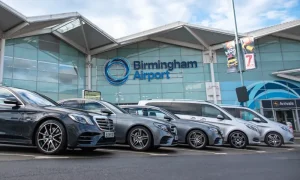
Birmingham Airport sits within the Solihull borough boundary — roughly 4 miles from the town centre. On a good day, you can drive door to door in under 10 minutes. This makes Solihull one of the closest major towns to a significant UK airport anywhere in the country.
For business travellers and international visitors, this is a genuine advantage. Staying in Solihull puts you closer to the terminal than most of the airport’s dedicated hotels — and the town is considerably more pleasant to spend time in.
National Executive Transfers runs fixed-price chauffeur transfers between Solihull and Birmingham Airport (BHX) — typically 10–20 minutes depending on traffic. No surge pricing. Flight monitoring included on all pickups.
Road and Rail Connections
The M42 motorway runs along the eastern edge of the borough. Junction 5 is the main gateway into Solihull; Junction 6 leads to the airport and NEC. From the M42, the M40 connects to London, the M6 to Manchester, and the M5 to Bristol.
By rail, Solihull station sits on the Chiltern Main Line with direct services to Birmingham New Street (18 minutes) and London Marylebone (around 90 minutes). The station is a 10-minute walk from the town centre, making it a realistic option for day visitors from London or Birmingham.
Green Belt and Countryside
One of the defining features of Solihull’s geography is how green it is. The borough contains significant areas of Green Belt land, and even within the town itself, parks and green spaces are woven into the fabric. This isn’t an accident — it reflects the town’s historical resistance to overdevelopment and the genuine priority residents place on their natural environment.
The River Blythe flows through the borough, and the landscape in the south and east transitions into proper Warwickshire countryside — rolling fields, ancient hedgerows, and the kind of scenery that makes you forget you’re 9 miles from a major UK city.
Top Things to Do in Solihull
1. Visit St Alphege Church
Most visitors walk past St Alphege on their way to Touchwood. Don’t. The church dates from around 1220, built in red sandstone with a tower that’s been a landmark in this town for centuries. Inside, you’ll find medieval stonework, vaulted ceilings, and brass memorial plaques going back to the 15th century. There are usually volunteers on hand who know the history well. Entry is free. Budget about 25 minutes — it’s genuinely worth it.
2. Touchwood Shopping Centre and Mell Square
Touchwood opened in 2001 and has been one of the Midlands’ most consistently popular shopping destinations ever since. It’s not the largest shopping centre in the region, but it might be the most pleasant — well-designed, well-maintained, and with a mix of high street retailers (John Lewis, Marks & Spencer, Next, Waterstones) alongside a good selection of independent shops, restaurants, and a cinema.
The outdoor Mell Square adjacent to Touchwood has been significantly regenerated and now hosts a variety of independent cafés, restaurants, and occasional market stalls. The whole area is pedestrian-friendly and easy to navigate on foot, and the quality of the food and drink options has improved markedly over the past five years.
Parking is available at Touchwood and several nearby council car parks, but Saturdays in particular can be frustrating. Many visitors to Solihull now choose to be dropped off by a chauffeur and collected later — it genuinely transforms the shopping experience when you’re not worrying about parking meters or carrying bags back to the car.
3. Malvern & Brueton Park — The Best Park You’ve Never Heard Of
If you only do one outdoor thing in Solihull, make it this. Malvern & Brueton Park is a genuinely beautiful green space that runs alongside the River Blythe, with an ornamental lake, wildflower meadows, formal gardens, and enough space to properly escape the urban feel of the town centre.
The formal Brueton Park section is an award-winner in the Britain in Bloom competition, and it shows — the planting and maintenance are exceptional. The Malvern section is wilder and more natural, with river walks and good birdwatching opportunities. The whole park is free, open all year round, and about 15 minutes’ walk from the town centre.
Pick up a coffee from one of the independents on Mell Square and take it to Brueton Park. It’s the kind of thing locals do on a Tuesday morning and visitors rarely discover. You’ll understand why people choose to live here.
4. Tudor Grange Park and Leisure Centre
Tudor Grange Park wraps around a Victorian house (now used as offices) and offers a good mix of open grass, wooded areas, and sports facilities. The adjacent Tudor Grange Leisure Centre is popular with locals, and the park itself has a lake, putting green, and extensive walking paths. It’s particularly good for families with children, as there’s plenty of space to run around without feeling hemmed in.
5. Solihull’s Food and Drink Scene
Solihull’s restaurant and café culture has transformed significantly over the past decade, and it now has a food scene that would hold its own against much larger towns. Here are the genuine highlights:
- The Farmhouse at Mackworth — reliable British food in a relaxed setting, good for lunch.
- Rajdoot Tandoori — a Solihull institution that has been on the High Street for decades. The kind of place that’s still excellent because it doesn’t try to be trendy.
- Hogarths Stone Manor Hotel (Dorridge) — a short drive from the town centre but worth it for a proper dinner. Popular for corporate entertaining and special occasions.
- The Fieldhouse at Hampton-in-Arden — a gastro pub in the village just outside Solihull that’s consistently excellent.
- Mell Square independents — a growing cluster of independent coffee shops and casual restaurants, good for lunch or afternoon visits.
For anyone visiting on business — particularly those attending events at the NEC or meetings in Solihull’s substantial business parks — the town offers far better post-meeting dining options than staying closer to the airport or the NEC would provide.
6. Golf — Seriously Underrated in Solihull
Solihull borough is home to several excellent golf courses, and this is something that barely gets mentioned in most guides to the area. Robin Hood Golf Club, Olton Golf Club, and Shirley Golf Club are all well-established clubs with good facilities and visitor policies.
For business visitors with an afternoon free, this is one of the best options in the Midlands — the courses are genuinely good, the distances from the town centre and airport are short, and it’s perfectly feasible to play 18 holes and still make an evening flight. Several of our clients at National Executive Transfers do exactly this on a regular basis, and it requires a chauffeur to make the logistics work smoothly.
7. Explore The Villages of Solihull Borough
One of the most underappreciated aspects of Solihull is that the borough includes some of the prettiest villages in the West Midlands, all within easy reach of the town centre:
- Knowle — a beautiful village with a 15th-century church (St John the Baptist, Guild House and Library), good independent shops, and a proper high street feel. About 4 miles south of the town centre.
- Dorridge — a quieter village with the excellent Hogarths hotel and good rail connections back into town.
- Hampton-in-Arden — a classic English village right on the edge of the borough, with a Norman church and a very good pub. Close to both the airport and the NEC.
- Balsall Common — a larger village with good local amenities, popular with families priced out of the town centre.
A chauffeur-driven tour of these villages is one of the most enjoyable ways to spend a free afternoon in the area — particularly if you’re visiting from abroad and want to see authentic English village life rather than tourist-facing attractions.
8. The Core Theatre and Arts Scene
The Core at Touchwood is Solihull’s main arts venue — a 216-seat theatre that hosts professional touring productions, comedy nights, live music, and community performances. It’s an intimate space that punches well above its size, and the programme is genuinely varied.
Beyond the Core, Solihull has an active arts community with regular exhibitions at the Solihull Arts Complex and various pop-up events throughout the year. The town is not a cultural centre in the way that Birmingham or Coventry are, but for a town of its size and character, the arts provision is impressive.
9. Seasonal Events Worth Planning Around
Solihull’s events calendar has some genuine highlights that are worth knowing about before you visit:
- Christmas Market (December) — held in the town centre each December, this is smaller and far less crowded than Birmingham’s famous Christmas Market, but arguably more enjoyable for it. Good food stalls, local crafts, and a genuinely festive atmosphere without the overwhelming crowds.
- Solihull Food Festival — an annual celebration of local produce, street food, and independent restaurants, typically held in summer in the town centre.
- Solihull Summer Festival — outdoor performances, live music, and community events across the parks during the summer months.
- Knowle Village Fête — a quintessentially English village fête that gives a genuine flavour of the borough’s community character.
Heading into Birmingham from Solihull? Our chauffeur service in Birmingham gets you there in comfort — no traffic stress, no parking fees, just a professional driver and a clean Mercedes waiting at your door. Get a quote.
Getting To and Around Solihull
By Train
Solihull station is on the Chiltern Main Line and is one of the more useful commuter stations in the West Midlands. Direct services run to Birmingham New Street in about 18 minutes, and to London Marylebone in roughly 90 minutes — a genuinely comfortable journey that’s an alternative to driving or flying for London-Solihull trips.
The station sits about 10 minutes’ walk from Touchwood and the town centre, which is manageable with light luggage. Dorridge and Widney Manor stations also serve the southern parts of the borough. Trains run frequently during peak hours and less so in the evenings and on Sundays, so it’s worth checking times if you’re planning an evening visit.
By Road
The M42 is your main artery. Junction 5 brings you directly into Solihull via the A41. Junction 6 connects to the airport and NEC. Birmingham Airport is approximately 5 minutes by road from Junction 6 in light traffic, though the A45 can be heavy during morning peaks.
Town centre parking is available at Touchwood and several council car parks. It fills quickly on busy Saturdays — if you’re visiting for shopping or a full day out, being dropped off and collected is a significantly more relaxed option.
By Chauffeur — The Recommended Option for Visitors
For anyone visiting Solihull from outside the area — particularly business travellers, airport arrivals, or groups — a pre-booked chauffeur service removes the two biggest friction points of any visit: parking and navigation.
At National Executive Transfers, we cover all major routes to and from Solihull, including:
- Solihull town centre to Birmingham Airport (BHX) — typically 10–20 minutes depending on traffic. Fixed price, no surge pricing, meet and greet included.
- Solihull to the NEC Birmingham — 10–15 minutes. A popular transfer for exhibition visitors and corporate event attendees.
- Solihull to Birmingham city centre — 25–35 minutes. Comfortable alternative to the train for early mornings or late evenings.
- Solihull to London — available as a city-to-city executive transfer in our Mercedes S-Class or V-Class vehicles.
- Village-to-airport transfers — we regularly collect from Knowle, Dorridge, Hampton-in-Arden, and the surrounding villages for Birmingham Airport departures.
All our vehicles are Mercedes — S-Class for executive solo and duo travel, V-Class for groups or families, E-Class for business transfers. Every booking includes professional chauffeurs, bottled water, and flight monitoring for airport pickups so we adjust automatically if your flight is early or delayed.
Where to Stay in Solihull
Solihull has a solid range of accommodation options, from major hotel chains to independent boutique properties:
- The St John’s Hotel (Solihull) — a well-regarded four-star hotel just off the M42, popular with corporate guests and well-positioned for both the town centre and the airport.
- Hogarths Stone Manor Hotel (Dorridge) — more of a country house hotel feel, excellent for leisure travellers and longer stays. The restaurant is one of the best in the borough.
- Ramada Hotel & Suites by Wyndham — close to the town centre, reliable mid-range option for business stays.
- Arden Hotel and Leisure Club — a Solihull independent with good leisure facilities, popular for both business and leisure guests.
For airport proximity without sacrificing quality, Solihull’s hotels genuinely outperform the dedicated airport hotel cluster on the A45. You’re roughly the same distance from the terminal but in a far more pleasant environment, with actual restaurants and shops within easy reach.
Why Solihull Deserves More Attention
Solihull exists in an odd position. It’s well-known enough to have a reputation — prosperous, green, comfortable — but not famous enough to feature on most people’s travel lists. It sits in Birmingham’s shadow despite being a genuinely different kind of place.
Visitors from Spain, Italy, and other European countries often search for “Solihull Inglaterra” when planning a UK trip — usually because they’ve got a connection through Birmingham Airport and want to understand what the town is actually like before they arrive. The honest answer is that Solihull, West Midlands, United Kingdom, is probably not what you’d expect. It doesn’t feel like a satellite town. It feels like somewhere that has its own clear sense of place — unhurried, well-kept, and quietly proud of what it is.
What makes Solihull unusual is the combination of things it offers in a relatively small area. You can walk from a proper shopping centre to a river park in 15 minutes. For business travellers, it works as an ideal base — central, well-connected, with the NEC and BHX on the doorstep. For leisure visitors, particularly those from abroad, it offers something harder to find: authentic English town life that hasn’t been packaged for tourism. The Christmas Market sells local crafts, not plastic souvenirs. The parks are used by residents on their lunch breaks. St Alphege is a functioning community church, not a heritage centre.
That’s what makes Solihull worth your time. It’s a real place, and real places — when you take the time to know them — are always more interesting than the ones that have been polished up for visitors.
Plan Your Visit to Solihull
Whether you’re visiting Solihull for the first time, returning for business, or simply passing through and finally making time to explore — this is a town that rewards attention. Take the time to walk the High Street, step inside St Alphege, find a good coffee, and get to Brueton Park before the afternoon is over. You’ll understand why people who live here talk about it the way they do.
And when it comes to getting there and getting around, National Executive Transfers has been the region’s trusted chauffeur service for over a decade. Fixed prices, professional drivers, and a fleet of Mercedes vehicles covering Solihull, Birmingham Airport, the NEC, and beyond.
Exploring Solihull is easy when you’re not worrying about parking or directions. Our chauffeur service in Solihull covers everything from airport pickups to shopping drop-offs and village tours — in a Mercedes, at a fixed price. Book your ride →
Book online at National Executive Transfers | Call: +44 1564 778080 | 10% off with code NET10T
Frequently Asked Questions
Solihull is approximately 4 miles from Birmingham Airport, with a drive time of around 10 to 15 minutes.
By train, it takes about 18 minutes via the Chiltern Main Line directly to Birmingham New Street.
Solihull is known for its high quality of life, Touchwood shopping centre, green spaces, and being home to Jaguar Land Rover HQ.
Yes, Solihull sits close to both, making it ideal for business travellers needing easy access without staying in the city centre.
Malvern & Brueton Park and Tudor Grange Park are top choices, offering lakes, gardens, and walking paths.
Direct trains run from Solihull to London Marylebone in around 90 minutes via the Chiltern Main Line.
Knowle, Dorridge, Hampton-in-Arden, and Balsall Common are charming villages within the Solihull borough.
Yes, parking can be challenging on Saturdays, so many visitors opt for chauffeur drop-off and collection instead.
A chauffeur transfer typically takes 10 to 20 minutes depending on traffic, with fixed pricing and flight monitoring included.
May to September is ideal for enjoying the parks, while December is popular for the town's Christmas Market.
Solihull is not part of Birmingham. It is a separate metropolitan borough within the West Midlands, with its own council and administration. It borders Birmingham to the southeast but has always had a distinct identity. The two are close — about 9 miles apart — but Solihull residents are generally quite clear on the distinction.
Solihull is located in the West Midlands, in the heart of England, approximately 9 miles southeast of Birmingham city centre. It sits within easy reach of the M42, M40, and M6 motorways, and Birmingham Airport (BHX) falls within the borough boundary. For international visitors, it is roughly 110 miles northwest of London.