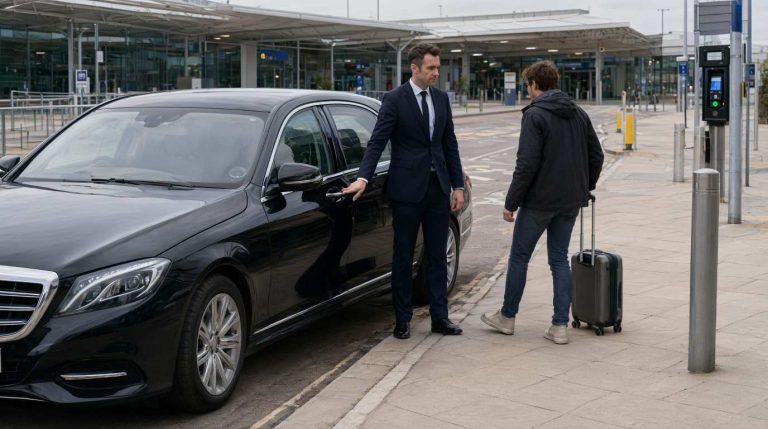
Right, let’s get straight to it, because this is the question that actually matters. Not “how long is the drive” on a good day, but what time you genuinely need to walk out of your front door. That way you’re not the person jogging through the terminal with one shoe half on.
I’ve driven this route more times than I can count. The honest answer isn’t a single number. It depends on your flight time, the day of the week, and whether you’re leaving during term time or the first Saturday of the summer holidays. Anyone who gives you one figure for every situation is guessing.
So here’s the real version. Realistic time bands, the reasons behind each one, and a straight answer for your specific flight rather than a vague “allow plenty of time.”
How early should you actually leave Birmingham for Gatwick?
For a normal daytime flight on a weekday, leave Birmingham 3.5 to 4 hours before departure. That covers a typical 2 hour 45 minute to 3 hour drive, plus a genuine buffer for the one section of the route that actually causes problems.
Flying before 9am changes the maths slightly. Leave 4 to 4.5 hours before departure instead. The roads out of Birmingham are usually quiet at that hour, so you’re not protecting against local traffic. You’re protecting against the M25, which doesn’t much care what time it is.
A Friday evening flight needs extra time regardless of departure hour. Friday afternoons out of the Midlands and into the South East are consistently the worst traffic of the week. Pretending otherwise on a Friday is how people miss flights.
School holidays add their own tax on top. Particularly the first weekend of the summer break, add another 30 to 45 minutes to whichever band applies. Every part of the journey gets busier at once, not just the motorway.
One honest point before we go further. These numbers assume a normal day. No guide, mine included, can promise you’ll dodge every delay on a route that runs straight through the busiest ring road in the country. A proper buffer turns a fifteen-minute hold-up into a non-event instead of a genuine problem.
Why does the same journey take such different amounts of time?
This is the bit most people get wrong. They look up “Birmingham to Gatwick” once, get a number, and treat it as fixed. It isn’t.
The first two-thirds of the drive barely changes from one day to the next. That’s the M40 stretch down through Oxfordshire. Traffic is light outside rush hour, and the road behaves the same way on a Tuesday as it does on a Thursday.
The M25 is where all the variation lives. It’s one of the busiest stretches of motorway in Europe, and it doesn’t follow a pattern you can plan around with any real confidence. A section that’s clear at 11am on Monday can be solid at 11am on Wednesday, and there’s no obvious reason why.
That’s the whole explanation for why “how long does it take” gets such different answers depending on who you ask. Someone who travelled on a quiet Sunday morning will tell you three hours flat. Someone who hit roadworks near the M25 will tell you it took four. Both are telling the truth about their own trip.
What’s the best time of day to set off?
If you have any flexibility at all, early morning is genuinely the best window for this drive. Leave Birmingham between 6am and 8am. You’ll clear the West Midlands before rush hour builds, and you’ll hit the M25 before the mid-morning traffic settles in.
Late morning through early afternoon, roughly 10am to 2pm, is the next best option. It’s not as quiet as first thing, but it avoids both the morning commute and the evening one.
The window to actively avoid, if your flight allows it, runs from about 3pm to 7pm. That’s rush hour on both ends of the journey, Birmingham and London. Both hit at almost exactly the time your drive would need them to be clear.
Sometimes your flight time gives you no choice, and you’re setting off straight into that afternoon window. This is exactly when the extra buffer earns its place. Treat the top end of whichever time band applies to you as the plan, not the fallback.
Does the day of the week actually change your answer?
Yes, more than most people expect. Tuesday through Thursday tend to be the calmest days for this route. Traffic on those days is fairly consistent and matches what most journey planners predict.
Friday is the one to watch. Traffic builds out of Birmingham from early afternoon onwards, and weekend getaway traffic converges on the M25 at the same time. That combination makes Friday evening the single worst time to attempt this drive without a proper buffer.
Saturday mornings during summer carry their own weight, mostly because that’s when the bulk of package holiday flights depart from Gatwick. More flights means more traffic converging on the same roads at once.
Sunday is generally easier for driving. The M25 can still catch you with maintenance works, since weekends are when a lot of scheduled roadworks happen. A quick check the day before is worth doing if you’re travelling on a Sunday.
If you want the terminal-side half of this question, our guide to how early you should arrive at Gatwick covers check-in deadlines and security queues once you’ve actually arrived.
Driving, chauffeur or train, what actually works for this route?
There isn’t one right answer here, and I’d rather be straight with you than pretend there is. It depends on your luggage, your flight time, and how much of the day you’re willing to spend thinking about the journey itself.
Driving yourself gives you full control. You choose your own departure time down to the minute, and if you’re travelling light it’s usually the cheapest option. The catch is real. You’re the one absorbing every bit of M25 stress, and you need to book parking in advance if you want a sensible price.
The train sounds simple on paper, but there’s no direct route. You’ll travel into London first, then cross the city before picking up a service south to Gatwick. Door to door, that’s typically 3.5 to 4.5 hours, and it gets genuinely awkward with a full suitcase or a pushchair in tow.
A chauffeur transfer takes the timing question off your plate entirely. The driver watches live traffic and adjusts the route without you having to think about it. Your fare’s agreed before you travel, and if your return flight lands early or hours late, someone’s still there waiting. For a Birmingham to Gatwick transfer specifically, that matters more than it sounds. A three-hour drive with a delay baked in is a genuinely stressful way to start a trip.
My honest take is this. Driving yourself is perfectly sensible if you’re one person with hand luggage and total flexibility on timing. A pre-booked transfer earns its cost back in stress alone if you’re a family or travelling for work. The same goes if you simply don’t fancy three hours watching the satnav for M25 warnings.
What should you sort out before the day itself?
A few things make the actual difference between a smooth departure and a stressful one, and none of them take long to sort.
Check your terminal the day before, not when you booked. Gatwick has North and South Terminals, and some airlines have switched between them in the past couple of years without much fanfare. Turning up at the wrong one costs you a shuttle transfer you didn’t plan for.
Book parking or your transfer as early as you can once your flight’s confirmed. Prices and availability both tighten closer to the date, especially around Friday evenings and summer weekends.
Weigh your bags at home rather than at the airport desk. It sounds obvious, but rearranging a suitcase in a queue while your flight time ticks closer is nobody’s idea of a good start.
Check the M25 the morning of your trip if you’re driving, rather than the night before. Conditions change fast on that stretch, and a five-minute check can save you a genuinely nasty surprise.
A quick checklist before you leave
- Confirmed terminal for your specific airline
- Parking booked in advance, or a transfer confirmed with your flight number
- Bags weighed at home, not at the desk
- A live traffic check on the morning itself
- Travel documents sorted, especially anything needing a visa or ESTA
- A buffer built in for the M25 specifically, not just the whole journey
- Contact details for your driver, if you’re using one
Our guide to pre-booking an airport transfer walks through exactly what to have ready. Worth a read if you’d rather sort that side properly instead of leaving it to a last-minute booking.
Does driving actually save you money?
A typical day of long-stay parking at Gatwick runs from around £15 upwards. Add fuel and the toll of driving yourself for three hours each way, and the true cost starts to look less obvious.
A chauffeur transfer is one fixed fare covering the whole door-to-door trip, with no separate parking bill to remember. Whether that saves you money depends on your group size and how many days you’re away. For time and stress specifically, it’s rarely a close call.
Our breakdown of Gatwick parking against chauffeur pricing runs the full numbers, if you want to compare properly for your own trip.
Is it worth paying more to remove the guesswork?
For some trips, honestly, no. Driving yourself is fine if you’re one person, travelling light, on a Tuesday morning with no meetings to rush to. There’s no need to overcomplicate a simple journey.
It starts to matter when the consequences of getting the timing wrong actually cost you something. Think a missed business meeting, or a family holiday that starts with everyone stressed before you’ve even reached the M40. Or simply a flight you genuinely can’t afford to miss.
That’s where a chauffeur earns its keep. Not because driving is hard, but because someone else is holding the timing risk instead of you. Your driver knows the route, tracks the traffic, and adjusts without a phone call. You get in the car and stop thinking about the M25 entirely.
Worth a mention here too. If you’re booking a transfer, you’ll be asked whether you want meet and greet or a standard pickup point. Meet and greet tends to earn its keep most on the return leg. After a long transfer, you’d rather someone was holding a name board than hunting for a pickup point in a busy terminal. Our comparison of meet and greet versus standard pickup covers when each makes sense.
Check availability for your transfer if you’d rather just get a fixed quote for your dates and stop weighing it up. It takes a couple of minutes.
What’s actually included in a chauffeur transfer?
It’s worth being specific here, since “chauffeur service” means different things depending on who you book with.
The car comes to your door, not a pickup point down the road. Your driver knows how the M25 behaves at different times of day, rather than following a fixed satnav route regardless of what’s happening on it.
Luggage is handled for you, which matters more than it sounds after a three-hour journey. We run a Mercedes fleet, including the S-Class and V-Class, built for a drive this length rather than a twenty-minute airport hop. Proper legroom, and a cabin quiet enough to work or switch off in.
Your flight’s tracked on the way back, so a delay doesn’t mean an awkward phone call. The fare’s fixed before you travel too. No surge pricing for a Friday evening departure, and no meter running while you sit on the M25.
So what’s the real answer to “how early”?
Here’s the honest summary, no hedging. Leave 3.5 to 4 hours before departure for a normal weekday flight. Make it 4 to 4.5 for an early morning flight. Add another 30 to 45 minutes on top of whichever band applies for a Friday evening or a school holiday departure.
The driving time itself rarely changes much. What changes is the M25, and that’s exactly why the buffer matters more than the base number.
Get a quote for your Birmingham to Gatwick transfer if you’d rather hand that timing decision to someone who drives this route regularly. We’ll work the timing out properly around your actual flight, not a generic average.
Frequently Asked Questions
On a clear day, yes, comfortably. During Friday afternoon traffic or a school holiday weekend, three hours can stretch to three and a half or four without much warning.
Around 140 to 150 miles, depending on your exact starting point and which Gatwick terminal you're heading to.
Not really, and this is the standard route for good reason. Alternatives tend to add distance without saving meaningful time, since the M25 bottleneck exists regardless of how you approach it.
Yes, add 30 to 45 minutes to whichever time band applies. Stops, car seats, and general logistics all take longer than a solo trip.
Not for the drive itself, since both sit close together off the M23. It matters more once you arrive, since vehicles can't cross directly between the North and South forecourts.
Rarely for this specific route, since there's no direct service and you're crossing London partway through. It can work if you're travelling light and don't mind the change.
Usually not much on the M40 stretch. The M25 section is where an extra thirty to forty minutes can appear with very little warning, which is why the buffer matters more than the raw driving time.
A genuine flight-tracking setup adjusts your pickup automatically if you're using a chauffeur service. If you're driving yourself, it's worth rechecking traffic conditions closer to the new departure time rather than assuming the same plan still applies.
For flights departing before 7am, particularly if you're coming from more than three hours away, yes, it often removes more stress than it costs.
As soon as your flight's confirmed, especially for Friday evenings and summer weekends, when availability tightens fastest.