You’re driving into Birmingham, minding your own business. Someone in the passenger seat suddenly asks, “wait, are we going to get charged for this?” Nobody wants to find out the answer three weeks later, in a letter with a fine attached.
The Birmingham Clean Air Zone catches out a fair number of drivers every single week. Most of them aren’t doing anything reckless. They just didn’t know the rules, or they assumed their car was fine when it wasn’t.
That’s an easy mistake to make. The zone doesn’t look like anything from the driver’s seat. There’s no toll booth, no barrier, and no obvious moment where you’d think to check. For a lot of people, the first sign is a letter through the post. It arrives weeks after the trip they’d already forgotten about.
This guide sorts out exactly what the zone is, what it costs, and where it starts and stops. It also covers how to make sure you’re never one of those drivers.
What is the Birmingham Clean Air Zone, in plain English?
The Birmingham Clean Air Zone is a charging area covering the city centre. If your vehicle produces too much pollution, you pay a daily fee to drive through it. If your vehicle is clean enough, you pay nothing at all.
The scheme has run since 1 June 2021, introduced because Birmingham’s air quality had a genuine problem. The idea is simple: charge the most polluting vehicles. Use that money to fund cleaner transport and better air across the city.
A lot of drivers get one detail wrong straight away. This isn’t a congestion charge. It doesn’t matter what time of day you drive through, and it doesn’t matter how busy the roads are. The charge is entirely about your vehicle’s emissions, not the traffic around it.
The zone also runs every single day of the year, including bank holidays and Christmas Day. There’s no quiet period when the cameras switch off.
Most modern cars never trigger a charge at all. Driving something older, or hired an unfamiliar vehicle? Two minutes of checking before you set off is time well spent.
It helps to understand why the rules are this strict. Birmingham’s air quality had breached legal limits for years before the zone launched. Around the same time, the government declared a national health emergency over air pollution, linking it to hundreds of early deaths a year across the city. Birmingham built the Clean Air Zone as a genuine response to that, not a symbolic gesture.
That background also explains why Birmingham charges private cars at all. Some UK cities, including Bath, run a Class C zone instead. That only charges taxis, vans, and heavier vehicles, letting ordinary cars through free regardless of emissions. Birmingham sits in Class D, the strictest tier, bringing private cars into scope alongside taxis, vans, buses, and lorries. That single difference explains why Birmingham’s zone catches out more everyday drivers than its counterparts elsewhere.
How much does the Birmingham Clean Air Zone actually cost?
For a non-compliant car, taxi, or small van, the standard daily charge sits at £8. Coaches, buses, and HGVs pay considerably more, at £50 per day.
That £8 or £50 covers you for the whole calendar day, from midnight to midnight. It doesn’t matter how many times you drive in and out. Cross into a new day, though, and you’re charged again. Someone driving in at 11pm and leaving at 1am technically pays twice, because they’ve crossed the midnight boundary.
If your vehicle meets the required emissions standard, you pay nothing. That’s Euro 4 for petrol engines, covering most petrol cars built from around 2006 onwards. For diesel engines, it’s Euro 6, meaning cars registered from around September 2015 onwards generally qualify. Fully electric and hydrogen vehicles are automatically exempt, whatever their age.
A quick way to think about it: an ordinary petrol model from the last fifteen years or so almost certainly won’t pay a thing. Older diesels are the ones that most commonly get caught out. The diesel emissions bar simply sits higher than the petrol one.
You have a flexible payment window: up to six days before travel, the day itself, or up to six days after. Use the official gov.uk payment service for all three. Miss that window entirely, and you’re into penalty territory, which we’ll come to shortly.
A quick example shows how the daily rule actually plays out. Say you drive an older diesel hatchback into the city centre for a 10am meeting. You leave the car in a car park all day, then drive home again at 6pm. That’s still just one charge, £8, because it’s a single calendar day. Drive back in after midnight for a late dinner reservation, though, and you’ve crossed into a new day. A second £8 charge applies.
One caution worth flagging: rates and rules do get revised over time. A quick check on the official government site before you travel makes more sense than assuming last year’s figure still applies.
How to pay it
Paying is simple once you know where to look. The official route is the gov.uk Clean Air Zone payment service. It takes a debit or credit card and confirms payment instantly. A phone option also exists through the Joint Air Quality Unit’s national helpdesk. It’s useful if you’d rather speak to someone, or don’t have online access at the time. Whichever route you use, keep the confirmation until the payment window has closed, in case a query comes up later.
Where does the zone start and stop? (the CAZ map)
The Birmingham CAZ map is easier to describe than most people expect. The zone covers everywhere inside the A4540 Middleway Ring Road, but crucially, it doesn’t include the ring road itself.
That means the A4540 acts as a free boundary you can drive around without triggering a charge. Stay on it, and you’re outside the zone. Turn off it into the centre, and you’re inside.
Inside that ring sits the whole of the city centre. It also includes areas that catch visitors off guard: Digbeth, the Jewellery Quarter, and the area around New Street and Moor Street stations. Heading to a hotel, a conference venue, or a restaurant near the centre? There’s a good chance you’re already inside the zone.
Nothing physically marks the boundary in a way you’d notice while driving. Instead, the system runs on automatic number plate recognition cameras positioned around the boundary and within the zone itself. They read your plate and check it against the DVLA database within seconds.
Signposting exists at the main entry points. It’s easy to miss, though, if you’re concentrating on the road ahead rather than the verges. First-time visitors do well to glance at a map beforehand, so the boundary doesn’t come as a surprise.
Popular destinations that sit firmly inside the boundary include the Bullring, Grand Central, and the Mailbox. Pretty much every major hotel in the city centre falls inside it too. Any of those on your itinerary, and you’re inside the zone the moment you turn off the ring road towards them. Whether you realise it or not, that’s the reality.
What sits outside the zone
Knowing what’s outside the zone matters just as much, since that’s usually the bit visitors get wrong. Edgbaston, Moseley, and most of the immediate suburbs sit outside the boundary entirely. So do the roads leading out towards the airport and the NEC. Stick to those areas, and the Clean Air Zone simply doesn’t come into it. The charged area is specifically the inner core, roughly the size of Birmingham’s original medieval town plus the Victorian expansion around it.
Is your car even affected? Checking and exemptions
Most people who worry about this don’t actually need to. The majority of cars on UK roads today already meet the emissions standard. Confirming yours takes no time at all.
The safest way to know for certain is the official Department for Transport vehicle checker on gov.uk. Enter your number plate, and it tells you straight away whether you’d be charged and how much. It takes less time than reading this paragraph.
What makes a vehicle exempt
A handful of vehicle types get treated differently, either because of who owns them or what they’re used for:
- Fully electric and hydrogen fuel cell vehicles, regardless of age
- Vehicles displaying a valid Blue Badge, which are permanently exempt
- Vehicles registered to residents of the zone, though the original two-year grace period from launch has now expired for most drivers
- NHS patients attending appointments within the zone, who can claim a reimbursement voucher through their hospital
- Certain historic and military vehicles, under separate rules
Think you might qualify for an exemption based on income? A hardship scheme exists for people who live outside the zone but work inside it. It applies if you earn under a set threshold, working a minimum number of hours a week. Check directly with Birmingham City Council if that sounds like your situation, since the criteria and grant amounts change from time to time.
Birmingham also runs a scrappage scheme alongside the zone. It offers grant support to scrap an older vehicle, in exchange for public transport, a bike, or a cleaner car instead. It targets residents and low-income commuters who’d otherwise pay the daily charge indefinitely, rather than occasional visitors. Still, it’s worth knowing it exists if you’re local and driving something that never seems to pass the checker.
What doesn’t make a vehicle exempt
A car being relatively new doesn’t automatically mean it’s compliant. Looking clean or well maintained tells you nothing about its actual emissions rating either. The only number that matters is the Euro standard the engine meets.
This catches out hire cars more than anything else. Picked up a hire vehicle for a business trip? Don’t assume it’s fine just because it looks like a recent model. Run the plate through the checker before you drive into the centre, particularly if it’s a diesel.
The checker only needs the registration number, nothing else. There’s no account to create and no personal details to hand over, which makes checking quicker than guessing. Bookmark the page if you drive into different UK cities regularly. Several other cities run their own separate Clean Air Zones, each with slightly different rules, and the same checker covers all of them from one place.
What happens if you don’t pay the charge
Drive through the zone in a non-compliant vehicle without paying, and a Penalty Charge Notice eventually follows through the post. The standard Birmingham Clean Air Zone fine is £120.
Pay that within 14 days, though, and it drops to £60. Leave it longer, and it can escalate further. It’s not a letter worth ignoring, or leaving on the side for a few weeks.
The cameras don’t miss much. Automatic number plate recognition technology cross-references your plate against the DVLA vehicle database as standard. There’s no manual step where a mistake might slip through unnoticed. Drive a non-compliant car through, and a notice follows.
If you believe you’ve been charged in error, perhaps because your vehicle is exempt but wasn’t registered correctly, you can appeal. Appeals go directly to Birmingham City Council. The process itself is straightforward, but it only works if you have a real case, not just a preference not to pay.
Leave a penalty notice unpaid for long enough, and the council can pass it on to a debt recovery process. That process costs considerably more than the original £120 ever would. This isn’t meant as a trap. The council wants the charge paid at the lower rate if possible. That’s exactly why the 14-day discount exists in the first place.
The simplest way to avoid ever seeing one of these letters is to check your vehicle before you travel, not after. It costs nothing and takes thirty seconds.
Do private hire cars and chauffeurs pay the charge?
This is the question a lot of people forget to ask, and it matters more than they realise. The scheme treats taxis and private hire vehicles exactly the same as any other car. There’s no blanket exemption just because a vehicle is licensed for hire.
What that means in practice comes down entirely to the fleet. A responsible operator runs newer, compliant vehicles that never trigger the charge in the first place. A less careful one might run older diesels that quietly rack up daily charges. Someone always ends up covering that cost eventually, whether directly or through higher prices.
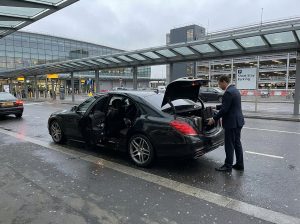
At National Executive Transfers, the entire Mercedes-Benz fleet, including the E-Class, meets current Clean Air Zone standards. That’s not a marketing line, it’s simply how a fleet built on late-model Mercedes vehicles works out. Book a car, and the Clean Air Zone charge, if there would even be one, is already covered. There’s no separate line item, no surprise, and nothing left for you to check yourself.
Weighing up whether to drive yourself into the centre or book something instead? That’s one less thing to think about. You focus on getting where you’re going; the driver takes care of the vehicle side of things properly.
A real example: airport pickups
This covers the whole fleet, not just one car kept aside for city centre runs. Choose the S-Class for a longer journey, the V-Class for a group, or the E-Class for a transfer. The same standard applies across the board, whichever you book. That consistency matters more than it might sound. It means the Clean Air Zone isn’t a factor when we decide which vehicle goes out on your booking.
Take a fairly typical example. A client lands at Birmingham Airport for a 2pm meeting in the Colmore Business District, right in the middle of the zone. They’ve never driven in Birmingham before, and they don’t know the CAZ boundary exists. The last thing they want after a long flight is a vehicle checker in an unfamiliar car park. A pre-booked airport transfer sidesteps the entire question. The driver already knows the route, and the vehicle is already compliant. The client walks straight from arrivals into the meeting without giving the zone a second thought.
How to avoid paying it altogether
There are only a few realistic ways to avoid the charge completely. It helps to be clear-eyed about which one suits your situation.
Drive a compliant vehicle. If your own car already meets the standard, you have nothing to worry about, ever. This is by far the simplest route for daily commuters and residents.
Stick to the ring road. If your route allows it, staying on the A4540 rather than cutting through avoids the zone entirely. This only works if your actual destination sits outside the boundary too, so check both ends of the journey.
Park outside the zone and walk or use public transport for the last stretch. This works well for short visits. A short walk or tram ride into the centre rarely takes long.
Book transport in someone else’s compliant vehicle. This is the option most people overlook. It’s often the most practical choice for visitors, business trips, or anyone driving an older or borrowed car. Nobody wants to deal with checkers, exemptions, and payment windows on top of everything else.
Things to consider before you decide
- Check your own vehicle’s compliance first. It’s the quickest way to rule the whole issue out.
- Hiring a car for the trip? Ask the hire company directly about its emissions standard, rather than guessing from the model year.
- Factor in the payment window. You can pay up to six days either side of travel, so there’s no need to panic if you forget on the day.
- Regular commuter into the zone? Apply for the hardship exemption properly if you might qualify, rather than risking repeated charges.
- Weigh up the genuine cost, not just the £8 itself. A wasted hour looking for parking, or the stress of realising too late you should have checked, often costs more than the charge ever would.
- Visiting for business? Factor the Clean Air Zone into your journey planning, the same way you’d plan around Birmingham’s rush hour traffic.
None of these options is objectively “best.” A driver with a compliant car has nothing to think about. Someone flying in for a single meeting, on the other hand, usually saves time booking a car instead. Sorting a hire vehicle, checking its emissions rating, and finding parking near the venue all take longer.
The simplest way to decide is to separate regular trips from one-off ones. Driving into the zone every working day? It’s worth ten minutes sorting your own compliance properly. Confirm your current car is fine, or look into the hardship scheme if it isn’t. A single visit, a wedding, a conference, or a client meeting calls for a different approach. That planning time is usually better spent elsewhere.
Why more people are just letting someone else drive
A lot of visitors to Birmingham spend more energy worrying about the Clean Air Zone than the £8 charge would ever actually cost them. That’s the real problem the zone creates for people who aren’t from here: not the fee, but the uncertainty.
Booking a chauffeur removes that uncertainty completely. You’re not checking a number plate against a government database on your phone in a car park. You’re not wondering whether your hire car from the airport happens to be Euro 6 compliant. Someone else has already sorted it, well before you landed.
That’s particularly useful for corporate and executive travel. The last thing anyone wants before a meeting is fumbling with a vehicle checker outside the venue. A longer day exploring the city works the same way. Hourly chauffeur hire means someone else handles the driving, the parking, and yes, the Clean Air Zone. You just get on with the actual day.
Every journey with National Executive Transfers runs in a Mercedes-Benz. The licensed, DBS-checked driver already knows exactly which routes work and which don’t. Weighing up the cost of a chauffeur in Birmingham against the hassle of driving yourself? The Clean Air Zone is one more small thing that tips the scales. Add in parking, unfamiliar one-way systems, and general stress, and the choice gets easier.
The real cost, time and stress comparison
Compare that to a self-drive trip into the centre. There’s the CAZ check, potentially the charge itself, and the search for parking. Then there’s the walk from wherever you eventually find a space. None of that is difficult on its own. Stacked together, on a day that already has enough going on, it adds up.
Some rough, typical numbers make the comparison clearer. A day of city centre parking near the zone’s core often runs to £15 to £25, a typical range, before any CAZ charge on top. Add the walk from car park to destination and back, usually ten to fifteen minutes each way, and it adds up fast. A fixed-price chauffeur booking, by comparison, is one upfront figure, door to door. There’s no separate charge to calculate, and no walk at either end. For a short business trip particularly, the time saved often matters more than the money either way.
This guide sits alongside NET’s wider coverage of getting around Birmingham without the usual hassle. That includes planning your journey around the city’s traffic, and day trips out of the city once you’re here. The Clean Air Zone is just one more piece of local knowledge worth having before you drive in. That’s true whether you’re doing the driving yourself, or letting someone else handle it.
Planning a trip into Birmingham and would rather not think about any of this? A fixed-price chauffeur booking sorts it before you’ve even left home. Book online in a couple of minutes, and the driver takes care of the rest.
The Birmingham Clean Air Zone isn’t complicated once you know the basics. Check your vehicle, know the boundary, and pay within the window if you need to. But if you’d rather skip all of that entirely and just arrive relaxed, that option exists too. For a lot of visitors, it’s the one that makes the most sense.
Frequently Asked Questions
Yes. The zone operates every single day of the year without exception, including Christmas Day. There's no reduced schedule at weekends or on public holidays.
No. The daily charge covers you from midnight to midnight regardless of how many times you enter or leave. You'd only face a second charge if you crossed into a new calendar day.
Yes. The government's official vehicle checker on gov.uk confirms it instantly once you enter your number plate. It's free and takes under a minute.
No. ULEZ is London's separate scheme, run by Transport for London, with its own rules, boundaries, and charges. Birmingham's Clean Air Zone operates independently, with its own emissions standards and pricing.
No. Fully electric and hydrogen fuel cell vehicles are completely exempt from the charge, whatever their age or registration date.
Depth doesn't matter. Cross the boundary on any road inside the A4540 Middleway Ring Road, other than the ring road itself, and the charge applies if your vehicle isn't compliant.
You can pay up to six days before your journey or up to six days after it, through the official gov.uk service. Miss that window, and you risk a penalty notice instead.
No. The scheme treats them the same as any other vehicle. Whether a taxi or chauffeur car gets charged depends entirely on that specific vehicle's emissions standard, not its licensing.
Confirm your own vehicle is compliant using the official checker, or book transport with an operator running a compliant fleet, so the question never comes up in the first place.
Revenue from the Clean Air Zone goes towards improving air quality and supporting cleaner transport schemes across Birmingham, including grants that help residents and low-income workers move away from older, more polluting vehicles.