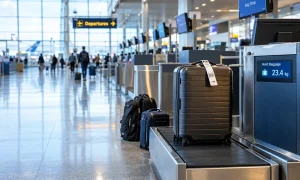
A couple flies out from Birmingham for a long weekend in Lisbon. They’ve done this trip a dozen times before, always the same routine: passport, gate, done. This time, border control takes forty minutes longer than expected, and nobody warned them why.
That’s the EU’s new Entry/Exit System, and it’s already live. Since 10 April 2026, every Schengen border now records UK travellers with fingerprints and a facial scan, not a passport stamp.
It isn’t a visa, and there’s nothing to apply for in advance. It happens entirely at the border, on the day you travel. That’s exactly why so many people are getting caught out.
This guide covers what EES actually does, and how it affects flights from Birmingham, Heathrow, and Manchester. It also covers what’s happening with ETIAS, the other system you’ve probably seen mentioned alongside it.
What is the EU’s Entry/Exit System, in plain English?
EES replaces the manual passport stamp with a digital, biometric record every time a non-EU national enters or leaves the Schengen Area. That includes British passport holders, even for a short weekend trip.
Instead of an officer flicking through your passport for a blank page, the system logs your entry and exit electronically. It links that record to your fingerprints and a facial photo, taken at the border itself.
The system rolled out gradually from 12 October 2025 across 29 European countries. It became fully operational at every Schengen air, land, and sea border on 10 April 2026.
There’s no cost involved, and no form to fill in beforehand. That’s a real relief compared to the UK’s own ETA system. EES happens entirely at passport control, on the spot, the day you travel.
It covers short stays specifically: up to 90 days within any 180-day period, the same limit that’s applied to UK travellers since Brexit. EES doesn’t change that limit. It just tracks it automatically instead of relying on stamps an officer has to count by hand.
One thing worth separating out early: EES is not ETIAS. They’re often mentioned in the same breath, but they do different jobs. EES records your border crossing. ETIAS, when it eventually launches, will be a pre-travel authorisation you apply for before you fly. More on that shortly.
Why the EU built this system at all
Passport stamps are easy to miss, smudge, or misread. Manually counting stamps to check someone hasn’t overstayed their 90 days was never reliable, and border officers knew it.
EES fixes that by making the whole process digital and automatic. The system calculates your remaining days itself, rather than leaving an officer to count backwards through a passport full of unrelated stamps.
It also tightens up identity checks generally. A facial scan and fingerprints are far harder to fake or swap. A passport photo an officer glances at for a few seconds simply can’t compete on that front.
How does EES actually work at the border?
Your first crossing after EES takes noticeably longer than you’re used to. Every crossing after that gets faster, because your details are already on file.
Here’s what happens on that first crossing:
- You hand over your passport, either to an officer or at a self-service kiosk where one’s available.
- A camera captures a facial photo.
- A scanner reads four of your fingerprints.
- The system creates your file, linking your biometric data to your passport and this specific entry point.
That whole process takes a few minutes per person, not seconds. Multiply that across a full flight’s worth of passengers going through it for the first time, and the queue backs up fast.
Return visits work differently. The system already holds your biometric data. It just needs to confirm your identity matches the file. That’s a quick facial check or fingerprint scan, closer to how the process used to feel before EES existed.
What families and first-timers should expect
Families travelling together should know one specific detail. Children under 12 don’t give fingerprints at all. They still get a facial photo taken and their own passport scanned, but the fingerprint step only applies from age 12 upwards.
That’s a small mercy for anyone who’s ever tried to get a toddler to hold still for anything. Every child still needs their own valid passport and their own entry in the system. Even so, skipping the fingerprint step shaves a genuine chunk of time off each child’s turn at the kiosk.
Some countries have started piloting an optional EES app that lets travellers pre-fill some of their details before arriving. France, for example, lets some travellers register in advance at certain crossing points this way. Uptake varies a great deal by country right now, so it isn’t something to rely on rather than simply allowing extra time regardless.
One surprising detail from the rollout deserves a mention. Some border e-gates weren’t fully compatible with UK and US passports during the early months. That pushed extra people into staffed booth queues instead of the automated lanes. It made the whole process slower than it should have been at several major airports.
Compatibility issues like that tend to improve over time, as software gets patched and hardware gets replaced. Whether that’s fully sorted by the time you travel is hard to predict. It brings us back to the same practical point: build in extra time rather than assume the system will run smoothly.
Does this affect flights from Birmingham, Heathrow, or Manchester?
Yes, for one specific leg of your journey. EES doesn’t touch UK airports themselves. It affects you the moment you land at your Schengen destination, or in some cases, before you even leave.
Flying from Birmingham Airport to somewhere like Amsterdam or Barcelona? Departure from BHX looks exactly the same as before. The EES check happens on arrival, at the Schengen border you’re entering, not at the UK gate you left from.
Heathrow and Manchester work the same way for standard flights. Where it gets more complicated is anywhere with juxtaposed controls. That means the destination country’s border checks happen on UK soil before you board, rather than after you land.
Eurostar from St Pancras is the clearest example of that. The queue problems there have been significant enough since April to deserve their own section.
For a standard flight from any of the three major UK airports covered here, the practical advice stays the same. It applies regardless of departure point. The EES delay happens at the other end. It’s your connecting time, hotel check-in, or onward transport that needs the buffer, not your UK departure itself.
That said, some busier UK-to-Schengen routes have started building extra time into their own scheduling too. Airlines have watched EES delays ripple backwards into tighter turnarounds and missed connections often enough to adjust for it proactively.
Business travellers flying regularly between the Midlands and European offices should treat this as a genuine planning consideration, not a one-off inconvenience. A meeting scheduled tightly against a connecting flight through an EES-affected border carries more risk today than it carried eighteen months ago.
Passport validity is worth a second look too, while you’re already thinking about border rules. Most Schengen countries still expect at least three months of validity remaining beyond your planned departure date, and EES hasn’t changed that requirement. It’s a completely separate rule from EES. The two often get checked at the same moment, though, so it makes sense to sort both together before you book.
What if you’re connecting through a Schengen hub?
This is where the practical impact often lands hardest, and it’s easy to miss when booking. A flight from Manchester to New York via Amsterdam, for example, means clearing EES at Schiphol during the connection, not at the final destination.
That connection window that used to feel generous can shrink fast once EES enrolment gets added to it. Airlines set minimum connection times based on pre-EES processing speeds in many cases, and those figures haven’t all caught up yet.
Booking a tight one-hour connection through a major Schengen hub is genuinely riskier now than it was two years ago. Where possible, choosing a longer layover, or a direct route that avoids a Schengen transfer entirely, removes that risk from the equation completely.
What about Eurostar, and the queues everyone’s talking about?
This is where EES has caused the most visible disruption for UK travellers, because the border check happens in London, not in France.
Eurostar operates juxtaposed controls, meaning French border officials process EES checks at St Pancras before you board, not after you arrive in Paris or Brussels. That’s convenient in theory. In practice, it’s meant long queues at the London terminal since the system went live.
Reports from spring and summer 2026 describe queues stretching well beyond normal boarding windows, with some peak-time waits running into hours rather than minutes. It’s been rocky enough that pressure has built on the European Commission to ease the rollout during the busiest summer periods.
Eurostar has responded with a few practical fixes. Premier passengers, and members of its Carte Blanche or Étoile loyalty schemes, can use pre-registration kiosks near the priority gates at St Pancras. Scanning your passport and registering your biometrics there, ahead of your scheduled slot, does genuinely save time at the main border point.
A quick way to think about it: travelling Eurostar Standard class without loyalty status? Budget significantly more time than the ticket’s stated arrival window suggests. If you do have Premier or loyalty access, use the pre-registration kiosk without exception. It’s free, and it’s the single most useful thing Eurostar currently offers to dodge the worst of the queue.
The Port of Dover and the Eurotunnel terminal operate under similar juxtaposed arrangements, run by French authorities on UK soil. Anyone driving to Europe through those routes should expect the same first-crossing delay as air travellers, just at a different kind of border post.
Families travelling with young children through Eurostar face an extra wrinkle worth mentioning. Biometric enrolment takes a little longer per person, and a queue that’s already stretched thin tests patience fast when there are tired kids involved. Building in that extra margin matters even more for a family group than for a solo business traveller.
Is ETIAS live too, or is that a separate thing?
Not yet, and this is worth getting right, because a lot of pages online are still quoting an outdated timeline. ETIAS was expected to launch in the last quarter of 2026. As of July 2026, the EU has quietly dropped that date from its own official site.
Financial Times reporting from that same month cited people close to the project describing a 2026 launch as no longer realistic. The agency building the system, eu-LISA, is reportedly aiming for a decision after a board meeting in September 2026. 2027 now looks like the more likely actual launch window.
That means, right now, there’s nothing to apply for. ETIAS will eventually work like the UK’s own ETA. It’s a paid, pre-travel authorisation you sort out online before you fly, rather than something that happens at the border itself. The expected fee sits somewhere between €7 and €20 depending on the source, valid for roughly three years once it does launch. Applicants under 18 or over 70 are expected to pay nothing at all, even though they’ll still need an approved authorisation.
When it does eventually go live, expect a transitional period of around six months. Travellers won’t be turned away purely for lacking one, provided everything else about their trip is in order. That grace period softens the initial rollout, based on how EES itself was introduced.
Part of the reason for the delay traces directly back to EES. One person close to the discussions summed it up well, speaking anonymously. Clean up the current border system, they said, before adding a second one on top of it. That’s a fair reflection of where things stand.
For anyone planning European travel through the rest of 2026, the practical takeaway is simple. EES is the one to prepare for right now. ETIAS isn’t something you need to act on yet, whatever a search result dated from earlier this year might still be telling you.
How does this connect to the 90/180-day Schengen rule?
UK travellers have followed the 90/180 day rule since Brexit ended freedom of movement. EES doesn’t change that limit. It just enforces it far more precisely than manual stamps ever did.
Previously, an officer had to count stamps across a full passport, sometimes years’ worth. That’s how they worked out how many of your 90 days you’d already used. Mistakes happened in both directions, sometimes in a traveller’s favour.
EES removes that guesswork entirely. The system automatically calculates your remaining days every time you cross a border, based on your actual recorded entries and exits, not a manual count.
That’s good news for anyone who travels to Europe often and has always kept careful track themselves. It’s less comfortable news for anyone who’s previously relied on an officer’s stamp-counting being a little generous, since that margin for error has effectively disappeared.
Frequent business travellers making regular short trips to EU cities should treat this as the moment to actually track their days properly, rather than estimating. An accidental overstay, even a small one, now shows up automatically rather than slipping through unnoticed the way it sometimes used to.
Anyone unsure exactly how many days they’ve used this year can check their own travel history against their calendar before booking the next trip. It’s a five-minute task that avoids a genuinely awkward conversation at the border.
What should you actually do before you fly?
Most of this comes down to timing and expectations, rather than anything complicated to arrange.
Things to consider before your next trip to the EU:
- Add real extra time for your first EES crossing after the trip you’re currently planning, particularly if you’re flying somewhere popular in peak season.
- Check whether your route uses juxtaposed controls, like Eurostar or the Eurotunnel, since the delay happens on the UK side for those specifically.
- If you hold Eurostar Premier or loyalty status, use the pre-registration kiosk at St Pancras every single time.
- Don’t apply for anything called ETIAS right now. It isn’t live, and anything claiming otherwise is either outdated or, worse, a scam site.
- Keep a rough personal log of your Schengen entry and exit dates if you travel to Europe regularly. That way, EES’s automatic count matches what you expect.
- Build extra buffer into tight connections, particularly if a short layover in a Schengen country was previously comfortable under the old system.
- Travelling with children? Factor in that biometric enrolment takes a little longer per person, the same point covered in our guide to stress-free family airport transfers.
None of these steps take much effort individually. Skip them, though, and the risk isn’t losing money. It’s standing in an unexpectedly long queue with a connecting flight or a meeting waiting on the other side.
Booking travel for a colleague, client, or family member? Mention EES to them directly, especially if they haven’t flown to Europe since before April 2026. A lot of experienced travellers are still working from an outdated mental picture of how quickly border control used to move.
Why book extra margin into your airport transfer
Everything above happens after you’ve left the UK. The one part of the journey you do control from home is how much slack you build in before you even reach the airport.
A lot of travellers still plan their departure time around pre-EES norms. Say you’ve always allowed two hours for a European short-haul flight. If your return leg or connection now runs through an EES-affected border, that old buffer might not stretch far enough anymore.
This is exactly the kind of thing a fixed-price airport transfer is genuinely good at absorbing. Book with a little more margin than you used to, and the driver builds it into the schedule automatically. There’s no meter running while you sit in traffic. There’s no anxiety about a taxi app hunting for a driver on the morning you can least afford it.
That matters even more for corporate and executive travel, where a delayed connection through an EES-affected border can cost a meeting, not just an afternoon. Building a slightly earlier departure into a regular business trip to Europe is a small change that removes a real, growing risk.
The vehicle and the driver behind it
Every National Executive Transfers journey runs in a Mercedes-Benz, with a licensed, DBS-checked driver who tracks your flight and adjusts pickup times automatically. Travelling solo, the E-Class covers a straightforward airport run comfortably. Heading out as a group for a European city break, the V-Class keeps everyone together. There’s no usual scramble for a second taxi, and the luggage fits properly too.
If your work regularly sends people through EU borders, it’s worth reviewing how this fits your existing travel planning. Our broader guide to business travel for executives visiting Birmingham covers that ground too. The EES change is exactly the sort of detail that’s easy to miss until it costs someone a connection.
For anyone weighing up a chauffeur against driving yourself or a standard taxi, the real cost comparison usually comes down to certainty. It’s rarely just about pounds and pence. A fixed pickup time, tracked against your actual flight, removes one more variable from a trip that already has enough of them right now.
EES isn’t going away, and the queues aren’t likely to disappear overnight either. Build the extra time in at both ends of the journey, and the whole trip stops feeling like a gamble. Book your transfer with that buffer already factored in, and the only border you’ll need to think about is the one at your destination.
Frequently Asked Questions
Yes. EES applies to all non-EU nationals travelling to the Schengen Area for short stays, and that includes British passport holders. Brexit removed freedom of movement, which is exactly why the 90-day limit and now EES both apply to UK travellers.
Generally yes, if you're passing through border control rather than staying within an international transit area that doesn't require you to clear passport control at all. It depends on the specific airport and connection, so check your itinerary carefully.
No. EES is free. There's no application, no form, and no charge. It happens automatically at the border using your existing passport and biometric data collected on the spot.
There's no fixed number, since it varies by airport and how busy that specific crossing is. Reports through 2026 describe anywhere from a modest delay to several hours at the worst-affected peak periods, so building in real buffer time matters more than guessing an exact figure.
Yes, for Schengen Area crossings specifically. Your passport itself still gets checked and scanned, but the border no longer physically stamps it. Your entry and exit are recorded digitally instead.
For most UK travellers heading to the Schengen Area for a short stay, no separate application currently exists. EES happens automatically at the border with no advance action needed on your part.
No. Ireland isn't part of the Schengen Area and operates its own separate border arrangements with the UK under the Common Travel Area. EES has no bearing on UK-Ireland travel.
That's the general expectation, since return visits already move faster than first-time registrations. Whether it reaches pre-EES speeds depends on how quickly the technical issues reported through 2026 actually get resolved.
Not necessarily, but plan around it consciously. If you have Premier or loyalty status, the pre-registration kiosk at St Pancras helps a great deal. Without it, allow considerably more time than the ticket suggests, particularly during peak travel periods.
The European Commission's official Migration and Home Affairs pages, and the individual EU country border agency sites, stay more current than most third-party travel blogs. Given how recently ETIAS's timeline shifted, it's worth checking official sources directly before any upcoming trip.