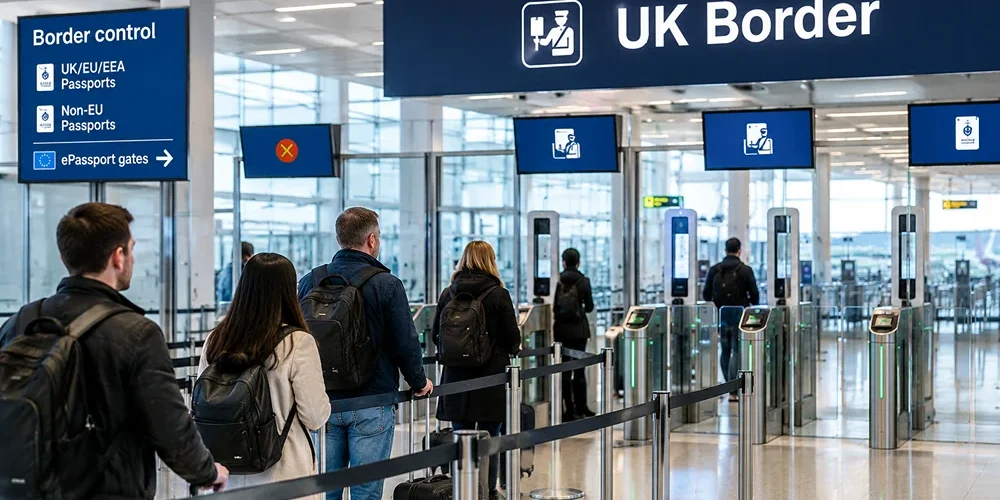
You’ve just landed, the queue at passport control stretches further than you can genuinely see, and someone nearby is saying the e-gates are down again. Or maybe you’ve read a headline about Border Force strikes and you’re wondering whether your flight next month is genuinely at risk.
A note on accuracy before we start: at the time of writing, there is no confirmed active Border Force strike or nationwide e-gate outage. This article explains what a Border Force e-gates outage UK airport-wide actually involves, what has happened historically, and what to do if something similar occurs during your own journey. Always check official sources, your airline and your specific airport directly before travelling, since this is exactly the kind of situation that can change quickly.
Understanding the current position matters whether or not disruption is happening right now. Knowing what to expect removes most of the uncertainty if it ever does.
What happens when UK airport e-gates stop working?
Understanding the mechanics of a Border Force e-gates outage UK airport-wide helps put any disruption into proper perspective.
E-gates are a self-service option, not the only route through the border
UK e-gates use facial recognition to match a traveller against their passport photo, letting eligible passengers cross the border without speaking to an officer. According to Birmingham Airport’s own guidance, eligible travellers include UK, EU and EEA citizens, along with passport holders from Australia, Canada, Japan, New Zealand, Singapore, South Korea and the United States. They must be aged 10 or over and hold a biometric passport.
Manual checks are the fallback, not a last resort
When e-gates are unavailable, whether due to a technical fault or simply because a traveller isn’t eligible, a Border Force officer checks passports manually at a staffed desk instead. This is the standard, normal process for anyone who can’t or doesn’t use the e-gates, disruption or not.
An outage genuinely can increase queue times
Since every passenger who would normally use an e-gate now needs a staffed desk instead, queues can lengthen considerably during a genuine outage. How much depends on how many desks are staffed, how many flights are arriving simultaneously, and how quickly the underlying issue gets resolved.
Airports and Border Force typically respond by redeploying staff
During past outages, airports have moved additional staff to passport control to help manage the increased manual workload. This works alongside contingency plans that exist specifically for this kind of technical failure. It doesn’t eliminate the delay entirely, but it’s part of why past incidents have generally resolved within a matter of hours rather than persisting indefinitely.
An outage does not mean the airport closes or flights are cancelled
This is worth stating plainly, since headlines during past incidents have sometimes made disruption sound more severe than the reality. Flights continue to land and depart as normal during an e-gate outage. The disruption sits specifically at the passport-control stage of arrival, not the airport’s wider operation.
Border security is maintained throughout
Official statements following past e-gate outages have consistently confirmed that security itself isn’t compromised. Manual checks are simply a different method of achieving the same checks the e-gates perform automatically.
Departing passengers aren’t affected by an arrivals e-gate issue
E-gate disruption specifically affects passengers arriving into the UK, since that’s where the automated passport check happens. Someone departing from a UK airport isn’t going through this process in the same way, so an arrivals-side outage doesn’t typically disrupt outbound check-in or security.
What’s the difference between an e-gate outage and a Border Force strike?
These get discussed almost interchangeably in casual conversation, but they’re genuinely different situations with different causes.
A technical outage is a systems problem
An e-gate outage is typically caused by a network or IT issue affecting the automated gates themselves. This is a technology fault rather than a staffing problem, and it can, in principle, affect any airport connected to the same national system simultaneously.
Industrial action is a staffing problem
Border Force strikes, when they occur, involve staff withdrawing their labour as part of a formal industrial dispute, typically over pay, pensions or working conditions. This reduces the number of officers available to staff both e-gates support desks and manual passport-control desks.
The practical effect on queues can look similar from a passenger’s perspective
Whether the cause is a technical fault or reduced staffing, the visible result for a traveller is often the same. Longer queues at passport control and reliance on fewer available desks are what you’ll actually notice. This is precisely why the two situations get conflated in everyday conversation, even though the underlying cause is completely different.
Contingency planning differs between the two situations
A technical outage is typically resolved once engineers fix the underlying system issue, often within hours. Industrial action follows an announced schedule, and airports and the Home Office generally have advance notice to plan contingency staffing, including drafting in additional personnel where needed.
Advance notice of strike action gives travellers a genuine planning advantage
Unlike a technical outage, which arrives without warning, industrial action is typically announced in advance, sometimes weeks ahead. This gives travellers a genuine opportunity to check current guidance before they fly, rather than discovering disruption only once they’ve landed.
Neither situation should be treated as guaranteed to affect every flight equally
Disruption from both causes has historically varied considerably between airports, and even between specific days. This depends on how many staff report for duty, current operational conditions, and how quickly any technical issue gets resolved.
How has this affected UK airports before?
Looking at genuine historical incidents helps set realistic expectations, without presenting old events as current.
The 7 May 2024 nationwide e-gate outage is the most significant recent example
A system network issue caused e-gates to fail across the UK on the evening of 7 May 2024, affecting Heathrow, Gatwick, Stansted, Manchester, Birmingham, Bristol, Edinburgh and several other airports. Border officials processed arrivals manually instead, and queues built up considerably at some locations during the evening. The Home Office confirmed the issue was resolved and e-gates came back online shortly after midnight. Officials ruled out any cyber attack and confirmed border security remained intact throughout.
This wasn’t an isolated incident in the gates’ history
Earlier system issues occurred over the Spring Bank Holiday weekend of 2023 and in September 2021, suggesting these technical outages, while not frequent, aren’t entirely unprecedented either.
The scale of disruption varied by location during the May 2024 incident
Reports from passengers on the night described queues of up to an hour at some airports, with delays building as more flights landed while manual processing continued. Some airports, including East Midlands, reported only minimal disruption at the time, illustrating how unevenly a single nationwide issue can affect different locations.
The incident received genuine parliamentary scrutiny afterwards
The May 2024 outage was discussed in the House of Commons, where MPs raised questions about the reliability of the e-gate system and whether existing contingency plans were sufficient. This level of scrutiny reflects how seriously the incident was taken, even though the practical resolution came within hours.
Border Force industrial action has occurred in previous years
Border Force staff, represented by the Public and Commercial Services Union, have taken strike action in past years over pay, pensions and job security. Past disputes have affected Heathrow, Gatwick, Manchester, Birmingham, Glasgow and Cardiff, often during periods around Christmas and New Year. Contingency arrangements, including drafted military and civil service personnel in some cases, were used to help keep passport control operating during these periods.
Past disruption has generally been temporary and resolved within hours or days
Every documented incident referenced here was resolved, whether through a technical fix or the conclusion of a strike period, rather than representing an ongoing state of affairs. This context matters for setting realistic expectations rather than assuming disruption is a permanent risk.
None of this reflects the current situation at the time of writing
As stated at the start of this article, there’s no confirmed active strike or outage right now. This history exists to help you understand what to expect if disruption does occur, not to suggest it’s currently happening.
What should you do if disruption happens during your journey?
Practical steps that apply whether the cause is a technical fault or industrial action.
Check official sources before you travel
GOV.UK and your specific airport’s website are the most reliable sources for current border information. Check these directly rather than relying on social media reports, which can spread faster than the actual situation develops and aren’t always accurate.
Follow airport and Border Force instructions on arrival
If you land during disruption, airport staff and Border Force officers will direct you to the appropriate queue or process. Following their instructions genuinely gets you through more efficiently than trying to work out an alternative route yourself.
Build in a genuine buffer if you have onward plans
If someone is meeting you, or you have a connecting flight, a tight schedule leaves genuinely little room for an unexpected queue. Building in extra time, particularly for a journey where being late has real consequences, is worth doing even when there’s no known disruption.
Connecting flights need particular care during any border disruption
If you’re transiting through a UK airport with an onward flight, check whether your connection requires clearing UK border control at all. This depends on your specific routing and airline. Where it does, a passport-control delay eats directly into your connection time in a way that a straightforward point-to-point journey doesn’t experience. If a delay genuinely puts your connection at risk, contact your airline directly rather than assuming the situation will resolve itself. Airlines can sometimes rebook a missed connection caused by a documented, genuinely verifiable border delay.
Keep your phone charged and check for updates
If you’re delayed at passport control, a charged phone lets you check your airline’s app or contact whoever’s meeting you. Checking current airport information this way avoids adding to your own stress.
Don’t assume every flight or every airport is affected equally
Historical disruption has varied considerably by location and time, even during a genuine nationwide issue. Check your specific airport’s current status rather than assuming the worst based on a general headline.
A flight delay and a border-control delay are genuinely different problems
If your flight itself is delayed, that’s an airline matter, and your airline’s app or website is the right place to check. If your flight lands on time but queuing at passport control adds an hour, that’s a separate issue entirely. It’s worth understanding which one you’re actually dealing with before deciding what to do next. Confusing the two can lead to contacting the wrong organisation for updates.
If you have a pre-booked pickup, let them know your situation
Whether that’s a friend, family member, or a pre-arranged transfer, a quick message once you’re through passport control helps. Sending it even before you’re through if you can helps whoever’s collecting you plan around your actual timing rather than the original schedule. This small step matters more than people expect, since standing around waiting for an uncertain arrival is genuinely tiring for whoever’s picking you up too.
Things to consider before you travel
- Check GOV.UK and your departure or arrival airport’s website for current information.
- Confirm your passport meets current validity and biometric requirements.
- Check whether you and your travelling companions are eligible for e-gates.
- Allow a genuine buffer if you have a tight connection or someone meeting you.
- Keep your phone charged and your airline’s app installed.
- Share your flight number with anyone collecting you or arranging your onward transport.
- Have a backup plan for onward travel if your arrival time shifts significantly.
- Follow airport and Border Force staff instructions directly if disruption occurs.
How does this affect Birmingham Airport passengers specifically?
Birmingham Airport passengers face the same underlying rules as travellers at any other UK airport, with some genuinely local context worth knowing.
Birmingham Airport was among the airports affected in May 2024
The well-documented nationwide outage on 7 May 2024 affected Birmingham alongside Heathrow, Gatwick, Stansted, Manchester, Bristol and Edinburgh. This confirms Birmingham sits on the same national e-gate network as the UK’s larger airports, rather than operating independently.
Birmingham’s e-gate eligibility follows the standard UK criteria
Birmingham Airport’s own published guidance confirms the standard eligibility rules apply: UK, EU and EEA citizens, plus passport holders from Australia, Canada, Japan, New Zealand, Singapore, South Korea and the United States. These travellers must be aged 10 or over with a biometric passport. Anyone with children under 10, a non-biometric passport, or a national identity card needs to use the staffed desk regardless of any wider disruption.
Registered Traveller status is worth knowing about if you travel frequently
Birmingham Airport’s guidance also confirms that members of the Registered Traveller service can use e-gates even where their nationality wouldn’t otherwise qualify. This is worth investigating if you travel through UK airports regularly and want a more predictable passport-control experience, since it’s a genuine option rather than something only relevant during disruption specifically.
Meeting someone at Birmingham Airport during disruption needs realistic timing
If you’re collecting a friend or family member and there’s any known disruption affecting arrivals, check current flight and airport information before you set off. This helps you avoid a long wait in the terminal, or conversely, arriving too early and circling for parking unnecessarily.
Business travellers arriving into Birmingham face particular time pressure
Someone with a meeting shortly after landing has less flexibility to absorb an unexpected queue than a leisure traveller. This is worth factoring into how tightly you schedule anything immediately after an arriving flight, disruption or not.
Families and less confident travellers benefit from extra planning time
Passport control with children, or for anyone less familiar with UK airport procedures, generally takes longer even without disruption. Building this into your expectations, rather than assuming a specific queue length, sets more realistic expectations for the whole family.
What should business travellers and families plan for differently?
Different types of traveller genuinely face different practical considerations.
Business travellers should protect their post-arrival schedule
If you have a meeting shortly after landing, avoid scheduling it immediately after your expected arrival time with no buffer at all. A confirmed pickup, rather than one you’ll need to arrange after clearing passport control, removes one variable from an already tight schedule.
A backup plan genuinely helps for a meeting you can’t afford to miss
If the meeting itself is critical, consider whether a colleague could join remotely on your behalf for the opening minutes if a genuine delay makes an in-person start impossible. This isn’t a comment on likely disruption, just sensible planning for any journey with a hard deadline attached.
Corporate travel planning benefits from flexible pickup arrangements
For regular business travel through UK airports, it’s worth knowing that your transport provider can adjust to a delayed arrival. This genuinely reduces the stress of unpredictable passport-control timing, rather than assuming a fixed pickup time will always work.
Families should build realistic buffers around young children
Passport control with young children, luggage and pushchairs takes longer under normal circumstances, and considerably longer during any disruption. Planning for this rather than hoping for the best makes the whole arrival less stressful.
Older travellers and those needing extra time deserve the same consideration
Anyone who needs more time to navigate an unfamiliar terminal benefits from the same realistic buffer, disruption or not. This applies whether due to mobility, unfamiliarity with UK airports, or simply preferring not to rush.
Assistance services exist independently of border disruption
Most UK airports offer dedicated assistance for passengers who need extra support navigating the terminal, and this service continues regardless of whether e-gates are working normally. If you or someone you’re travelling with would benefit from this, arrange it through your airline or the airport in advance. Do this separately from anything related to passport-control timing.
None of these groups can control the disruption itself
The practical advice here is about managing your own side of the journey, not influencing Border Force’s operations, which sit entirely outside any traveller’s control.
Should you pre-book an airport transfer during disruption?
Be honest about what a pre-booked transfer actually does and doesn’t change.
A chauffeur cannot speed up or bypass passport control
This needs to be stated clearly: no transport provider, however well organised, can influence Border Force processing times or provide any kind of priority through immigration. Passport control operates entirely independently of how you’re travelling onward.
Waiting arrangements are worth confirming in advance
If you’re arranging a pre-booked pickup for a journey where the arrival time is genuinely uncertain, confirm how the operator handles a longer-than-expected wait. Knowing this in advance, rather than discovering it mid-delay, removes one more source of stress from an already unpredictable situation.
What pre-booking genuinely changes is the journey after immigration
Once you’ve cleared passport control, whenever that happens, a pre-booked transfer means your onward transport is already arranged. This beats something you need to work out after a potentially long and tiring wait.
Flight monitoring, where offered, adjusts to your actual arrival
If a transfer service monitors your flight, your pickup can adjust automatically to reflect delays, rather than leaving you to contact the operator yourself once you’ve finally cleared the border.
This matters more for certain journeys than others
A quick local trip with a flexible schedule doesn’t need the same planning as a business meeting shortly after landing, or a family arriving late at night after a long-haul flight. Match the level of planning to how much an unpredictable arrival time would actually disrupt your day.
Comparing the practical trade-offs
| Option | Typical cost | Time certainty | Best for |
|---|---|---|---|
| Public transport | Typical, lower fare | Reduced during disruption | Flexible travellers without heavy luggage |
| Taxi or private hire | Typical, metered or fixed | Moderate, depends on availability | Direct journeys with some flexibility |
| Pre-booked chauffeur | Typical, higher, fixed in advance | Higher planning certainty | Business travel, families, uncertain arrival times |
Typical / indicative only, since actual costs vary by route, vehicle, operator and demand. None of these options change how long passport control itself takes.
If you’d rather have your onward journey settled in advance than work it out after an unpredictable wait at passport control, arrange this before you travel. Sorting it on arrival leaves you with fewer options.
National Executive Transfers offers pre-booked airport transfers from Birmingham
National Executive Transfers is a Birmingham-based chauffeur service with professional drivers, running Mercedes-Benz vehicles. The service covers pre-booked airport transfers, with flight monitoring where offered. This is genuinely useful for the uncertainty this article has described, though it changes nothing about the passport-control process itself.
For further reading
Our airport transfers page covers the service more broadly. The business chauffeur services page is worth checking if a fixed, quotable cost for work travel matters to you. Our corporate chauffeur account page may also be relevant if your organisation books airport travel regularly. The fleet page covers the specific vehicles available if you’re travelling as a group.
What should you check before you travel?
A final practical rundown covering the essentials this article has worked through.
Check current information close to your travel date
Check GOV.UK and your specific airport’s website in the days before you travel, given how quickly circumstances like this can genuinely change. This gives you the most accurate picture, rather than relying on older information.
Confirm your e-gate eligibility rather than assuming it
Check the current eligibility criteria for your specific passport type and age, since these rules can be updated. Don’t assume every member of your travelling party qualifies just because you do.
Check more than one source if you’re genuinely concerned
If you’ve seen a headline about potential disruption and want to confirm it before travelling, cross-check GOV.UK, your airline and your specific airport. Don’t rely on a single news report alone. Official sources tend to be updated more reliably than social media during a fast-moving situation.
Plan your onward journey with realistic flexibility
Whether that’s a flexible pickup arrangement, a buffer before a meeting, or simply telling whoever’s collecting you that timing might shift, building in this flexibility costs little. It genuinely reduces stress if anything doesn’t go exactly to plan.
Whatever you’re arranging for the journey after you land, a little planning before you travel removes most of the uncertainty this article has been describing.
Frequently Asked Questions
Border Force officers process arrivals manually at staffed desks instead, which is the standard fallback for anyone who can't use the e-gates. Flights and the wider airport continue operating normally.
Yes. Manual passport checks continue regardless of e-gate availability, though queues can take longer since every passenger needs a staffed desk instead.
Past incidents have generally involved a technical or network issue affecting the automated gates' systems, rather than a deliberate action or security breach. Officials have consistently confirmed border security remains intact during these events.
Not necessarily equally. Past industrial action has affected specific airports differently depending on staffing levels and contingency arrangements at each location.
Building in a realistic buffer is sensible advice generally, and becomes more important during known disruption, though this depends on your specific flight and airport.
No. No transport provider can influence or speed up Border Force processing. A pre-booked transfer only affects your journey after you've cleared passport control.
Allow sufficient connection time regardless of border conditions, and contact your airline directly if a delay genuinely puts your connection at risk, since this is an airline matter rather than something a transfer provider can resolve.
This can reduce the stress of an unpredictable arrival time, particularly if the service offers flight monitoring, though it won't change how long passport control itself takes.
Some transfer services offer flight monitoring, which lets your pickup adjust automatically to a delayed arrival. Check this directly with your chosen provider before booking.
Update whoever's collecting you as soon as you can, and check your airline's current guidance if the change relates to your actual flight rather than border processing.