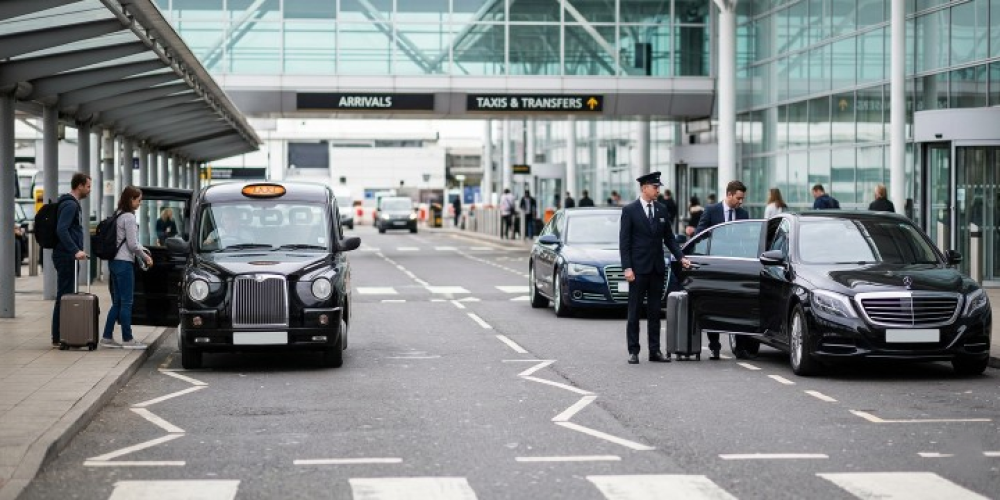
Most UK travellers choose between two options for getting to or from an airport: book a standard taxi, or arrange a pre-booked airport transfer. They can look similar from the outside, but the way each one works, and where each one falls short, differs more than people expect.
This guide compares both honestly across cost, reliability, luggage, flight delays, and different types of traveller. Neither option wins every category. Which one suits you depends on your journey, not on a blanket rule.
Airport Transfer vs Taxi: What’s the Difference?
A taxi, in the broad sense most people mean, covers a few different things. A hackney carriage hailed on the street or from a rank. A private hire minicab booked by phone or app. Or a ride-hailing app like Uber or Bolt. Each operates under different rules, but they share a common pattern. You typically book on the day, or close to it. The price is often not fixed in advance, whether that’s a taxi meter, a distance-based private hire fare, or app-based dynamic pricing.
A pre-booked airport transfer works differently. You confirm your pickup point, destination, date, and time in advance, often days ahead. The price gets agreed before you travel, and a specific vehicle and driver are assigned to your booking rather than whichever car happens to be nearby when you request one.
Neither model is inherently better. A taxi suits journeys where flexibility matters more than certainty. A pre-booked transfer suits journeys where the opposite is true.
Airport Transfer vs Taxi: Quick Comparison
| Factor | Standard Taxi | Pre-Booked Airport Transfer |
|---|---|---|
| Booking | On-demand or short notice | Arranged in advance |
| Price certainty | Varies, sometimes metered or demand-based | Usually fixed at time of booking |
| Driver assigned in advance | No | Yes |
| Flight monitoring | Not standard | Often included, varies by operator |
| Airport pickup | Rank, street hail, or app pickup point | Often a specific meeting point |
| Meet and greet | Not typically included | Often available, varies by operator |
| Luggage assistance | Depends on driver and vehicle | Often included, varies by operator |
| Vehicle choice | Limited, based on availability | Usually selected at booking |
| Early morning travel | Availability can be inconsistent | Confirmed in advance |
| Long-distance travel | Cost can be harder to predict | Usually quoted as a fixed fare |
| Family or group travel | Vehicle size not guaranteed | Vehicle matched to group size |
| Business travel | Workable, less predictable | Suited to fixed schedules |
| Last-minute availability | Often stronger | Weaker, since advance booking is the model |
| Best suited for | Short, flexible, spontaneous journeys | Planned journeys where certainty matters |
How Much Does an Airport Transfer Cost Compared With a Taxi?
“A taxi is cheaper” is true often enough to become the default assumption, but it isn’t always true, and the reasons are worth understanding rather than taking on faith.
A taxi fare depends on the operator, the distance, and traffic and time of day. It also depends on whether it’s a metered hackney carriage, a private hire minicab with a fixed local rate, or an app-based service with demand pricing. That last category is the one where cost becomes genuinely unpredictable. Ride-hailing apps can and do raise prices during high-demand periods, including early mornings and peak holiday travel. The fare you see when you open the app can be considerably higher than on a quiet day.
An airport transfer’s price depends on distance, vehicle size, time of booking, and whether the route crosses any road charges such as the London Congestion Charge or ULEZ. Reputable operators quote this fare before you travel, and it doesn’t move regardless of traffic or demand on the day.
For a short, local journey, a taxi is very often the cheaper option, and there’s no reason to pay more for certainty you don’t need. For a longer route, a larger group, or a journey during a period when demand pricing is likely, the gap between the two can close considerably. Sometimes it even favours the transfer, once you account for a taxi’s peak-time surcharge.
What Does a Standard Taxi Offer?
Taxis and ride-hailing apps are genuinely useful for a lot of journeys. Availability is usually their strongest point: black cabs and licensed minicabs can be found at ranks, hailed on the street in many cities, or requested through an app within minutes.
For short trips, spontaneous journeys, or situations where your schedule isn’t fixed, that flexibility outweighs the benefits of pre-booking. You’re not committing to a specific time days in advance, and if your plans change, there’s no cancellation to manage.
Where taxis are weaker is in the specific demands of airport travel. Unpredictable pricing during high-demand periods, no flight monitoring as standard, and no guarantee of vehicle size for larger groups or luggage.
What Does a Pre-Booked Airport Transfer Offer?
A pre-booked transfer is built around removing the variables that matter most for airport journeys. The price is agreed in advance. The vehicle is confirmed before you travel, matched to your passenger and luggage numbers rather than left to chance. Many operators, though not all, include flight monitoring, adjusting your pickup time automatically if a flight lands early or late.
Meet and greet, where a driver waits inside the terminal with a name board rather than at an external pickup point, is a common feature of professional transfer services, though it varies by operator and isn’t universal to every taxi or every transfer company. National Executive Transfers includes this on airport arrivals: your driver waits inside the terminal in the arrivals hall and helps get your bags to the vehicle.
The trade-off is flexibility. You’re committing to a specific pickup time and location in advance, which suits planned journeys far better than spontaneous ones.
Airport Transfer vs Taxi for Different Travellers
Solo Travellers
For a solo traveller on a short, local route, a taxi is often the simpler and cheaper choice, particularly if your schedule has some flexibility. A pre-booked transfer earns its cost when the route is longer, the flight is early, or missing it isn’t an option.
Families
Luggage, car seats, and simply managing children through an airport all add friction that a taxi doesn’t always account for. Vehicle size isn’t guaranteed with an on-demand taxi, whereas a pre-booked transfer lets you choose a vehicle to match your group before you travel.
Business Travellers
Punctuality and a predictable schedule matter more than cost for a lot of business journeys. A fixed pickup time, confirmed in advance, removes one variable from a day that often has several already. This isn’t about presentation for its own sake. It’s about not needing to think about the journey at all once it’s booked.
Groups
Splitting the cost of one larger vehicle across several passengers often narrows or closes the price gap between a taxi and a transfer. This applies particularly on longer routes, where a taxi might otherwise need two vehicles.
Airport Transfer vs Taxi for Early Morning Flights
Early departures are where taxi reliability is tested most. Booking a taxi or rideshare for a 4am pickup carries a real risk. Driver availability is lower at that hour, and a last-minute cancellation leaves very little time to arrange an alternative before a flight.
A pre-booked transfer removes that specific risk, since the vehicle and driver are confirmed in advance rather than allocated on the morning itself. For a flight you genuinely can’t miss, that certainty is often worth more than the cost difference.
What Happens If Your Flight Is Delayed?
If you’re arranging a taxi for an arrival, the driver typically has no way of knowing your flight status unless you contact them directly once you’ve landed. That usually means booking or hailing a taxi from the arrivals hall itself, competing with everyone else on a delayed flight doing the same thing.
A pre-booked airport transfer, where the operator offers flight monitoring, adjusts the pickup time automatically as the landing time changes. This isn’t universal across every transfer company, so it’s worth confirming as part of any booking rather than assuming it’s included. National Executive Transfers tracks your flight from departure and adjusts your pickup automatically if it lands early or late, with 60 minutes of free waiting time included to cover baggage reclaim and customs.
Airport Meet and Greet vs Taxi Rank Pickup
A taxi rank pickup means finding the rank, joining any queue, and taking whichever vehicle is next available. A curbside app pickup means finding your specific car among others waiting in the same zone, sometimes in a car park some distance from the terminal itself.
Meet and greet, where offered, means a driver waiting inside the terminal building with a name board, ready to help with luggage before you’ve even reached the car park. Not every transfer operator provides this to the same standard, so it’s worth checking what “meet and greet” actually includes with any specific company before booking.
Airport Transfer vs Taxi for Long-Distance UK Journeys
For a short hop to a nearby airport, the choice between taxi and transfer often comes down to convenience alone. For a longer journey, say Birmingham to Heathrow or Manchester to Gatwick, the calculation changes. A taxi meter or app fare over two or three hours can become expensive and unpredictable, while a pre-booked transfer quotes a fixed price for the whole route regardless of traffic.
This applies across UK airports generally, not just one route. Birmingham, Heathrow, Gatwick, Manchester, Stansted, Luton, and East Midlands all see the same pattern. Local journeys suit either option, while longer cross-country routes tend to favour the predictability of a pre-booked fare. If you’re specifically comparing chauffeur services against taxis for a Birmingham Airport journey, our dedicated Birmingham comparison covers that route in more detail.
When Is a Taxi the Better Choice?
- Short, local journeys where the fare stays low regardless of route
- Spontaneous trips with no fixed schedule
- Situations where taxi availability in your area is consistently strong
- Journeys where a delay or cancellation would be inconvenient but not serious
- Budget-conscious travel where the cost gap favours a taxi clearly
When Is a Pre-Booked Airport Transfer the Better Choice?
- Early departures where a last-minute cancellation isn’t an option
- Long-distance routes where a metered or app-based fare becomes unpredictable
- International arrivals where you want someone reliably waiting after a long flight
- Family or group travel with specific vehicle and luggage needs
- Business travel built around a fixed schedule
- Any journey where a confirmed price and vehicle matter more than flexibility
Common Mistakes When Choosing Airport Transport
Choosing based on headline price alone, without checking whether that price is fixed or subject to change, is one of the most common mistakes. Ignoring luggage requirements until the vehicle arrives is another, particularly for families or groups.
Booking a taxi for an early morning flight without a backup plan carries real risk, given how availability drops at that hour. Assuming all airport transfer companies offer the same service, including meet and greet and flight monitoring, is also a mistake. Coverage and inclusions vary by operator, so it’s worth checking before you book rather than after something goes wrong. Leaving an important airport journey until the last minute removes your ability to compare options properly.
Airport Transfer vs Taxi: Which Should You Choose?
Choose a taxi if your journey is short, your schedule has flexibility, and the cost difference clearly favours it for your specific route.
Choose a pre-booked airport transfer if your journey is long-distance, your flight is early or you’re arriving internationally, you’re travelling with a family or group, or the schedule simply can’t absorb a delay or cancellation.
Compare both if you’re not sure which category your journey falls into. Getting an actual quote for a pre-booked transfer, rather than assuming it costs more, is the only reliable way to know for a specific route and date.
Making the Right Call
Airport transfer versus taxi isn’t a question with one correct answer. It comes down to what your specific journey needs: how far you’re travelling, how much flexibility you have, and how much a delay or cancellation would actually cost you. For short, simple trips, a taxi remains a perfectly sensible choice. For longer routes, early flights, or journeys where certainty matters more than saving a few pounds, a pre-booked transfer is usually worth the extra planning.
Frequently Asked Questions
A taxi is typically booked on demand or at short notice, with a price that can vary. An airport transfer is pre-booked in advance, usually with a fixed price and a specific vehicle and driver confirmed before you travel.
Not always. For short, local journeys, a taxi is often cheaper. For longer routes, larger groups, or periods when demand pricing applies, the gap can close or even favour a pre-booked transfer.
For journeys where reliability matters, such as an early flight or a long-distance route, yes. For short, flexible trips, pre-booking adds less value.
Often, since vehicle size is confirmed in advance rather than left to chance. A taxi can still work well for families on shorter, simpler routes.
Generally yes. Taxi and rideshare availability tends to drop at very early hours, increasing the risk of delays or cancellations when you can least afford them.
With a standard taxi, you typically need to arrange pickup yourself once you've landed. A pre-booked transfer with flight monitoring, where offered, adjusts the pickup time automatically, though this varies by operator.
Most reputable operators quote a fixed price at the time of booking, though this isn't universal. It's worth confirming with any specific company before you book.
Often, yes. For a short trip with a flexible schedule, the certainty of a pre-booked transfer usually isn't necessary.