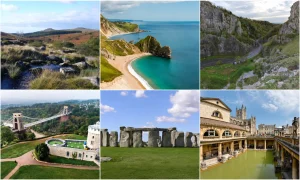
The best places to visit in South West England are Bath, Stonehenge, Bristol, Cheddar Gorge, Lulworth Cove and Durdle Door, Dartmoor, Tintagel Castle, the Eden Project, St Michael’s Mount and St Ives. Between them you get Roman and Georgian cities, a prehistoric monument, open moorland and some of the finest coastline in Britain.
Most “top 10” lists stop at the sights. This guide also tells you roughly how far each place is from Birmingham, how long to allow, whether you need to book and how to get there with or without a car. Further down you’ll find sample itineraries, the best time to go and what changes in winter.
The top 10 at a glance
Distances are approximate road miles from central Birmingham. Drive times depend heavily on traffic, particularly on the M5 and A303 on summer weekends.
| Place | County | Approx. distance from Birmingham | Time to allow | Book ahead? |
|---|---|---|---|---|
| Bath | Somerset | 95–100 miles | Full day | Roman Baths: yes, timed entry |
| Stonehenge | Wiltshire | 125 miles | 2–3 hours | Yes, timed tickets |
| Bristol | Bristol | 90 miles | Full day | Only for paid attractions |
| Cheddar Gorge | Somerset | 110 miles | Half day | Caves: recommended |
| Lulworth Cove & Durdle Door | Dorset | 175 miles | Half to full day | No, but parking is paid |
| Dartmoor National Park | Devon | 180–200 miles | Full day | No |
| Tintagel Castle | Cornwall | 215 miles | Half day | Yes, timed tickets |
| Eden Project | Cornwall | 230 miles | 4–6 hours | Recommended |
| St Michael’s Mount | Cornwall | 260 miles | Half day | Yes, and check tide times |
| St Ives | Cornwall | 270 miles | Full day | No |
From Lulworth westwards, an overnight stay makes far more sense than a day trip from the Midlands.
Which counties are in South West England?
South West England covers Cornwall, Devon, Dorset, Somerset, Wiltshire, Gloucestershire and Bristol, plus the Isles of Scilly. It is the largest of England’s official regions by area. It also contains two complete national parks, Dartmoor and Exmoor.
Some travel lists include the Isle of Wight, but it belongs to South East England. This guide also leaves out the Cotswolds. Part of that area falls within Gloucestershire, but most visitors from the Midlands treat it as a trip of its own. The Isles of Scilly need a ferry or flight from Cornwall, so they sit outside the itineraries below.
How the region splits for a trip from Birmingham
Distance shapes every plan here, so it helps to think in three zones.
- Bristol, Bath, Cheddar Gorge and Stonehenge sit in the day-trip zone, within roughly two hours 45 minutes of Birmingham. An early start gives you a full day on site.
- Lulworth Cove, Durdle Door and Dartmoor sit in the overnight zone, three and a half to four hours away. One night away turns a tiring day into a proper trip.
- Cornwall is the multi-night zone, with over four hours each way. Allow at least three nights, and four or five if you want more than one stretch of coast.
Which place suits you?
Pick the row that matches your trip, then read that entry first.
| If you want | Start with | Why |
|---|---|---|
| One easy day from Birmingham | Bath | Closest big-name sight, and the day is spent on foot |
| Prehistory | Stonehenge | The world’s best-known stone circle, with a good exhibition |
| A city break with food and museums | Bristol | Harbourside, street life and several free museums |
| Dramatic coastline and short walks | Lulworth Cove and Durdle Door | The Jurassic Coast’s most photographed stretch |
| A wet-weather option | Eden Project | Much of it sits under cover |
| King Arthur legends and clifftop ruins | Tintagel Castle | Castle ruins above the Atlantic, linked by a footbridge |
| Art, beaches and a working harbour | St Ives | Tate St Ives and the Hepworth Museum sit minutes from the sand |
| Open moorland and big skies | Dartmoor | Free entry, ponies and granite tors |
| Travel without a car | Bath, Bristol or St Ives | All three have rail stations close to the centre |
The top 10 places to visit in South West England
Each entry covers why the place is worth the journey, how long to spend there, what to book and how to get there.
1. Bath, Somerset


Bath is the easiest South West city to reach from Birmingham, and the whole city has held UNESCO World Heritage status since 1987. The Roman Baths are the main draw. Leave time for Bath Abbey, the sweep of the Royal Crescent and Pulteney Bridge, which has small shops built into both sides. If you would rather get in the water than look at it, Thermae Bath Spa has a rooftop pool with views across the city.
- Time needed: A full day. Allow two hours or so for the Roman Baths if you use the audio guide.
- Tickets: The Roman Baths sell timed tickets, and prices vary by day and season. Book online before you travel. Bath Abbey tower tours are booked separately.
- From Birmingham: About 95 to 100 miles via the M5, then the M4 or A46. In reasonable traffic, the drive usually takes under two hours.
- Without a car: Take the train to Bath Spa, usually with a change at Bristol Temple Meads. The station is a short walk from the Roman Baths.
- Parking: City-centre spaces are limited and expensive. If you drive, the park and ride sites on the edge of the city are the better option.
- Clean air zone: Bath’s zone does not charge private cars. It applies to taxis, private hire vehicles, vans, coaches, buses and lorries that fall below the emission standard.
Bath works well as a drop-off and collection trip, because the day is spent on foot and nobody has to hunt for a space. For door-to-door travel from the Midlands, see our Birmingham to Bath transfer page.
2. Stonehenge, Wiltshire

The stones went up roughly 4,000 to 5,000 years ago, and English Heritage looks after the site today. The visitor centre sits about 1.5 miles from the circle. A free shuttle links the two, or you can walk across the open landscape in around half an hour.
- Time needed: Two to three hours, including the exhibition.
- Tickets: Book a timed slot online, as busy days sell out. English Heritage members and National Trust members in England get in free, but they should still reserve a slot. A limited number of walk-up tickets go on sale at the site, usually at a higher price, so do not count on them.
- From Birmingham: Around 125 miles. Most routes finish on the A303, which is often slow on summer Fridays and Saturdays. The government revoked consent for the planned Stonehenge tunnel in March 2026, so the slow stretch past the stones stays.
- Without a car: Take the train to Salisbury, which involves at least one change from Birmingham. From there, a tour bus carries passengers to the stones. Check the current timetable before you travel.
- Nearby: Salisbury Cathedral, home to an original 1215 Magna Carta, is about 20 minutes’ drive away. Avebury, roughly 25 miles north, has a vast stone circle where you can walk among the stones for free.
Is Stonehenge worth visiting?
Yes, as long as you know what to expect. A standard ticket lets you walk a path around the stones, but not inside the circle. Getting inside is only possible on separately booked Stone Circle Experiences at dawn or dusk.
If you would rather not pay, public rights of way across the surrounding National Trust land give a free view from further away. For a first visit, the paid ticket and exhibition are worth it.
3. Bristol

Bristol is the region’s largest city. It suits anyone who prefers museums, food and street life to Georgian terraces. Most sights are linked by the harbourside. On board Brunel’s SS Great Britain you can explore a restored Victorian steamship. The Clifton Suspension Bridge, which opened in 1864, costs nothing to walk across.
- Time needed: A full day, or two if you want to see Clifton properly.
- Tickets: The SS Great Britain charges admission. Several museums, including M Shed, are free.
- From Birmingham: About 90 miles down the M5, usually around an hour and a half.
- Without a car: Direct CrossCountry trains from Birmingham New Street reach Bristol Temple Meads in roughly 1 hour 20 minutes to 1 hour 30 minutes.
Driving in: Bristol’s Clean Air Zone covers the city centre and, unlike Bath’s, it charges private cars. Petrol cars below Euro 4 and diesel cars below Euro 6 pay a daily charge. As a rough guide, that means petrol cars registered before 2006 and diesels registered before late 2015. Check your registration on GOV.UK before you drive in.
For business visits or a day out in the city, our executive chauffeur service in Bristol covers journeys around Clifton, the harbourside and beyond.
4. Cheddar Gorge, Somerset

Sheer cliffs rise on both sides of the road that cuts through this gorge in the Mendip Hills. Driving through it costs nothing and is a highlight in itself. The ticketed Cheddar Gorge & Caves attraction adds Gough’s Cave, Jacob’s Ladder (a long, steep flight of steps), a lookout tower and a clifftop walk.
- Time needed: Half a day.
- Tickets: One day ticket covers the main attractions. The attraction’s own listing gives opening of 10am to 5pm in summer and 10am to 4pm in winter, but check the official site for your date.
- From Birmingham: About 110 miles via the M5.
- Without a car: Buses are limited, which makes this one of the harder places on the list to reach without a vehicle.
- Nearby: Wells, a small cathedral city a short drive away, or Glastonbury Tor for wide views over the Somerset Levels.
5. Lulworth Cove and Durdle Door, Dorset

This is the most photographed part of the Jurassic Coast. The coastline is protected as a UNESCO World Heritage Site, and its rocks span roughly 185 million years. The protected stretch reaches about 95 miles, from East Devon to Dorset. Lulworth Cove is an almost perfectly round bay, and Durdle Door, a limestone arch standing in the sea, sits over the next headland.
- Time needed: Half a day for the cove and the arch. Add Corfe Castle or the Isle of Purbeck and it becomes a full day.
- Tickets: There is no entry fee, but the main car parks are on private estate land and charge for parking.
- From Birmingham: About 175 miles, so this works best as part of an overnight trip.
- Without a car: Wool is the nearest station, a few miles inland, and onward buses are limited.
- Crowds: In summer, the car parks and the steep path to Durdle Door are busy by late morning, so arrive early.
Safety: The path down to the beach at Durdle Door is steep. Stay back from cliff edges, and check sea conditions before you swim, because currents can be strong. The coast path east of Lulworth Cove crosses army firing ranges that close on some days, so check the published range access times before you plan a longer walk.
Jurassic Coast places to visit for fossils
Lulworth is about the scenery. For fossil hunting, head west to Charmouth and Lyme Regis. Search loose material on the beach as the tide goes out. Never dig into or climb the cliffs, because rockfalls happen without warning. Check tide times before you go.
6. Dartmoor National Park, Devon

Dartmoor is open moorland, broken up by granite tors, old clapper bridges and ponies grazing freely. Haytor and Hound Tor give big views for fairly short walks. For lunch, stop at Postbridge, Widecombe-in-the-Moor or Princetown.
- Time needed: A full day.
- Tickets: Entry to the national park is free, though some car parks charge.
- From Birmingham: About 180–200 miles, depending on which side of the moor you head for, via the M5 and A38.
- Without a car: Trains reach Exeter and Plymouth, but buses onto the moor are limited and some operate only in season.
- Weather: Conditions change quickly and mist can come down within minutes. Mobile signal is patchy, so download maps before you set off. Admire the ponies from a distance and never feed them.
Exmoor, further north, is a quieter alternative with a dramatic coastline and dark skies for stargazing.
7. Tintagel Castle, Cornwall

Ruins cling to a headland above the Atlantic here, and the site has been linked with King Arthur for centuries. A footbridge, opened in 2019, now crosses the gap between the mainland and the island. Below the castle, Merlin’s Cave can be explored at low tide.
- Time needed: Half a day.
- Tickets: English Heritage timed tickets. Book ahead, especially in school holidays. English Heritage usually charges less for tickets bought online in advance.
- From Birmingham: About 215 miles via the M5 and A30.
- Without a car: There is no railway station nearby and buses are limited.
- Parking: The car parks in Tintagel village are not managed by English Heritage, and the walk to the entrance includes steps. Arrive early in summer.
- Opening days: From November, the castle opens on selected days only and closes over Christmas, so check the English Heritage calendar before you book a winter trip.
- Accessibility: Expect plenty of steep steps and uneven ground. Read English Heritage’s access information before visiting.
- Nearby: Boscastle harbour, Port Isaac and Padstow all sit close by on the north coast.
8. Eden Project, Cornwall

Built in a former clay pit near St Austell, the Eden Project’s giant biomes hold a rainforest and a Mediterranean garden, surrounded by large outdoor gardens. So much of it is under cover that it is one of the best rainy-day options in Cornwall.
- Time needed: Four to six hours.
- Tickets: Book online to confirm opening times and any seasonal events.
- From Birmingham: About 230 miles via the M5 and A30.
- Without a car: Take the train to St Austell, then a local bus.
- What to wear: The rainforest biome is hot and humid, so wear layers. The site is also hilly, with a long walk between the entrance and the biomes.
- Nearby: The Lost Gardens of Heligan, near Mevagissey, make a good second stop on a longer stay.
9. St Michael’s Mount, Cornwall

A castle and terraced gardens crown this rocky island in Mount’s Bay, just off the village of Marazion. The National Trust owns the island. When the tide is low, a granite causeway lets you walk across. Once the water covers it, small boats make the crossing instead, for a fare.
- Time needed: Half a day.
- Tickets: Book castle and garden tickets online. Opening is seasonal and the gardens open on set days, so check the official site for your date. If you hold National Trust membership, check what it covers before you pay.
- From Birmingham: About 260 miles, so plan it as part of a stay in west Cornwall.
- Without a car: Take the train to Penzance, then a short bus ride or a walk along the coast to Marazion.
- Accessibility: The climb to the castle is steep and cobbled.
St Michael’s Mount tide times: how to plan your crossing
- Check the published tide and causeway times for your date.
- Book a castle ticket for a slot that suits the tide.
- Park in Marazion.
- Walk over at low tide, or take the boat if the causeway is covered.
- Check the return tide before you start exploring.
10. St Ives, Cornwall

St Ives mixes sandy beaches with a working harbour and a long artistic tradition. Tate St Ives and the Barbara Hepworth Museum and Sculpture Garden are both here. Porthmeor and Porthminster rank among Cornwall’s best town beaches.
- Time needed: A full day.
- Tickets: The town is free to explore. The Tate and the Hepworth museum charge admission.
- From Birmingham: About 270 miles, the longest journey on this list.
- Without a car: Take the train to St Erth, then the short branch line that follows the edge of the bay into St Ives.
- Parking: The streets are narrow and steep. If you drive, use the car parks above the town, or the park and ride by train from Lelant Saltings.
From St Ives, the Minack Theatre, Land’s End and the fishing village of Mousehole are all within easy reach.
Hidden gems worth adding to your list
These places did not make the top 10, but they fit easily into the itineraries further down.
- Salisbury Cathedral: Britain’s tallest spire and an original Magna Carta, a natural partner for Stonehenge.
- Avebury: A huge stone circle that wraps around a village, with no ticket needed to walk among the stones. It is quieter than Stonehenge.
- Lyme Regis: A small seaside town at the heart of the Jurassic Coast, with a fossil museum and a relaxed harbour.
- Wells: A compact cathedral city near Cheddar, with the moated Bishop’s Palace beside the cathedral.
- Glastonbury Tor: A short but steep climb to a hilltop tower, with wide views over the Somerset Levels.
- Clovelly: A steep, car-free fishing village on the north Devon coast. Entry is through a paid visitor centre.
- Padstow: A busy harbour town on Cornwall’s north coast, popular for seafood and handy for Tintagel.
- The Minack Theatre: An open-air theatre carved into the cliffs above Porthcurno. Advance booking is essential, and the approach road is narrow and slow in summer.
How to get to South West England from Birmingham
Almost every South West trip from the Midlands starts on the M5. It leads from Birmingham to Exeter, where the A30 and A38 carry on into Cornwall and Devon. The real decision is whether you drive, take the train or book a driver.
Driving yourself
A car gives you the most freedom, and it is often the only practical way to reach the coast and the moors. Still, a few things regularly catch out first-time visitors.
- Summer Saturdays bring heavy traffic on the M5, A30 and A303, especially on holiday changeover days. Leave before 7am or travel midweek.
- Many roads in Cornwall and Devon are single-track, so expect to reverse to passing places.
- Popular car parks, such as Lulworth and St Ives, fill by mid-morning in peak season. Download the parking app before you arrive, because mobile signal drops in rural areas.
- A four-hour drive home after a full day of walking is hard going, so plan overnight stops. Break the journey every two hours at services such as Gloucester, Michaelwood, Sedgemoor and Exeter.
- Rapid chargers cluster along the M5 and in larger towns, but many rural car parks have none. Electric car drivers should charge fully before heading for Dartmoor or the north Cornish coast.
- Bath’s clean air zone does not charge private cars, but Bristol’s charges older petrol and diesel cars that miss the emission standard. Check your registration on GOV.UK before you go.
South West England without a car
Trains work well for the cities. CrossCountry runs direct services from Birmingham New Street to Bristol, Exeter and Plymouth, and some continue into Cornwall as far as Penzance. Great Western Railway connects Bristol, Bath and the Cornish branch lines.
The countryside is the weak point. Dartmoor, Cheddar Gorge, Tintagel and much of the Jurassic Coast have limited buses, and some routes run only in season. Without a car, base yourself in Bath, Bristol, Exeter, Penzance or St Ives and use local transport from there.
Travelling with a private chauffeur
A pre-booked chauffeur sits between the train and driving yourself. You are collected from your door, dropped at the entrance and picked up again when you are ready. Nobody in the group faces the drive home after a long day.
On multi-stop days, such as Bath and Stonehenge or Tintagel and Padstow, hourly or full-day chauffeur hire keeps the same driver and car with you between stops. Child seats are available on request.
Groups can travel together in a Mercedes-Benz V-Class, which seats up to seven passengers with room for luggage. You can compare vehicles across the Mercedes-Benz fleet before you book.
For trips deeper into Devon and Cornwall, National Executive Transfers also arranges long-distance chauffeur journeys from Birmingham. The price is agreed before you book, so you know the cost from the start.
Flying in: Bristol, Heathrow and Birmingham airports
Bristol Airport is the nearest major airport to Bath, Bristol, Cheddar and the rest of Somerset. Exeter and Newquay airports serve Devon and Cornwall, though with fewer routes. Many international visitors land at Heathrow and head west along the M4.
If you land at Bristol and want to go straight to your hotel or first stop, a Bristol Airport chauffeur service avoids queuing for buses or taxis. Your flight is tracked, and waiting caused by a delayed flight is included in the fixed price.
National Executive Transfers is based at Birmingham Airport, so arrivals at BHX can travel south directly. See our Birmingham Airport transfers page for pickup details.
South West England itinerary ideas
How many days you need depends on how far west you go. Bath, Bristol and Stonehenge fit into a long weekend. Cornwall needs at least four or five days to justify the journey from the Midlands.
One day from Birmingham: Bath (or Bath and Stonehenge)
Bath on its own makes a comfortable day trip. Leave around 8am, spend the day in the city and you are home by evening.
Adding Stonehenge turns it into a very long day. Allow roughly two hours to Bath, an hour on to Stonehenge, a couple of hours at the stones and over two hours home. It works best with an early start and someone else at the wheel.
Two days: Bristol and Bath
- Day 1: Drive or take the train to Bristol. Walk the harbourside, board the SS Great Britain, cross the Clifton Suspension Bridge and stay overnight in the city.
- Day 2: Take the short train ride to Bath. Visit the Roman Baths and the Abbey, then walk the Royal Crescent before you head home.
Three days: Bath, Stonehenge and the Jurassic Coast
- Day 1: Travel to Bath for the Roman Baths, the Abbey and the Royal Crescent, then stay overnight.
- Day 2: Stonehenge in the morning and Salisbury Cathedral in the afternoon, with a night in Salisbury.
- Day 3: Lulworth Cove and Durdle Door, then the drive home of over three hours.
Five to seven days: a Devon and Cornwall road trip
- Day 1: Drive to Dartmoor, breaking the journey near Bristol or Exeter.
- Day 2: Spend the day on Dartmoor, taking in Haytor, Hound Tor and Widecombe.
- Day 3: Cross into Cornwall for Tintagel, Boscastle and Port Isaac.
- Day 4: Visit the Eden Project, then spend the evening in Fowey or St Austell.
- Day 5: St Michael’s Mount, timed with the tide, then on to St Ives.
- Day 6: The Minack Theatre, Land’s End and Mousehole.
- Day 7: Head home, which takes five hours or more from west Cornwall, with a lunch stop on the way.
Only have five days? Skip Dartmoor, drive straight to Tintagel on Day 1 and move every later stop one day earlier. That change saves several hours of driving and still keeps the best of Cornwall.
Best time to visit South West England
The South West is milder than most of the UK, so you can visit all year round. Each season still changes what you find.
Spring and early autumn
April to June and September to October are the best overall months. The weather usually suits coast paths, school holidays are over, and car parks and beaches are far quieter. Spring wildflowers along the Jurassic Coast are a bonus.
Summer and school holidays
July and August bring the warmest sea and the longest days, along with the biggest crowds. Book timed tickets well in advance, reach popular beaches early, and avoid Saturday travel on the M5 and A303 if you can. Around the June solstice, Stonehenge draws large crowds, so check English Heritage’s notices before you book that week.
South West England in winter
Winter is quieter, often cheaper and good for city breaks. Bath, Bristol, Stonehenge, the Eden Project and Dartmoor all stay open, though some opening hours are shorter. Cheddar Gorge & Caves moves to winter hours, and the castle and gardens at St Michael’s Mount open only seasonally.
Tintagel Castle opens on fewer days from November, and several attractions close over Christmas. Daylight is the main limit, as it can be dark before 4.30pm in December. Plan fewer stops a day, and check each attraction’s winter calendar before you set off.
Practical tips for families, older passengers and dog owners
Travelling with children
The Eden Project, the SS Great Britain in Bristol and the caves at Cheddar Gorge suit children best, because each gives them something to explore under cover. Pushchairs struggle at Tintagel, Durdle Door, Jacob’s Ladder in Cheddar and St Michael’s Mount, where steps, slopes and cobbles slow you down. In a private car, children need a child seat until they reach 12 years or 135 cm, whichever comes first. If you book a chauffeur with us, ask for child seats when you reserve.
Older passengers and reduced mobility
Choose places with level paths or a shuttle where you can. Stonehenge has a shuttle between the visitor centre and the stones, and Bath’s main sights sit close together. Tintagel, St Michael’s Mount and Cheddar’s clifftop routes involve steep climbs. Read each site’s access information before you book, and ask about accessible parking. A chauffeur can drop you at the entrance and collect you from the same spot.
Travelling with dogs
Dogs are welcome across the National Trust landscape around Stonehenge and on most coast paths. Keep them on a lead near ponies, livestock and cliff edges, particularly on Dartmoor. Check the dog policy at each paid attraction before you set off.
Weather and what to pack
The weather changes fast on Dartmoor and along the coast, so pack layers, a waterproof jacket and shoes with a good grip. Add sun cream in summer and a power bank for your phone, because you will use maps and parking apps more than usual. Carry a little change as well, since a few rural car parks still take cash.
Tickets and booking: what to sort before you go
This guide does not list ticket prices, because most South West attractions now use date-based pricing that changes often. Always book through the official website rather than a resale site. Before any trip, work through this list.
- Book timed entries early. Stonehenge, Tintagel Castle, the Roman Baths, St Michael’s Mount and the Minack Theatre all use timed tickets or advance booking.
- Check memberships. English Heritage covers Stonehenge and Tintagel, and National Trust members in England also enter Stonehenge free. The National Trust looks after many gardens and coastal sites. Over a few days, membership can cost less than separate tickets. Bring your membership card, and expect to show photo ID.
- Look at overseas passes. An English Heritage Overseas Visitor Pass covers Stonehenge and Tintagel. Other overseas passes may also work, so check before you buy.
- Buy online ahead of time. English Heritage usually charges less for tickets booked in advance than for tickets bought at the gate.
- Check tide times. St Michael’s Mount, Merlin’s Cave and fossil hunting all depend on the tide.
- Confirm seasonal opening. Many coastal attractions cut back their opening days between November and March.
- Plan your parking. Many car parks, including those at Lulworth, are privately operated and charge. Bath, St Ives and Bristol are easier on foot or by park and ride.
Planning your South West trip from Birmingham
A good South West trip starts with a realistic plan. Choose a base, group nearby places together and book timed entries early. Above all, respect the distances. Bath, Bristol and Cheddar Gorge work as day trips, while Cornwall deserves several nights. The best places to visit in South West England reward visitors who leave time to enjoy them.
If you would rather leave the driving to someone else, National Executive Transfers can plan a South West route with you from Birmingham, Solihull or Birmingham Airport. That might be a single day in Bath or a week touring Devon and Cornwall. Find out more about chauffeur-driven UK holiday travel, or call 01564 778080 for a fixed quote.
Find out more about chauffeur-driven UK holiday travel, or call 01564 778080 for a fixed quote.
Related Articles
- Day Trips from Birmingham: 20 Best Places to Visit
- Best Places to Visit in UK Without Driving Yourself
- Top 10 Castles to Visit in the UK: A Full Travel Guide
Frequently Asked Questions
A long weekend covers Bath, Bristol and Stonehenge. Add Lulworth Cove and Dartmoor and you need three to four days. Cornwall needs four or five days, because the drives between sights are long.
Yes, if you pick one place. Bath, Bristol and Cheddar Gorge all work as day trips, and Bath and Stonehenge together make a very long day. Cornwall is too far for a day trip.
Tintagel is about 215 miles away and St Ives about 270 miles, depending on your route. Allow four and a half to five and a half hours each way by road. A direct CrossCountry train to Penzance takes about five and a half hours.
Stonehenge, Tintagel Castle, the Roman Baths, St Michael’s Mount and the Minack Theatre all use timed tickets or advance booking. The Eden Project and the caves at Cheddar Gorge also benefit from booking ahead.
Dartmoor, Avebury, the Clifton Suspension Bridge (on foot), M Shed in Bristol and the town of St Ives cost nothing to enter. Lulworth Cove and Durdle Door have no entry fee, but you pay for parking. Cheddar Gorge’s road is free, though the caves and lookout tower charge.
The Eden Project, the Roman Baths, Bristol’s museums, Tate St Ives and the caves at Cheddar Gorge all keep you under cover. Save the coast paths and Dartmoor for a drier day.
It depends on the trip. On multi-stop days, long distances and tourist-heavy weekends, a chauffeur removes the driving, the parking and the late drive home. If you prefer your own car, plan overnight stops and leave early on summer weekends.
Base yourself in the city or town that suits your plan. Bath or Bristol suit the day-trip zone, Salisbury suits Stonehenge, and Exeter works as a stop before Dartmoor. In Cornwall, choose St Austell or Fowey for the Eden Project, and Penzance or St Ives for the far west.