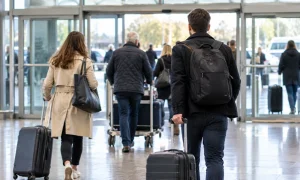
You step off a long flight, your phone is on 4 percent and the signs ahead seem to point everywhere at once. That is the moment most people arriving at Heathrow for the first time start wondering what happens next. This Heathrow Arrivals Guide covers the first hour after you land, with most of the detail on what happens once you reach the arrivals hall: what to sort out first, where each terminal’s exit leads and how to get moving towards your hotel or home.
Heathrow has four terminals in use, Terminals 2, 3, 4 and 5, and each has its own layout. Border control, baggage reclaim and meeting your driver already have their own guides, so this one picks up once you are through. If you are travelling with children, landing very late or helping an older relative, there are sections for you further down.
Before you land
Good Heathrow arrivals start before you land. A few minutes of preparation in your seat save more time than anything you can do in the terminal. Keep your hotel address and any booking or driver details somewhere you can open without a signal, and take a screenshot as a back-up. Confirm your terminal in your airline’s app or email, since an airline does not always use the same one, and tell whoever is meeting you which meeting point you will use.
Charge your phone before the descent if you can, and decide how you will leave the airport. Choose between a train, a cab and a pre-booked car, and look up any engineering works on the route. If anyone in your group needs assistance, check that the airline has arranged it. Decisions made on a tired, crowded walk to the exit tend to be the expensive ones.
Check your entry paperwork as well. Since 25 February 2026, most visitors who do not need a visa must hold an approved Electronic Travel Authorisation before they board, and airlines check it at departure. It is linked to your passport, so travel on the same one you applied with. British and Irish citizens are exempt, and dual British citizens should travel on a British passport. GOV.UK has the current rules, and it is worth reading them weeks before your flight rather than at the check-in desk. If you carry chargers from abroad, pack a UK adaptor, because UK sockets take three-pin Type G plugs at 230 volts.
The first hour at a glance
Most of the hour is spent clearing the checkpoints between the aircraft door and the public arrivals hall. If you are wondering what to do after landing at Heathrow, this is the order you will meet them in, and what to have ready at each one.
| Stage | What to do |
|---|---|
| Leaving the aircraft | Follow the Arrivals and Baggage Reclaim signs. Keep your passport and boarding pass in your hand rather than in your bag. |
| Border control | Join the eGate or staffed desk queue that suits your passport. Our note on border control delays and eGate outages explains what to expect when queues build. |
| Baggage reclaim | Find your belt on the screens and pick up a free trolley from the reclaim hall. If a bag does not appear, report it at your airline’s baggage desk before you leave the hall, then read what to do about delayed or lost luggage. |
| Customs | Choose the green or red channel before you enter the public arrivals hall. |
| Arrivals hall | Message whoever is meeting you, get connected and sort out money. If a chauffeur is collecting you, how Heathrow meet and greet works shows where to look for them. This is where the rest of this guide starts. |
| Onward journey | Pick the transport that suits your luggage, your destination and the time of day. |
How long the first four stages take depends on how many flights have landed around the same time as yours. Heathrow publishes live immigration wait times on its passenger updates page, which is worth a look if someone is waiting for you and you want to give them a realistic estimate.
Customs: choosing your channel
Customs comes last in the Heathrow arrivals sequence, after baggage reclaim and just before the public hall, and every passenger has to pick a channel. The blue channel that once served arrivals from the EU has closed, so everyone now chooses green or red. Use green if you have nothing to declare. Use red if you carry goods above your allowance, restricted items or commercial goods, or if you are simply not sure. Border Force officers can stop anyone in either channel, so answer questions honestly and keep receipts for expensive purchases.
Cash catches people out. If you carry £10,000 or more, or the equivalent in another currency, you must declare it. Food, plants and animal products are also restricted, and that includes some meat and dairy from the EU. Allowances change, so read Heathrow’s UK customs information and the GOV.UK guidance before you pack. Passengers on domestic flights skip both passport control and customs.
What to do first in the Heathrow arrivals hall
Once you are through the customs doors, step to one side and give yourself two minutes. The people who rush for the nearest exit are usually the ones who end up pushing a heavy trolley the wrong way.
Get online first. Heathrow offers free Wi-Fi in every terminal: pick Heathrow Wi-Fi in your settings, follow the sign-in steps and it stays free for the rest of your visit. Then message whoever is meeting you, or your driver, hotel or host, so they know you are out.
Money comes next, and you may need less than you think. Contactless debit and credit cards work almost everywhere in London, including taxis, buses, trains and the Tube. If you still want sterling, cash machines are spread across the terminals and most take major international cards, although your own bank sets the exchange rate and any overseas charges. Bureaux de change can add commission, so ask what you will pay before you hand anything over.
Then deal with the small jobs. Heathrow’s arrivals facilities include free luggage trolleys in key areas, plus toilets, charging points and family facilities in each terminal. Heathrow’s interactive map shows where they are. If you need a UK mobile connection, sort out an eSIM before you fly if your phone supports one, so it works as soon as you land.
If your bags are holding you back, every terminal has a left-luggage desk in its arrivals hall, which helps when you land before hotel check-in time. Desks usually close overnight and set weight limits per bag, so they will not rescue a very late landing. Check the operator’s hours first.
Finally, if someone is collecting you, head for the official meeting point in your terminal rather than waiting by the doors. Heathrow does not let people wait on the terminal forecourt, so the person picking you up may be parked some distance away and will need a few minutes to reach you. The terminal sections below show where each meeting point is.
Heathrow arrivals guide by terminal: where you come out and where to go
Every terminal ends in a public arrivals hall, but the layout and the meeting points differ. Confirm your terminal before you agree a meeting point with anyone, because an airline does not always land at the same terminal. Our Heathrow terminal guide explains how to check yours.
Heathrow Terminal 2 arrivals
Terminal 2, known as the Queen’s Terminal, sits on the eastern side of the airport. Heathrow’s official meeting point is opposite the international arrivals exit, so that is the easiest spot to give a friend or relative. Terminals 2 and 3 share a station, and the walk to Heathrow Central for the Heathrow Express uses the inter-terminal walkway. If a train is your plan, head for it once you have your bags and have told whoever is waiting that you are through. For airlines, shops and the airside areas, see our complete guide to Heathrow Terminal 2.
Heathrow Terminal 3 arrivals
Terminal 3 sits in the middle of the airport, with Terminal 2 to the east and Terminal 5 to the west. Arrivals are on the ground floor, and Heathrow’s official meeting point is in the seating area there. If your driver, friend or relative has gone to the wrong one of the two neighbouring terminals, Terminals 2 and 3 are linked by a walkway, so you do not need a bus or train to reach each other. Heathrow Central station, for the Heathrow Express, is a short walk away along the same route. Our complete guide to Heathrow Terminal 3 covers the airlines that use it and what is inside.
Heathrow Terminal 4 arrivals
Terminal 4 is on the south side of the airport, and it is the one where the pick-up arrangements have changed most. The multi-storey car park closed in June 2026 as part of a redevelopment, and Heathrow now points people meeting passengers to Zone A of the Terminal 4 Park & Ride or to a paid Priority Pick-Up area outside arrivals. Shuttle buses for Zone A leave from stops outside the arrivals hall. Black cabs and private hire vehicles carry on as normal, and so do the Tube, rail and coach links.
The official meeting point is next to WHSmith on the ground floor of Arrivals. For the Heathrow Express, a shuttle bus takes you to Heathrow Central. If you want the airlines and facilities, see our complete guide to Heathrow Terminal 4.
Heathrow Terminal 5 arrivals
Terminal 5 has two official meeting points, and this is where people most often miss each other. The north point is opposite Travelex and the south point is near Costa Coffee, so agree which one before you land and stick to it. The terminal is on the western side of the airport and has its own Heathrow Express station, so you can board the train here without a transfer. If you are collecting luggage after a long flight, take your time. A trolley and a calm few minutes in the hall are worth more than the first exit you see. You can read more in our complete guide to Heathrow Terminal 5.
Meeting someone at Heathrow arrivals
Plenty of people search for Heathrow arrivals because they are collecting someone, not landing. A flight shown as landed does not mean your passenger is about to walk out. They still have the aircraft exit, border control, baggage reclaim and customs ahead of them. Check Heathrow’s live arrivals board for the terminal shown against the flight, and agree one of the official meeting points before they land.
You cannot wait on the terminal forecourt. Heathrow directs people to its terminal car parks or Park & Ride, where a short free period applies, and to the Priority Pick-Up area outside Terminal 4. Rules and charges change, so check Heathrow’s passenger pick-up information before you set off. If the passenger has heavy luggage, is very tired or has mobility needs, meeting them inside the hall is usually kinder than expecting them to find you in a car park.
Late-night and early-morning Heathrow arrivals
A landing at 23:40 plus a long border queue can leave you walking into the arrivals hall well after midnight. That changes what is open to you, so decide on your route before you leave the plane rather than after.
Public transport thins out at night. Heathrow’s Underground page lists regular Piccadilly line trains from about 05:00 to 23:30, with Night Tube on Friday and Saturday nights. Night Tube does not serve Terminal 4. The N9 night bus also links the airport with central London. Timetables change, so check the TfL website on the day, especially if your flight is delayed.
Black cabs wait at the ranks outside each terminal, which makes them the simplest unplanned option once other services have finished. A pre-booked driver is the calmer one, because they track your flight and adjust to a late landing without you having to ring anyone.
Tell your hotel or host that you will arrive late, and ask how check-in works after midnight. If you land at dawn, the first trains start from around five, but your room may not be ready for hours. Ask whether you can leave your bags and have breakfast nearby.
Arriving with children, older relatives or reduced mobility
Heathrow arrivals look different when someone in your group walks slowly, tires quickly or travels with a pushchair. Most of the useful preparation happens before you fly.
If anyone needs help, tell your airline in advance. Heathrow asks for at least 48 hours’ notice so that the assistance team can plan for you. On landing, your airline helps you off the aircraft and a member of the airport assistance team then meets you and takes you to passport control, by buggy or wheelchair if needed. After customs, the team can escort you to a bus, train or Underground station, or to your car park. Heathrow sets out the full process in its assistance arrivals guide.
With young children, keep snacks and water within reach, take a free trolley as soon as you reach the baggage hall and find the family facilities before you leave the arrivals hall. Heathrow’s Wi-Fi carries the Friendly Wi-Fi certification, which filters unsuitable content.
For the onward journey, think about stairs, long platform walks and train changes. Black cabs at every terminal are wheelchair accessible, and a pre-booked car removes the queue entirely. If you need a child seat, ask for it when you book rather than when you reach the kerb.
Getting from Heathrow to London after landing
Once you are through Heathrow arrivals, the right choice depends on how much luggage you have, how tired you are and where you are heading. Our guides to getting to and from Heathrow and to Heathrow to central London transfer options go deeper on each one.
| Option | Best for | Worth knowing |
|---|---|---|
| Heathrow Express | The fastest train to Paddington | Trains leave every 15 minutes. From Terminals 2 and 3 the journey takes 15 minutes. Board at Heathrow Central, with a shuttle bus from Terminal 4, or at Terminal 5 station. |
| Elizabeth line | Direct trains to Bond Street, Farringdon and Liverpool Street | Central London in under 40 minutes. Pay with contactless or Oyster. |
| Piccadilly line | The cheapest rail route | Stops at every terminal. About 50 minutes to central London, so it suits light luggage better than a heavy case at rush hour. |
| Black cab | Door to door with no booking | Ranks outside every terminal, and all cabs are wheelchair accessible. Fares are metered. |
| Pre-booked car or chauffeur | Late arrivals, families, groups and heavy luggage | Agreed price and a driver who has tracked your flight. Share your flight number and terminal when you book. |
| Coach and bus | Towns outside London | Rail-Air links operate between Heathrow and National Rail stations including Feltham, Guildford, Reading, Watford Junction and Woking. |
Whichever you pick, check National Rail and TfL for engineering works before you land. Planned closures often shut sections of the line at weekends and around Christmas, and a closure can turn the quickest train into the slowest option.
Avoiding unlicensed taxis
Only black cabs can pick up passengers from the rank, and every minicab must be booked in advance. A driver who approaches you in the arrivals hall offering a lift is not a licensed option, however friendly, so say no and keep walking. Book with a licensed operator, check that the driver’s name and car match your confirmation and sit in the back. If you land without a booking, Heathrow’s approved private hire provider has desks in the arrivals halls.
How a pre-booked chauffeur transfer from Heathrow works
If you land late, travel with children or need to reach a meeting on time, a pre-booked car takes most of the decisions out of Heathrow arrivals. With National Executive Transfers you receive your chauffeur’s name, photo and car registration before you leave home, and we track your flight, so an early landing or a delay does not change anything for you. Your driver waits inside the arrivals hall with a name board and helps with your luggage. Waiting time is included, 60 minutes on international flights and 45 on domestic ones, so a slow border queue does not add to your bill.
The price is fixed when you book, and the service operates around the clock, including bank holidays. If you need a child seat, extra luggage space or a larger car for a group, mention it when you book so the right vehicle is ready.
The details of our Heathrow Airport chauffeur service are online, and journeys into the capital are covered under Heathrow to London airport transfers. If you would like a fixed price for your landing time, send us your flight number and destination and we will quote you.
The short version
Most of the first hour at Heathrow goes on border control and baggage reclaim, and you cannot hurry either. What you can control is the part after customs. Connect to the free Wi-Fi, message whoever is meeting you, check which meeting point you agreed and decide how you are leaving before you reach the kerb. A late landing, or travelling with children or older relatives, makes that decision matter more, so settle it earlier. Keep this Heathrow arrivals guide on your phone if the airport is new to you, and check TfL or National Rail on the day if you plan to take a train. A little preparation turns a tiring landing into a straightforward one.
Frequently Asked Questions
Yes. Heathrow offers free Wi-Fi in every terminal. Choose Heathrow Wi-Fi in your settings, register once and it stays free for the rest of your visit.
Not on the terminal forecourt. Heathrow asks people meeting passengers to use its car parks or the official meeting point in the arrivals hall. At Terminal 4 there is also a paid Priority Pick-Up area outside arrivals for quick collections.
Usually not. Contactless debit and credit cards work almost everywhere in London, including on taxis, buses, trains and the Tube. Carry a little sterling only if you want a back-up.
Tell them straight away and check the live arrivals board for your flight. Terminals 2 and 3 are linked by a walkway. For the others, use Heathrow's guide to travelling between terminals to find the right route.
There are assistance areas in the arrivals hall. The team can escort you to a bus, train or Underground station, or to your car park. Tell your airline before you fly so that help is arranged for your arrival.
Heathrow lists family facilities, toilets, charging points and free trolleys across its terminals. Its interactive map shows where to find them in the terminal you land in.
Most visitors who do not need a visa do. Since 25 February 2026, airlines can refuse to board passengers who lack the required Electronic Travel Authorisation. British and Irish citizens are exempt. Apply through GOV.UK or the official UK ETA app, and travel on the passport you applied with.
Each terminal has a left-luggage desk in the arrivals hall. Opening hours are limited and usually exclude the middle of the night, so check them before you rely on one after a late flight.
No. Follow the Flight Connections signs instead. If your bags are checked through to your final destination, you clear customs there. If you collect them yourself and check in again, you clear customs at Heathrow.