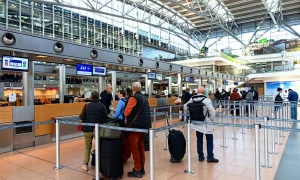
You’ve landed, walked briskly to the gate, and found the doors already closed. Your connecting flight has gone without you, and the departure board isn’t offering any obvious next step. What you do in the next ten minutes matters more than almost anything else about the rest of your day.
A missed connecting flight UK airport situation is genuinely stressful, but it’s also more manageable than it feels in the moment. This guide walks through exactly what to do first, and how your booking structure changes your options. It also covers what to do if your replacement flight ends up leaving from a completely different airport.
Working through a missed connecting flight UK airport situation calmly, in the right order, makes a genuine difference to how the rest of your day actually goes.
What should you do in the first ten minutes?
Panic wastes time you don’t have. A clear sequence doesn’t.
Head straight to the transfer or airline desk
Don’t join the general check-in queue. Airlines have a dedicated transfer or rebooking desk specifically for passengers in your situation, and getting there quickly matters more than almost anything else you can do.
If you can’t find the desk immediately, ask airport staff
Airport information points and gate staff generally know exactly where each airline’s transfer desk sits, even if it isn’t obviously signposted from where you’re standing. Asking early saves genuine time compared with wandering to find it yourself. This matters particularly at a larger airport where transfer desks aren’t always near where you actually land.
Have your booking reference and boarding passes ready
Keep your original boarding passes, e-tickets and booking confirmation accessible on your phone or printed. Staff can move faster when they’re not waiting for you to find these.
Check your airline’s app before you even reach the desk
Many airlines automatically detect a missed connection and start rebooking you, sometimes before you’ve reached the desk. Check the app first so you know what’s already been offered.
Note the actual reason given for the disruption
Ask for the cause in writing, or get it confirmed by email or message, according to CAA guidance. This matters considerably more later than it feels like it should right now.
Keep receipts for anything you pay for yourself
Meals, ground transport or a hotel the airline didn’t arrange become relevant later. Keep every receipt, even ones that feel too small to matter.
Resist booking an expensive replacement flight immediately
Check what the airline is actually offering first. A rushed, self-booked replacement flight can be considerably more expensive than the airline’s own rebooking option, and it can also complicate your position on compensation later.
Stay calm and clear at the desk, even under pressure
Staff can move through your options faster when you explain your situation clearly and concisely, rather than arriving stressed and unclear about what actually happened. A minute spent gathering your thoughts before you speak often saves considerably more time than it costs.
Check whether your onward journey needs a terminal change
If your replacement flight leaves from a different terminal, confirm this early rather than discovering it while already rushing.
Ask specifically about your checked baggage
If you checked luggage on the original flight, ask directly whether it’s already been transferred to your new flight or whether you need to collect and recheck it yourself. This varies by airline and situation, and assuming the wrong answer here causes genuine problems later, particularly if you end up at the wrong baggage carousel entirely.
If you already know your flight has been rebooked, check your onward transport options early. Don’t leave this until you’re actually at the new departure gate.
Does it matter whether your flights were on one booking or two?
This is genuinely one of the most important things to understand, and it changes everything that follows.
One booking, one itinerary
If you bought every leg of your journey on a single ticket or itinerary, the airline covers the whole journey as one booking. If an earlier flight runs late and causes you to miss the next leg, UK261 still protects your rights, according to CAA guidance.
The airline takes responsibility here
When your flights sit together as a connecting itinerary, the airline generally takes responsibility for getting you to your final destination, including rebooking you onto another flight if needed.
Separate tickets are a different situation entirely
If you booked two completely independent flights yourself, rather than a single connecting itinerary, the CAA treats these as separate contracts. If the first flight delays you and you miss the second, you generally don’t have the same legal protections you’d have with a single booking.
Codeshare flights are still covered
If your journey involves a codeshare, where one airline sells a seat on a flight another airline actually operates, this still counts as a single booking for rights purposes. This applies provided you booked the whole journey together.
Self-transfer needs particular care
A self-transfer means collecting your baggage after the first flight, checking in again for the second, and passing through security again yourself. This counts as your own responsibility, not the airline’s, according to CAA guidance.
Why self-transfers carry more genuine risk
If your first flight is delayed and you arranged the second leg entirely separately, you’re generally on your own for rebooking and any associated costs. This is exactly why a self-transfer needs a genuinely generous buffer built in from the start, not a tight connection.
Check which situation actually applies to you
Look at your booking confirmation and work out honestly which category you’re in before assuming the airline owes you a rebooking. This single check shapes everything else you do next.
Travel agent and package bookings sit differently again
If a travel agent or tour operator booked your flights as part of a package, your protections may come through the package holiday contract rather than UK261 directly. Sometimes both apply together. Check your booking confirmation or contact the agent directly if you’re unsure which applies.
What happens if the delay wasn’t the airline’s fault?
The cause of the disruption genuinely changes your position, even within a single protected booking.
Airline-caused delays
A technical fault, crew scheduling issue, or an airline’s own operational problem generally sits squarely within its responsibility, and your rights under UK261 apply in full.
Weather and air traffic control disruption
Extraordinary circumstances, including severe weather or air traffic control restrictions, can affect compensation eligibility specifically, even though the airline’s general duty of care during the delay itself still applies.
What counts as extraordinary is often genuinely disputed
Airlines and passengers don’t always agree on what qualifies as a genuine extraordinary circumstance versus an operational problem the airline should have managed better. If your claim is rejected on these grounds, this doesn’t automatically mean the airline is correct, and it’s worth checking the reasoning given rather than simply accepting it.
Airport congestion or long security queues
If you personally arrived at the gate late because of a long security queue rather than a delayed inbound flight, this sits differently again. Airlines generally treat this as outside their own responsibility.
The cause matters more for compensation than for care
Regardless of cause, airlines must generally still provide food, drink and, where necessary, overnight accommodation during a genuine delay. Compensation specifically is where the cause of the disruption starts to matter considerably more.
Don’t assume the worst before checking
Ask the airline directly what caused your specific disruption and get this in writing where possible. This single piece of information affects your actual position more than any general rule can tell you in advance.
The care you’re owed doesn’t disappear just because the cause is unclear
Even where compensation itself remains uncertain, most airlines still owe you basic care during a genuine delay, food, drink, and access to communication, according to CAA guidance. Don’t let uncertainty about compensation stop you asking for this in the meantime. If your disruption genuinely means an overnight stay, ask specifically about hotel accommodation too. This is often owed separately from any compensation question entirely.
Can you actually get compensation?
Be realistic about this rather than assuming an automatic payout.
The general principle
Under UK261, compensation may apply if the disruption was within the airline’s control. This applies specifically when you arrive at your final destination more than three hours late as a result, according to CAA guidance.
This isn’t guaranteed in every situation
Extraordinary circumstances, separate-ticket bookings, and self-transfers all change this picture. Compensation is genuinely possible in many missed-connection situations, but it isn’t automatic simply because you missed a flight.
Booking structure matters as much as the delay itself
A protected, single-booking itinerary gives you a considerably stronger position than two separately booked flights, regardless of how long the actual delay genuinely was. This is exactly why checking your booking structure honestly matters more than the specific length of the delay itself.
Start with the airline itself before anything else
Writing to the airline directly is generally the quickest, free route to a straightforward claim, and it doesn’t require a lawyer or a claims company to begin. Third-party claims services can help with a more complicated dispute, but they usually take a percentage of any payout in return, which is worth weighing against handling the claim yourself first.
This deserves its own proper explanation
Rather than repeating the full detail here, our flight delays and passenger rights guide covers exactly what you may be entitled to, the current compensation bands, and how to actually make a claim.
What to do practically in the meantime
Keep every piece of evidence: boarding passes, booking confirmations, written confirmation of the cause, and receipts for anything you paid for yourself. None of this costs you anything to collect, and it matters considerably if you do end up making a claim.
A photo of the departure board takes seconds and helps later
A quick photo showing the delay or cancellation as it was displayed, along with the time, gives you genuine evidence that’s easy to forget to collect once you’re focused on rebooking. It costs nothing and takes seconds, and it’s genuinely one of the easiest pieces of evidence to gather in the moment.
There’s no need to rush a claim on the day itself
You generally have several years to make a UK261 claim, so there’s no pressure to sort compensation while you’re still dealing with the actual disruption. Focus on getting to your destination first, and deal with any claim properly once you’re home.
What does this look like at Heathrow, Birmingham, Gatwick and Manchester?
The practical experience genuinely differs by airport.
Heathrow
Heathrow’s terminal structure means a missed connection can also mean a terminal change for your replacement flight. Confirm this specifically at the transfer desk, since walking or transferring between Heathrow’s terminals takes genuine time that’s easy to underestimate when you’re already stressed.
Heathrow’s own guidance is worth checking directly
Minimum connection times vary by terminal and by whether your connection is domestic, short-haul or long-haul. Check Heathrow’s own current guidance for your specific route rather than assuming a single figure applies.
Birmingham Airport
Birmingham is a smaller, single-terminal airport, which genuinely simplifies things if your onward journey changes here. If your replacement flight departs from a different UK airport entirely, you’ll need to plan that ground journey separately. Birmingham’s own connections don’t stretch as far as the larger hubs.
This simplicity works in your favour here
With only one terminal to navigate, you won’t face the terminal-change confusion that’s common at Heathrow or Gatwick. If your replacement flight still departs from Birmingham itself, this is genuinely one of the more straightforward airports to manage a disrupted day from.
Gatwick
Gatwick’s North and South Terminals are physically separate, connected by a shuttle. If your replacement flight moves you between terminals, build in genuine time for this transfer, particularly with luggage.
The Gatwick shuttle runs frequently but still adds time
The inter-terminal shuttle at Gatwick typically runs every few minutes. Walking to and from the platform at each end, plus the journey itself, genuinely adds more time than a quick glance at the map suggests.
Manchester
Manchester’s Terminal 2 and Terminal 3 differ meaningfully in facilities. If you’re facing a genuine wait for a replacement flight, this is worth knowing in advance. One terminal offers considerably more in the way of shops and places to sit comfortably than the other. Check which terminal you’re actually in before settling in for a long wait.
The common thread across all four
Wherever you are, confirm your new terminal specifically, not just your new flight number. Assuming your replacement flight leaves from the same terminal as your original one is a genuinely common and avoidable mistake.
What if your replacement flight leaves from a different airport?
This is where the situation moves beyond the terminal and into planning an actual ground journey.
This happens more often than people expect
A cancelled or heavily disrupted route can mean the next available seat is on a flight from a different UK airport entirely. Heathrow to Gatwick, Birmingham to Heathrow, or Manchester to Birmingham are all genuine possibilities.
Airlines generally try to keep you on their own network first
An airline will usually try to rebook you on its own flights before considering a partner airline or a different airport, since this is simpler for them administratively. This is worth knowing if you’re wondering why a seemingly obvious alternative wasn’t offered first.
Confirm the new airport and terminal immediately
Get this in writing from the airline before you leave the current airport, including the exact terminal, so you’re not working from an assumption once you’re already travelling.
Check whether you have a new booking reference
A rebooked flight sometimes comes with a new booking reference separate from your original one. Confirm this clearly and save it somewhere accessible, since you may need to quote it at check-in or security for the replacement flight.
Work out your realistic journey time honestly
Road and rail journey times between UK airports vary considerably depending on the specific route and time of day. Check current, realistic estimates for your specific journey rather than assuming a rough figure will hold.
Build in a genuine buffer at the other end too
Arriving at the new airport isn’t the finish line. You still need to check in, potentially recheck baggage, and clear security again before your replacement flight. Don’t plan your ground journey so tightly that any of this becomes a second scramble.
Late-night replacement flights change the calculation
If your new flight departs late in the evening or very early the following morning, public transport options may be limited or unavailable entirely, which genuinely narrows your realistic choices.
Luggage complicates an already stressful journey
If you’re travelling with checked luggage that’s now travelling separately, or extra bags picked up during the disruption, factor this into whichever transport option you choose.
Families and larger groups need particular care here
Coordinating multiple people, luggage and a tight new departure time is genuinely harder without a plan. A single, larger vehicle removes several separate decisions at once for a group in this situation.
Keep everyone together rather than splitting up to save time
Splitting a group across different transport options in the name of speed often creates more coordination problems than it solves, particularly if plans change again along the way. Travelling together, even if it takes slightly longer, generally keeps the situation simpler.
Train, taxi or chauffeur: which one actually makes sense?
Be honest about your specific situation rather than assuming one option automatically wins.
Train or coach
Can genuinely be the sensible choice if you’ve got a reasonable amount of time, are travelling light, and your route has a direct, reliable connection between the two airports.
Taxi
Works for a straightforward journey with light luggage. Availability and price can vary considerably though, particularly late at night or during a period when many other disrupted passengers are searching for the same thing.
A private chauffeur
Removes several genuine sources of uncertainty at once: a confirmed pickup time, a direct route, and no need to search for transport availability while already stressed and short on time.
Being honest about when public transport is the better choice
If you’ve got a reasonable time buffer, light luggage, and a direct train route, there’s little reason to pay more for a chauffeur simply because your day has already gone wrong. Match the option to your actual circumstances, not to how stressful the day has felt so far.
Compare an actual quote before deciding
Rather than assuming a chauffeur costs more than it does, or a train costs less once you factor in a taxi at either end, get a genuine comparison for your specific journey. The real numbers sometimes tell a different story than the general assumption does.
When a chauffeur genuinely earns its place
A tight connection window, heavy luggage, a family or group, or a late-night departure with limited public transport are all genuine reasons to book a direct transfer. So is simply not wanting to manage one more decision on an already difficult day.
If you’ve had to change airports or flights unexpectedly, check your transfer options early. Don’t leave this until you’re already at the new departure gate with less time than you’d like.
What should you tell your transfer company, and where does National Executive Transfers fit?
Complete, accurate information matters more than usual when you’re already dealing with a disrupted day.
The essentials to confirm
Your current airport, the new airport if different, terminal, new flight number, new departure time, passenger count, and luggage amount all form the baseline for a booking made under these circumstances.
Anything specific worth mentioning
Whether children are travelling, whether the journey is genuinely urgent, and your exact pickup location within the terminal all help a driver plan properly rather than working from assumptions.
A direct contact number matters more than usual
Give a number you’ll actually answer. A driver may need to reach you quickly if your situation changes again, which is genuinely more likely on a day that’s already been disrupted once.
Get the booking confirmed in writing
Ask for written confirmation of the pickup time, vehicle type and driver contact number. On a day when plans have already changed once, having something concrete to check against matters considerably more than usual.
Things to consider before booking
- Have you confirmed your new flight number, terminal and departure time with the airline directly?
- Do you know honestly whether your booking structure protects you, or whether you arranged a self-transfer?
- Have you kept your boarding passes, receipts and written confirmation of the cause?
- Have you checked realistic journey times if your replacement flight leaves from a different airport?
- Does your transfer provider genuinely monitor flights, so a further delay doesn’t strand your booking?
- Have you given your transfer company a direct number you’ll actually answer?
Where National Executive Transfers fits into this
National Executive Transfers is a Birmingham-based chauffeur service running Mercedes E-Class, S-Class and V-Class vehicles, with professional drivers, across airport transfers and airport-to-airport journeys throughout the UK. NET tracks flights automatically, and every arrival includes meet and greet as standard.
Being straightforward about what this does and doesn’t solve
A chauffeur can’t rebook your flight or secure your compensation. What a pre-booked transfer genuinely removes is the uncertainty of the ground journey itself, particularly useful exactly when your plans have already changed once and you don’t want them changing again.
Availability for last-minute bookings genuinely varies
A transfer booked with several hours’ notice generally has more vehicle choice than one arranged at the last possible minute. If you know fairly early that your journey has changed, booking sooner rather than later gives you a better chance of the right vehicle for your group.
For further reading
Our flight delays and passenger rights guide, linked earlier in this article, covers UK261 compensation in full depth. The Heathrow arrival guide covers that airport’s own connection timing, the airport transfer checklist covers general booking preparation, and our airport transfers page covers what to expect from the road journey itself.
Missing a connection is genuinely stressful, but it doesn’t have to mean the rest of your day is unplanned too. Once you’ve confirmed your new flight, get in touch with National Executive Transfers to arrange the ground journey properly, whichever UK airport you end up flying from.
Frequently Asked Questions
Head straight to the airline's transfer or rebooking desk rather than the general check-in queue, and check your airline's app, which sometimes rebooks you automatically before you even arrive.
If both flights were booked together as a single itinerary, the airline is generally responsible for rebooking you. If you arranged a self-transfer with separate tickets, this generally isn't guaranteed.
If your flights were on one booking, your rights under UK261 remain protected even though the delay affected an earlier leg, according to CAA guidance.
Potentially, if the disruption was within the airline's control and you arrive at your final destination more than three hours late. Our flight delays and rights guide covers current compensation bands in full.
The CAA treats separately booked flights as separate contracts, so you generally don't have the same legal protections you'd have with a single connecting itinerary.
Yes, by train, taxi or a private chauffeur. Check realistic current journey times for your specific route, since this varies by time of day.
This varies by airport, terminal and whether your connection is domestic, short-haul or long-haul. Check your specific airport's current minimum connection time guidance rather than assuming a single figure.
Yes, this is exactly the kind of journey a pre-booked, flight-monitored transfer suits well, particularly with luggage, a group, or a tight new departure time.
Your new airport and terminal, new flight number and departure time, passenger count, luggage, and a direct contact number you'll genuinely answer.