Most people learn the hand luggage rules the hard way. A full-size shampoo bottle gets pulled out of the tray. A pair of nail scissors goes in the bin. Someone’s other half is still talking about the Swiss Army knife they lost at Stansted in 2019.
The frustrating part is that the rules keep moving. In 2026, the biggest change in twenty years landed at UK airports: some now let you carry two litres of liquid through security, while others still hold you to the old 100ml limit. Add in the newer confusion around power banks, and it is easy to see why so many passengers get caught out.
This guide covers exactly what you can and can’t take in your hand luggage at UK airports right now, based on the government’s official hand luggage guidance and the current position at each major airport. Liquids, electronics, sharp objects, medicines, sports gear, and the handful of things that are banned everywhere. No jargon, just what you need to know before you pack.
At a Glance
| Item | Allowed? | Watch out for |
|---|---|---|
| Water and drinks | Yes | Limit is 100ml or 2 litres, depending on your airport |
| Toiletries and cosmetics | Yes | Same liquid limit applies |
| Laptop, tablet, phone | Yes | May need to come out of your bag at some airports |
| Power bank | Yes, hand luggage only | Watt-hour limits apply, never allowed in the hold |
| Vape or e-cigarette | Yes, hand luggage only | Never allowed in the hold |
| Essential medicines | Yes | Proof needed if the liquid container is over 100ml |
| Baby food and milk | Yes | No fixed limit, but check with your airport |
| Breast milk | Yes | Containers up to 2,000ml each |
| Small scissors (blade under 6cm) | Yes | Longer blades must go in the hold |
| Knife | No | Any sharp or pointed blade is banned from the cabin |
| One lighter | Limited | Must stay in a resealable bag on your person |
| Corkscrew | No | Allowed in the hold only |
| Golf clubs, bats, walking poles | No | Hold luggage only |
| Pepper spray or mace | No | Banned in hand and hold luggage |
| Fireworks and explosives | No | Banned entirely |
This is a starting point rather than the full picture, so treat the sections below as the detail behind each row.
The Liquids Rule Now Depends on Your Airport
For nearly two decades, the liquids rule was the same everywhere in the UK: 100ml per container, all squeezed into one small clear bag, taken out of your case at the tray. That is no longer true.
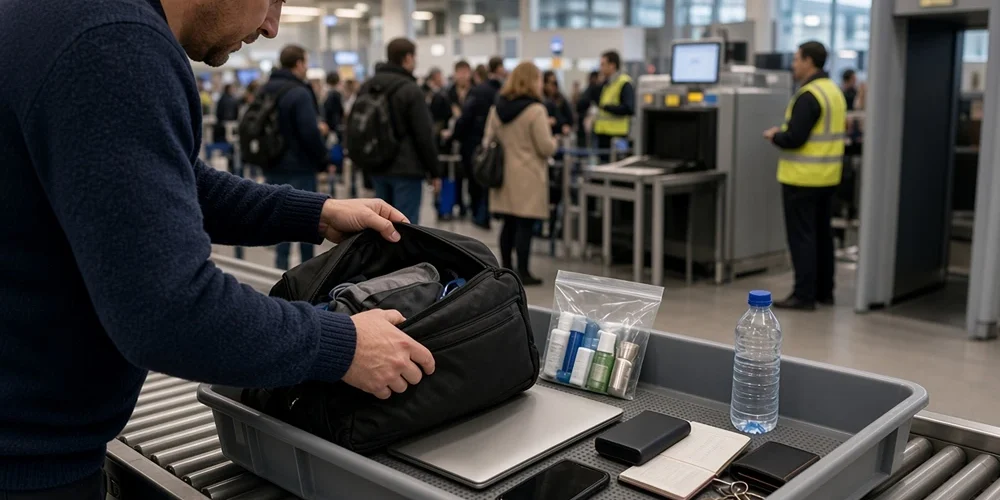
New CT scanners give security staff a detailed 3D view of your bag, which means some airports no longer need you to separate liquids out at all. As things stand, Heathrow (all four terminals), Gatwick, Birmingham, and Edinburgh let you carry liquid containers up to two litres, kept in your normal hand luggage, with no clear bag required.
Manchester, Stansted, Luton, East Midlands, Liverpool, Newcastle, Bristol, and Glasgow are still working under the traditional 100ml rule. Each container has to be 100ml or under, packed into a single clear resealable bag no bigger than 20cm x 20cm.
Here’s the detail that catches people out most: the rule that applies is whichever airport you’re departing from at that moment, not your home airport or your airline. Fly out from Birmingham under the two-litre system and come home through Manchester, and the 100ml rule applies on the way back. If you’re unsure which side your outbound and return airports fall on, our full breakdown of UK liquids rules for 2026 covers every major airport and how to pack for either system.
What Actually Counts as a Liquid
This trips up more people than the limit itself. Under UK airport security rules, anything that pours, sprays, spreads, or smears counts as a liquid, not just drinks and toiletries.
That means the obvious things: water, juice, alcohol, perfume, shampoo. But it also covers items people rarely think about, including toothpaste, lip balm, mascara, peanut butter, jam, honey, soup, hummus, and yoghurt. Aerosols count too, so deodorant and hairspray need to follow the same rule, even though you can’t actually use them once you’re on the plane.
Exceptions That Apply at Every UK Airport
A few categories are treated differently no matter which system your departure airport uses.
Essential medicines above the standard liquid limit are allowed, but you’ll need proof if the container holds more than 100ml, such as a prescription copy or a letter from your GP. Tablets and liquid medicines in containers of 100ml or under don’t need any paperwork at all.
Baby food, baby milk, and sterilised water can be carried in reasonable quantities for the journey, with the baby travelling with you. There’s no fixed legal limit on this one, though it’s worth mentioning it to staff at the tray so they know what they’re looking at.
Breast milk gets its own allowance. You can carry it in containers of up to 2,000ml each, and you don’t need to be travelling with a baby to bring it. Frozen breast milk isn’t allowed in hand luggage, so if you’re bringing a supply home, it needs to go in the hold.
Anything bought after security, including duty-free bottles, can go on board even above the usual limit, as long as it’s sealed in the tamper-evident bag with your receipt inside. Just be aware that if you’re connecting through a second airport, that bag needs to stay sealed, or it may be confiscated at the next screening point.
Electronics: Laptops, Phones, and What Actually Needs Removing
Phones, laptops, tablets, MP3 players, hairdryers, straighteners, travel irons, and electric shavers are all fine in both hand luggage and the hold. E-cigarettes are the one exception on this list. They’re allowed in hand luggage only, never in checked bags.
One rule that catches travellers off guard: your electronic devices need to be charged enough to switch on if a security officer asks. A phone or laptop that won’t power up can be refused at the gate, so it’s worth topping everything up the night before rather than relying on a low battery getting you through.
Whether you need to take laptops out of your bag at the tray still depends on the airport. At Heathrow, Gatwick, Birmingham, and Edinburgh, the new scanners mean laptops and tablets can usually stay inside your bag. Older lanes elsewhere still ask you to pull them out separately, the same way the liquids rule splits by location.
Power Banks and Spare Batteries: The Rule Most People Get Wrong
Power banks count as spare lithium batteries under UK airport security rules, which means they must always travel in your hand luggage, never in the hold. The reason is simple. If a lithium battery overheats in the cabin, crew can deal with it. In the hold, nobody would know until it was too late.
The watt-hour rating is what matters, and it’s usually printed on the device itself:
- Up to 100Wh: allowed without needing airline approval. This covers the vast majority of consumer power banks, roughly up to 27,000mAh.
- Between 100Wh and 160Wh: allowed, but only with approval from your airline in advance.
- Above 160Wh: banned from passenger aircraft entirely.
If your power bank only lists mAh, you can work out the watt-hours yourself. Divide the mAh figure by 1,000, then multiply by the voltage, usually 3.7V for standard lithium-ion cells. A 20,000mAh power bank comes out at roughly 74Wh, well inside the limit.
Since 27 March 2026, new international rules also apply. You’re limited to two power banks per passenger, you can’t recharge a power bank from the aircraft’s power supply during the flight, and airlines are increasingly asking passengers to keep power banks somewhere within reach rather than in the overhead locker, so they can be dealt with quickly if there’s ever a problem.
E-Cigarettes and Vapes
The same logic applies to vapes and e-cigarettes, because of the battery inside them. They’re allowed in hand luggage only, and never in the hold, at every UK airport. If one ends up packed into a checked bag by mistake, it’s worth pulling it out before you check in rather than hoping it goes unnoticed, since airlines tend to enforce this one properly rather than waving it through. Keep the device switched off during the flight itself, and check your airline’s own policy on using it on board, since a few carriers have added their own restrictions on top of the standard rule.
Sharp Objects and Small Items That Trip People Up
This is where most confiscations happen, usually over items people didn’t think twice about packing.
Knives with a blade or point longer than 6cm cannot go in hand luggage, though they may be allowed in the hold depending on your airline. Scissors follow the same logic. Small scissors with blades under 6cm are fine to carry on, but anything longer needs to go in checked baggage. Round-ended or blunt scissors are always allowed, regardless of length.
Disposable razors with a fixed cartridge blade, nail clippers, nail files, tweezers, knitting needles, and sewing needles are all fine in hand luggage. Corkscrews are the odd one out on this list. Most people assume they’re harmless, but corkscrews aren’t allowed in hand luggage at all, only in the hold.
Everyday items like umbrellas, walking sticks, and mobility aids are permitted, though pushchairs and wheelchairs will be screened separately before you board.
Lighters have their own peculiar rule. You’re allowed exactly one per person, and it has to go inside a resealable plastic bag, the same kind used for liquids, which you keep on you for the entire flight. A lighter can’t be packed in the hold, and once you’re through screening, you can’t put it back inside your hand luggage bag either. It has to stay on your person.
Safety matches are fine to carry. The strike-anywhere, non-safety kind aren’t allowed at all. Fireworks, flares, party poppers, and toy caps are banned outright, no matter how small or novelty they seem.
Work Tools Have to Go in the Hold
If you’re flying out for a trade job, it’s worth knowing that almost every hand tool is banned from hand luggage, even small ones. Screwdrivers, hammers, pliers, wrenches, drills and drill bits, saws (including portable power saws), Stanley knives, bolt and nail guns, crowbars, and blowtorches all need to go in the hold. Anything with a blade or shaft over 6cm, such as a chisel, follows the same rule. None of this is negotiable at the tray, so it’s far easier to pack tools into checked luggage from the start.
Sports Equipment: What Flies in the Cabin and What Doesn’t
Sports gear is a genuine mixed bag, and the distinctions aren’t always obvious.
Not allowed in hand luggage: golf clubs, heavy bats and sticks (baseball, cricket, and softball bats included), darts, walking and hiking poles, catapults, crossbows, harpoons, and spear guns. Martial arts equipment such as nunchuks, knuckledusters, and coshes falls into the same category. All of these are fine in the hold instead.
Allowed in hand luggage: tennis racquets, snooker, pool, and billiard cues, fishing rods, and sports parachutes. None of these are treated as a security risk, so there’s no need to check them in specially.
Diving equipment and firearms, including replica firearms, sit in a grey area and should be checked directly with your airline before you travel, since policies vary. If you’re flying with clubs specifically, our guide to flying with golf clubs from UK airports covers packing, costs, and which airlines handle them best.
Medicines and Medical Equipment
Tablets and capsules are never an issue, in hand luggage or the hold. Liquid medicines are allowed above the standard 100ml limit too, but if the container holds more than 100ml, you’ll need proof that it’s prescribed to you, such as a copy of the prescription or a letter from your doctor. No proof is needed if the medicine is in tablet form, or if the liquid container is 100ml or smaller.
Hypodermic syringes, inhalers, CPAP and TENS machines, and cooling gel packs are all permitted in hand luggage. Ice packs need a quick check with the airport first, and oxygen cylinders need approval from your airline directly, since these vary more than most other categories. If your medication contains a controlled drug, the rules are different again, so it’s worth checking gov.uk’s guidance on travelling with controlled drugs before you fly rather than assuming the standard medicine rules apply.
Travelling With a Baby
Parents get a reasonable amount of flexibility here. Baby food, baby milk, and sterilised water can be carried in the quantities needed for the journey, with no fixed legal limit, as long as the baby is travelling with you. It’s still sensible to check with your specific airport ahead of the trip, since some ask you to declare it at the tray.
Breast milk is treated separately from other baby items. You can carry it in containers of up to 2,000ml each, and unlike baby food, you don’t need to be travelling with a baby to bring it home from a trip. The one restriction is that it can’t be frozen if it’s going in hand luggage. Formula milk, cow’s milk, and soya milk for babies are all fine too, provided the baby is present, and cooling or ice packs used to keep any of this cold are permitted as well.
Musical Instruments, Pushchairs, and Mobility Aids
A few personal items don’t sit neatly in any of the categories above, but they come up often enough to be worth a mention.
Musical instruments are allowed in the cabin, though they get screened separately from the rest of your luggage, so it’s worth building in a little extra time at the tray. If you’re travelling with something larger than a guitar, contact your airline before you book, since you may need to buy an extra seat to give it proper room.
Pushchairs, walking aids, and wheelchairs are usually fine to bring right up to the gate, and they’ll be screened before you board. If your mobility aid runs on a battery, check with your airline ahead of time, since the battery’s type and size can affect how it needs to travel.
If you’ll need any kind of assistance getting through the airport, whether that’s help at security, priority boarding, or support moving between terminals, it’s worth booking this with your airline in advance rather than asking on the day. Most airlines want at least 48 hours’ notice, and some ask for more, so an early call saves a lot of standing around later.
What’s Banned Outright, No Matter What
A short list of items simply cannot fly, whether in hand luggage or the hold, and no airline discretion changes this.
Chemicals and toxic substances are banned completely. This includes bleach and other oxidisers, corrosive substances like mercury and chlorine, acids and alkalis (including spillable wet-cell batteries), self-defence sprays such as pepper spray or mace, radioactive materials, poisons, biological hazards, anything that could spontaneously combust, and fire extinguishers.
Weapons and explosives are banned just as firmly. Guns and firearms, including air rifles, starting pistols, and replica or imitation firearms, cannot go in hand luggage under any circumstances, though genuine firearms may sometimes be allowed in the hold with the airline’s prior approval. Detonators, blasting caps, fuses, grenades, military ordnance, fireworks, smoke canisters and cartridges, dynamite, gunpowder, plastic explosives, flares, and novelty gun-shaped lighters are all banned entirely, in hand luggage and the hold alike.
If in doubt about anything not covered here, it’s always worth checking gov.uk’s hand luggage restrictions guidance directly, since it’s updated as the rules change.
What Happens If You’re Stopped or Hand-Searched
Getting pulled aside for a closer look doesn’t mean you’ve done anything wrong. Bags get flagged for all kinds of ordinary reasons: an oddly packed item, food that doesn’t scan clearly, a bottle that needs a second glance. It happens to plenty of people who haven’t broken a single rule.
If your bag is selected, a security officer will usually ask you to open it so they can check the contents by hand. That might mean opening a container to test a liquid, or a quick question about something specific inside. It normally adds a few minutes rather than holding up your whole journey, and staying calm and answering directly is the fastest way through it.
You might also be asked to step through the scanner again, or to remove your belt, shoes, or jacket separately. None of this means anything is wrong. Scanner images can make perfectly ordinary objects look ambiguous from certain angles, and staff are trained to check anything unclear rather than guess. Cooperating and letting them do their job is really the whole trick to getting through quickly.
Common Mistakes That Slow People Down at Security
A handful of small, avoidable errors cause most of the delays at the tray.
- A drink or water bottle left in a coat pocket or side pouch, forgotten because it wasn’t packed with the rest of your liquids
- The one lighter you’re allowed, packed in hand luggage or the hold instead of staying on your person
- Dense or unusual food, like a block of cheese or a jar of thick sauce, that doesn’t scan cleanly and triggers a manual check
- Liquid medicine over 100ml carried without the prescription or GP letter to back it up
- Assuming the rule at your home airport applies at your connecting or return airport too
- Gifts wrapped before you travel, since staff may need to unwrap them to see what’s inside
How to Get Through Security Without the Drama
Most delays at the tray have very little to do with the rules themselves. They’re caused by people who packed in a rush and didn’t know what was in their own bag.
Check the current liquid rule for both your departure and return airport before you pack, not just the general headlines, since the rollout is still uneven and can shift with little notice. Keep a small clear bag in your hand luggage anyway, even if your airport has moved to the two-litre system, in case there’s a manual check on the day. Empty metal flasks and vacuum-insulated bottles before you reach the scanner, since the insulation blocks the machine from seeing what’s inside, and refill once you’re through. Keep power banks and any liquid medicines somewhere easy to reach rather than buried at the bottom of your bag.
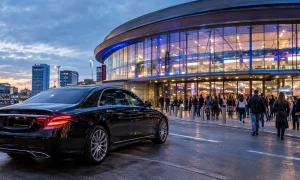
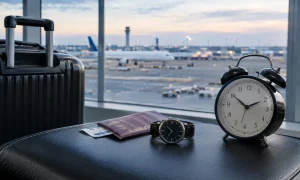
The other big factor is timing, and this is where a lot of avoidable stress happens. A tight journey to the airport eats into the buffer most people leave for security, and rushing is what actually causes people to forget things or pack badly in the first place. A pre-booked chauffeur transfer to Birmingham Airport or a fixed-time pickup for a Heathrow departure removes that variable entirely, since your driver builds real traffic conditions into your pickup time rather than leaving it to guesswork.
Final Thoughts
The rules aren’t as complicated as they first look once you know which category something falls into. Most of what people lose at security comes down to a handful of repeat offenders: oversized liquids, forgotten scissors, a power bank that should have stayed in a pocket rather than a checked bag.
If you’re flying out of the Midlands, National Executive Transfers gets passengers to Birmingham Airport, Heathrow, Manchester, and beyond, with proper time built in to deal with whichever security system your airport is running. The Mercedes E-Class suits solo and business travellers, while the Mercedes V-Class gives families and groups the room they need for luggage and everyone travelling together. You can book online through the NET booking page for an instant fixed price, or call the team directly to talk through your journey.
Related reading:
- UK Liquids Rules: Everything You Need to Know Before Flying from UK Airports
- How to Clear Birmingham Airport Security Quickly: Proven Tips for Faster Passage
- Flying with Golf Clubs from UK Airports: Rules, Costs & Best Airlines
- Airport Transfer Checklist: Your Guide to Smooth Arrivals & Departures
Frequently Asked Questions
It depends on your departure airport. Heathrow, Gatwick, Birmingham, and Edinburgh allow containers up to two litres with no separate bag needed. Manchester, Stansted, Luton, East Midlands, Liverpool, Newcastle, Bristol, and Glasgow still enforce the 100ml limit in a clear resealable bag.
Yes, and it must go in hand luggage, never in the hold. Power banks up to 100Wh are allowed without airline approval, those between 100Wh and 160Wh need approval in advance, and anything above 160Wh is banned from passenger aircraft.
Small scissors with blades under 6cm, disposable razors, nail clippers, tweezers, and sewing needles are all fine. Knives and scissors with a blade over 6cm, along with corkscrews, aren't allowed in hand luggage at all.
It depends on the airport. Heathrow, Gatwick, Birmingham, and Edinburgh have scanners that let laptops stay inside your bag. Other airports still ask for electronics to be removed and placed in a tray separately.
Yes. Tablets and liquid medicines in containers of 100ml or under don't need proof. Liquid medicines in larger containers are allowed too, but you'll need a prescription copy or a letter from your doctor to carry them.
Chemicals and toxic substances like bleach, corrosives, and self-defence sprays, along with weapons and explosives such as firearms, fireworks, and detonators, are banned in both hand luggage and the hold at every UK airport.
Yes, but only in hand luggage, never in the hold, because of the battery inside it. Keep it switched off during the flight and check your airline's own policy on using it on board.
It usually means something needed a closer look, not that you've done anything wrong. Staff will open the bag, check the contents by hand, and may ask a quick question. It normally adds a few minutes rather than causing a real delay.