Getting to the gate on time, with a valid boarding pass, only to hear there is no seat for you, is genuinely frustrating. Airlines often sell more tickets than they have seats, a practice called overbooking, and that usually causes this.
What happens if you’re denied boarding depends on a few specific factors, and getting them right matters more than it sounds. Handle them correctly, and UK law says you could claim anywhere from £110 to £520. Get them wrong, and you risk walking away with nothing, or with far less than you actually deserve.
This guide sorts out the real rules, the real figures, and exactly what to do at the gate and afterwards, using plain language rather than legal jargon.
What Happens If You’re Denied Boarding
Denied boarding, which people often call getting bumped, happens when an airline refuses to let you board a flight you already booked. This happens even though you arrived on time with the right documents. It works under its own set of rules, separate from a flight delay or a cancellation.
Two things make it easy to spot. First, the plane actually takes off, on time or close to it. Second, you personally lose your seat. This is not because you did anything wrong, but because the airline could not fit everyone who held a ticket.
Why Airlines Deny Boarding
Overbooking happens across the whole airline industry, not just occasionally with one carrier. Airlines know from experience that a certain number of passengers on any flight simply will not show up. Someone might miss a connection, change their plans, or simply forget. To avoid flying with empty seats, they sell more tickets than the plane holds.
Most of the time this works out fine. Sometimes, though, more passengers turn up than expected. The airline then ends up with more people than seats. A last minute switch to a smaller aircraft can cause the exact same problem, even when the airline never deliberately overbooked at all.
How Denied Boarding Actually Unfolds
Here is what typically happens at the gate, step by step.
The airline asks for volunteers first
Staff realise before boarding that they have more checked in passengers than seats. They usually announce this at the gate and ask for volunteers. Compensation, vouchers, or a later flight often come with the offer, in exchange for giving up a seat willingly. If enough passengers agree, the airline does not need to bump anyone against their wishes.
If not enough people volunteer
The airline then has to choose passengers to remove involuntarily. Airlines set their own criteria for this. Check in time, fare type, or frequent flyer status might all play a part. Law does not set these criteria, the airline does.
Once staff tell you that you will not be boarding, your original booking on that flight ends there and then. From this point, the airline owes you a genuine choice. Fly to your destination as soon as possible, or fly at a later date that suits you better instead. While you wait for either option, the airline must give you reasonable food and drink, along with a way to communicate. If your rerouted flight leaves the next day, that also means accommodation plus transport to and from it.
Once you finally reach your destination, whether that happens the same day or later, that is when you should look at claiming compensation, provided the airline bumped you involuntarily.
Voluntary or Involuntary, Why This Changes Everything
This single distinction matters more than almost anything else in this guide, since it decides what you can actually claim.
If you volunteer to give up your seat
If you put your hand up when staff ask for volunteers, you and the airline privately agree whatever compensation follows. It might be cash, vouchers, or a mix of both. The amount is whatever you negotiate or accept, not a fixed legal figure.
Volunteering does not take away your other rights, though. You still get either a replacement flight or a refund. This applies exactly as if the airline had bumped you against your wishes.
If the airline bumps you without your consent
Sometimes nobody volunteers, or not enough people step forward. If staff refuse you boarding anyway, this counts as involuntary denied boarding. Provided you checked in on time, this is where the fixed statutory compensation below applies.
Checking in on time is a genuine condition here, not a small technicality. Say you checked in late and then lost your seat as a result. The rules treat this completely differently from bumping someone through no fault of their own.
What You Need to Have Done Right
Before you assume you can claim compensation, a few basic conditions need to line up. You need a confirmed booking on the flight, and you need to have arrived and checked in on time, following the airline’s stated deadline. The correct travel documents for your journey matter too, and so does meeting any other reasonable requirement the airline set.
Denied boarding compensation covers situations where the airline is at fault, typically overbooking. It does not cover every scenario where someone simply does not end up travelling.
How Much Compensation Can You Get
UK261, the UK’s own version of the EU’s air passenger rights rules, sets your compensation. It works on a flat rate. Two things decide the figure together: how far you were flying, and how late your replacement flight actually landed.
| Flight Length | Delay to Final Destination | Compensation |
|---|---|---|
| Short haul, under 1,500km (e.g. Glasgow to Amsterdam) | 2 hours or more later | £220 |
| Short haul, under 1,500km | Less than 2 hours later | £110 |
| Medium haul, 1,500km to 3,500km (e.g. East Midlands to Marrakesh) | 3 hours or more later | £350 |
| Medium haul, 1,500km to 3,500km | Less than 3 hours later | £175 |
| Long haul, over 3,500km (e.g. London to New York) | 4 hours or more later | £520 |
| Long haul, over 3,500km | Less than 4 hours later | £260 |
A few things are worth understanding about this table. What you paid for your ticket makes no difference at all. Whether you flew on a basic economy fare or a business class seat, the same distance and delay earn you the same compensation. Only your original flight’s distance and how much later you actually arrived decide your final payout.
Does UK261 Actually Cover Your Flight?
Not every flight qualifies, so check this before you assume anything. UK law covers you if your flight departs from a UK airport. This applies on any airline at all, whatever country that airline calls home. It also covers you when your flight arrives at a UK airport, provided a UK or EU airline operates it. And it covers you if your flight arrives at an EU airport, provided a UK airline operates it.
Say your journey falls outside all three of these, perhaps a flight arriving in the UK on an airline based outside the UK and EU. UK261 does not apply here. The rules of whichever country you departed from might still help you instead.
When Compensation Does Not Apply
Genuine situations exist where an airline can refuse you boarding without owing statutory compensation. It helps to know the real ones, rather than assume the worst about every situation.
Arrive late at the gate, after the boarding deadline passes, and that falls on you, not the airline. Miss the check in deadline entirely, and the same rule applies. The same goes for incorrect or missing travel documents. An invalid passport, a missing visa, or paperwork your destination requires all give the airline every right to refuse you. Genuine security concerns, or real health and safety reasons, count as legitimate grounds too.
And remember, if you agreed to give up your seat voluntarily, your compensation is whatever you negotiated, not the fixed statutory amount from the table above.
The actual circumstances genuinely matter here. Assuming “the airline denied me boarding, so I automatically qualify for £520” simply is not accurate. Check your own situation honestly against these conditions before you assume any claim will succeed.
Compensation and Assistance Are Two Different Things
People use these two words almost interchangeably, but they mean different things. It helps to keep them separate in your head.
Compensation means a cash payment. The airline owes it specifically when it involuntarily denies you boarding under circumstances it caused itself. This is the fixed amount from the table above, nothing more, nothing less.
Assistance means the practical help the airline must give you while you wait for your replacement travel. It applies far more broadly than compensation does. This covers a reasonable amount of food and drink, usually as vouchers, and a way to communicate such as reimbursed phone calls. If your rerouted flight leaves the next day, it also covers accommodation, plus transport to and from it.
Here is the key point. You can qualify for assistance even in situations where cash compensation does not apply. Do not assume that because compensation rules exclude you, the airline owes you nothing whatsoever.
What to Do at the Airport
If staff tell you there is no seat for you, work through this practical sequence rather than panicking or accepting the first thing you hear.
Stay calm, and ask staff directly why they are refusing your boarding. Ask specifically whether overbooking caused this. Ask whether the airline is currently seeking volunteers, since this changes your compensation. If you do not want to volunteer, say so clearly, and do not let anyone pressure you into it. Ask exactly what alternative flight the airline is offering, and when it departs. Ask about meals and accommodation if you are likely to wait several hours or overnight. Keep your original boarding pass and booking confirmation, since you will need these later. Ask staff to confirm the reason for your denied boarding in writing if they can. Keep receipts for anything reasonable you end up paying for yourself. Before you leave the desk, ask directly how to make a compensation claim, since gate staff can usually point you toward the right process.
Denied Boarding vs Delay vs Cancellation vs Voluntary Bumping
People constantly confuse these four situations, yet different rights apply to each one.
| Situation | What It Means | Compensation Basis |
|---|---|---|
| Denied boarding (involuntary) | The airline refuses you a seat despite your confirmed booking and being on time | Fixed amount by distance, under UK261 |
| Denied boarding (voluntary) | You agree to give up your seat for a deal | Whatever you negotiate with the airline |
| Delay | Your flight departs and arrives, just much later than scheduled | Fixed amount by distance, if the delay reaches 3 or more hours and the airline caused it |
| Cancellation | Your flight never operates at all | Depends on how much notice you got and what caused it |
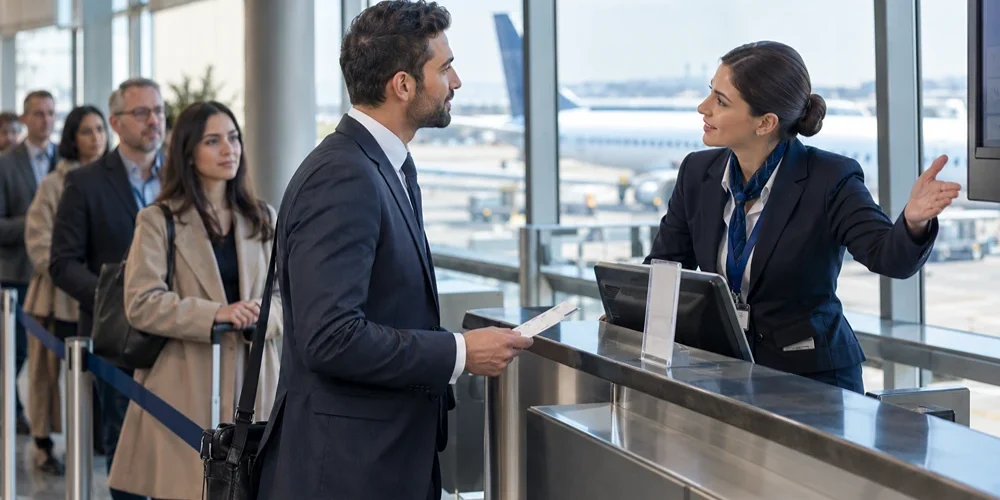
Denied boarding stands apart from the other three. You are physically present, checked in, and ready to fly, yet the airline simply refuses you a seat that was already yours.
Real Examples of Denied Boarding Compensation
A few realistic scenarios help make these numbers feel concrete. Treat them as educational rather than guaranteed outcomes. Your own circumstances decide what you can actually claim.
A short journey
A passenger holds a confirmed booking from Birmingham to a European destination under 1,500km away. The airline overbooks the flight. Despite arriving on time with the correct documents, staff refuse this passenger’s boarding. The airline puts them on a flight that lands 2 hours and 40 minutes later than planned. The delay passes 2 hours, so this passenger can claim £220 in compensation. This assumes the airline bumped them involuntarily, and they had checked in on time.
A longer journey
The same situation happens again. This time, though, the original flight covers a medium haul route of around 2,000km, and the replacement flight lands 3 hours and 15 minutes late. That pushes the passenger into the higher medium haul band, £350 rather than £175.
A very delayed replacement
A long haul passenger, flying over 3,500km, loses their seat. The next available flight lands almost 6 hours later than scheduled. Since this clears the 4 hour threshold for long haul routes, £520 applies here.
A volunteer
A passenger at the same gate hears the announcement asking for volunteers. They agree to take a later flight for a £300 voucher and a hotel room. The statutory table above does not cover this passenger, since nobody bumped them involuntarily. Whatever they negotiated with the airline is exactly what they get. They still keep their separate right to that replacement flight or a refund.
Arriving late
A passenger checks in ten minutes after the airline’s stated deadline. Staff then tell them there is no seat. Because this passenger missed the check in deadline, their case sits outside the usual involuntary denied boarding protection. Any claim here becomes considerably harder to win.
How to Claim Denied Boarding Compensation
Once you understand your situation, here is the practical process for actually getting your money.
Start with the airline directly. Use its official compensation or complaints process, rather than a general customer service email. Provide your booking reference, flight number, and date of travel. State clearly whether you volunteered, or the airline denied you boarding involuntarily. This changes everything about how the airline should respond. Include any evidence you have, which we cover in detail below. Keep copies of every piece of correspondence you send and receive. Did you pay for genuine extra costs yourself, meals or a hotel you had to book? Keep the receipts, and mention them in your claim.
Follow up if the airline does not respond within a reasonable time. Say it rejects a claim you genuinely believe is valid. You do not have to accept that as final. You can escalate to the Civil Aviation Authority, which oversees UK261 compliance. Or use an approved alternative dispute resolution scheme instead, such as CEDR, which many UK airlines have joined. As a genuine last resort, the small claims court remains an option if an airline wrongly refuses a valid claim.
What Evidence You Should Keep
A denied boarding claim moves much faster when you have the right paperwork ready. Trying to piece events back together weeks later only slows you down. Keep your original booking confirmation, your boarding pass, and a note of the exact flight number and date. Save any emails or text messages the airline sent you about the disruption. If staff gave you written confirmation of the denied boarding itself, hold onto that specifically. Keep receipts for meals, hotel costs, or transport you paid for yourself, along with the details of whatever replacement flight you eventually took.
None of this needs much effort. Just use a simple folder, physical or digital, and keep everything from that day in one place. It makes the whole claims process considerably smoother.
Getting to Your Destination After a Flight Disruption
Being bumped from a flight rarely happens on its own. It often means a replacement flight the next morning rather than the same evening, an unfamiliar airport if your new route runs through a different hub, or simply arriving several hours later than the people collecting you had planned for.
If your revised arrival time now means you need transport from a different airport, or much later at night than you originally booked, a pre-booked chauffeur transfer removes one variable from a day that already carries enough uncertainty. This helps whether you are a family travelling with luggage and children who just want to get home, or a business traveller whose tight schedule the disruption has already thrown off.
A professional chauffeur service can offer collection built around your actual revised arrival time, flight monitoring where available, flexible pickup arrangements if your new flight time shifts again, help loading and unloading luggage, and a transfer straight from the airport to a hotel or home. For longer journeys between airports, say if your new route sends you through a different city entirely, the same door to door transfer covers that too.
If your denied boarding situation now means you need a transfer from Heathrow, Birmingham, Gatwick, Manchester, or another major UK airport, you can book our airport transfer services once you confirm your new arrival details, so that part of a disrupted day becomes one less thing to think about.
Related Articles
- UK261 Flight Compensation Rules Explained
- Flight Delays: Your Rights, What to Do at UK Airports
- Lost or Delayed Baggage Compensation at UK Airports
- Missed Your Connecting Flight? What to Do at UK Airports
- Airport Transfer Checklist: Smooth Arrivals and Departures
Conclusion
Hearing there is no seat for you, despite doing everything right, genuinely feels stressful in the moment, but what happens if you’re denied boarding follows a clear structure once you know it. If the airline bumped you involuntarily and you had checked in on time, you can likely claim somewhere between £110 and £520, depending on your flight distance and how late you eventually arrived. If you volunteered instead, your compensation is whatever you agreed with the airline, alongside your separate right to a replacement flight or refund either way.
The details genuinely matter here. Check whether UK261 covers your specific journey, keep your boarding pass, receipts, and any correspondence with the airline safe, and never assume every refusal at the gate automatically means a payout. When your case does qualify, the process stays straightforward, provided you gather the right evidence and know exactly where to turn if the airline gets it wrong.
Once your travel plans settle again, whether that means a replacement flight later that day or the next morning, plan the rest of your journey properly too. Getting from the airport to where you actually need to be matters just as much, so one disrupted day does not turn into two.
Frequently Asked Questions
Yes, if you were involuntarily denied boarding as a result and had checked in on time. The amount depends on your flight distance and how late your replacement flight arrived.
Between £110 and £520, depending on the distance of your original flight and how many hours later your replacement flight arrived at your final destination.
UK261 is the UK regulation covering passenger rights on flights connected to the UK, including a fixed compensation table for passengers who are involuntarily denied boarding due to overbooking or similar airline-caused reasons.
The fixed statutory table does not apply to volunteers. Instead, whatever you negotiate directly with the airline at the gate is what you receive. You still separately keep the right to a replacement flight or a refund.
You are entitled to this either way, whether you were bumped voluntarily or involuntarily. The airline must get you to your destination as soon as possible, or at a later date that suits you, and provide assistance while you wait.
If your rerouted flight departs the next day, the airline should arrange and pay for reasonable accommodation, along with transport to and from it.
These typically come under assistance rather than compensation, and the airline should provide them directly, usually as vouchers or by arranging accommodation themselves. If you end up paying yourself, keep the receipts and include them in your claim.
Escalate through the airline's formal complaints process first. If they still refuse a claim you believe is valid, you can go to the Civil Aviation Authority or an approved Alternative Dispute Resolution scheme such as CEDR.
Yes, UK261 applies to any flight departing a UK airport, regardless of which airline operates it.
Only if the flight is operated by a UK or EU airline.
This is one of the recognised exceptions. If your travel documents were genuinely incorrect or missing, the airline is not required to pay statutory compensation.