Heathrow is the airport that makes first-time flyers nervous, and it is easy to see why. It is big, it is busy, and its four terminals can feel like four separate airports. If it is your first time at Heathrow Airport, one wrong turn, such as heading to the wrong terminal, can cost you a lot of time.
The good news is that every trip follows the same order. You get to the airport, check in, clear security, wait for your gate and board. Each step is simple once you know what to expect at Heathrow Airport. This guide takes you through them one at a time, with practical advice from the team at National Executive Transfers, who see how Heathrow works from the kerb.
Whether it is your first time flying from Heathrow or you simply want a refresher, you can use this guide as a checklist. Where a step deserves more detail, we link to our fuller guides. Arrivals get a short section near the end, because landing at Heathrow is a topic of its own.
How Heathrow is laid out
Heathrow has four terminals in use: Terminals 2, 3, 4 and 5. Old guides and maps still mention Terminal 1, but that closed in 2015. Your airline decides which terminal you use, so two flights to the same city on the same day can leave from different buildings. That makes confirming your terminal the first job on any trip.
Check your booking confirmation, your airline’s app or Heathrow’s terminal finder. Do not guess from the airline’s name or from what a friend did last year, because airlines do change terminals. Our Heathrow terminal guide shows which airlines use each one, and there is a full guide to every terminal: Terminal 2, Terminal 3, Terminal 4 and Terminal 5.
Terminals 2 and 3 sit side by side and connect by a walkway. Terminals 4 and 5 are separate from them and from each other, so a mistake there means a train or bus ride. Heathrow explains the routes on its page about getting between terminals, but that journey eats time you may not have if you are already late.
Before you leave home
Most first-timer problems at Heathrow start at home, so do these checks in the week before you fly.
Start with your passport. It must be valid for the whole trip, and some countries want at least six months left on it. Then check your destination’s entry rules in GOV.UK’s foreign travel advice. You may need a visa or an online travel authorisation, and airlines can refuse to let you board without one. Even on a flight within the UK, you need photo ID that your airline accepts.
Next, read your airline’s baggage rules. Your allowance depends on the airline, your fare and where you are going, so a friend’s allowance on a different ticket tells you nothing about yours.
Online check-in opens about 24 hours before most flights. Use it. You choose your seat, get your boarding pass and, if you travel with hand luggage only, you can go straight to security when you arrive. Save the boarding pass on your phone and take a screenshot in case the signal drops. Plenty of experienced travellers also carry a paper copy, which never needs charging.
For a wider checklist covering insurance, money and what to wear, see our guide to first time flying from a UK airport. Our Heathrow check-in guide covers desk opening times and bag drop rules in more detail.
Packing and bag rules
Heathrow’s security rules on liquids and laptops changed in January 2026, and plenty of first-timers still carry the old advice in their heads. You can now keep liquids in your cabin bag in containers of up to 2 litres each. You do not need a clear plastic bag, and laptops, tablets and other large electronics can stay in the bag too. Empty any metal or insulated water bottle before security and refill it afterwards.
There is one catch. These rules apply at Heathrow only. If you fly home from an airport that still uses the 100ml limit, your large bottles will not get through, so pack your return trip with that in mind. The same goes for any airport where you change planes.
Some items are banned or restricted whatever the scanner can see. Heathrow publishes a list of banned and restricted items, so check it before you pack, especially if you carry tools, sports equipment or anything unusual. Spare batteries and power banks belong in your hand luggage, not in a hold bag.
Keep your essentials in the bag that stays with you: passport, phone, charger, medication, a change of clothes and anything you could not replace. If your hold bag turns up late, you will be glad you did.
Getting to Heathrow
The best route depends on your luggage, your flight time and where you start. Our guide to getting to and from Heathrow compares every option, and this is the short version.
Trains suit light luggage and journeys from central London. The Heathrow Express leaves every 15 minutes and takes 15 minutes from Paddington to Terminals 2 and 3. The Elizabeth line reaches central London in under 40 minutes. The Piccadilly line takes about 50 minutes and stops at every terminal, but it gets crowded and has stairs, so think twice before you bring a large suitcase. Contactless cards work on the Tube and the Elizabeth line, so you can skip the ticket queue. Check National Rail and TfL for engineering works first. They often close sections of the line at weekends and over Christmas.
If a friend or relative drives you, Heathrow charges for dropping off at the terminal kerb. Check the current terminal drop-off charge on Heathrow’s website before you agree a plan. Coaches and Rail-Air buses also link Heathrow with towns outside London.
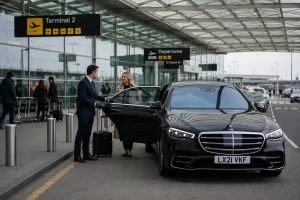
A pre-booked chauffeur makes sense if you have heavy bags, a very early flight or a group. The driver takes you to the right terminal and the price is fixed in advance. Our Heathrow Airport chauffeur service explains how it works.
If your flight leaves very early, many travellers stay nearby the night before. Our guide to the best hotels near Heathrow with chauffeur service lists the options.
Whichever you choose, leave extra time for traffic. The roads around Heathrow are busy at peak hours, and our guides to avoiding Heathrow traffic and the best time to leave from central London show how much.
How early to arrive
Heathrow recommends arriving three hours before an international flight and two hours before a domestic or European one. On a first trip, treat those as the minimum. Add 30 to 45 minutes in school holidays, on summer weekends and around Christmas. Our guide on how early to arrive at Heathrow breaks the timings down by flight type.
Two details catch people out. First, arriving at the terminal is not the same as leaving home. Count your journey separately, including traffic or a delayed train. Second, airlines set their own bag drop cut-off times, and these are often earlier than passengers expect. Turn up late and the desk can refuse your bag even though the plane is still on the ground.
Here is a simple example. Say your flight to Spain leaves at 10:00. Two hours before puts you at the terminal at 08:00. If your train takes 50 minutes and you want a 30-minute cushion, you leave home at about 06:40. That is the time to plan around.
You can check live security wait times before you set off. A short queue is a nice surprise, not a reason to leave later.
At the terminal: check-in and bag drop
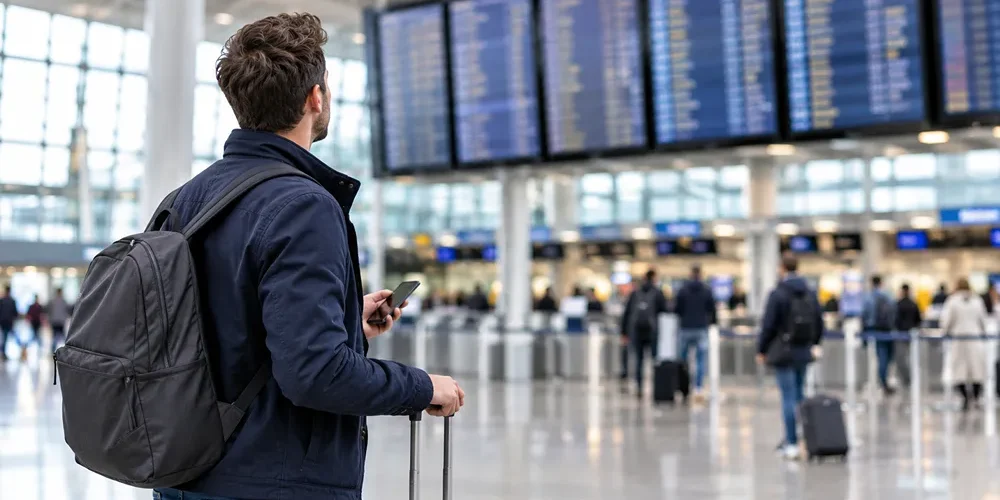
When you walk into Departures, look up. Overhead screens show which check-in area belongs to your airline, and Heathrow’s interactive map shows the same thing before you arrive. Airline staff stand near the desks and kiosks, and they deal with first-timers every day. Ask them.
If you checked in online and have no hold bag, you can skip this stage and go to security. If you have a hold bag, you can usually scan your boarding pass at a kiosk and go to bag drop. If you have not checked in yet, the self-service process works like this:
- Scan your passport or booking details at the kiosk and print your boarding pass.
- Print your bag tag and slide it face down through the handle of your bag, joining the red dots and smoothing the tag flat.
- Take the bag to the bag drop, show your passport and boarding pass, and hand it over.
Keep the tag receipt until you collect your bag at the other end. It helps the airline find your bag if something goes wrong.
Some airlines still use staffed desks. They are the better choice if you need help, have an unusual item or are travelling with a young child. Our Heathrow Airport departure guide covers the whole departure process in more detail.
Going through security
Security is the step people worry about most when flying from Heathrow for the first time, and it is easier than it used to be. Have your boarding pass ready and keep your liquids and laptop in your bag. Empty your pockets into the bag or a tray, and take off your coat or belt if the officers ask. Metal bottles must be empty.
Your bag goes through a scanner that builds a 3D picture of what is inside. Many passengers have a bag pulled aside for a closer look, and it does not mean you did anything wrong. Open the bag, answer any questions and carry on. You then walk through a body scanner, and an officer will explain what happens next if it picks anything up.
When you collect your things, step away from the belt before you repack. It keeps the queue moving and stops you leaving a phone or a belt behind. Put your passport and boarding pass back in your pocket where you can reach them.
Heathrow also sells Fast Track, which you can pre-book if you want a quicker lane. It is optional, and the standard queue gets you through the same checks.
After security: the departure lounge
Once you are through security, you enter the departure lounge, the large area of shops and restaurants before the gates. Your gate will not be on the screens yet. Heathrow usually shows it about 45 minutes before departure, so you have time to relax, but do not wander far.
Knowing what to do at Heathrow before your flight boards makes the wait easier. Find a seat near a flight information screen, charge your phone at the free charging points and connect to the free Wi-Fi. Heathrow has plenty of restaurants, cafés and bars, and lounges in every terminal that you can book in advance. Our guides to Heathrow duty free and Heathrow lounges help you decide whether either is worth your money.
When your gate appears, head there straight away. Some gates are a long walk from the shops, and at some terminals you need a short train ride to reach them. Follow the signs and give yourself more minutes than you think you need. Check your boarding pass for the boarding time and treat it as a deadline, not a suggestion. The Heathrow app and your airline’s app can also show gate changes, which is useful if you step away from the screens.
Boarding your flight
Head to your gate when boarding is called. Airlines usually board by row, zone or priority group, and staff will tell you when it is your turn. Have your boarding pass and passport ready, because some airlines check documents again at the gate.
Gates close before departure, and the airline can leave late passengers behind even if the plane is still at the stand. If the gate changes or the flight is delayed, follow the screens rather than the crowd. Once you are on board, put your hand luggage in the overhead locker or under the seat in front, and keep your passport and phone where you can reach them.
If your flight is delayed or cancelled
Delays happen, even at Heathrow. Your airline, not the airport, is responsible for looking after you. Check the screens and your airline’s app, then speak to the airline’s desk or contact it directly before you leave the terminal. Ask what it offers, such as a new flight, refreshments or a hotel. What you receive depends on the airline, your route and the cause of the delay, so check its policy. Keep every receipt for anything you pay for, because you may be able to claim it back later.
When you land at Heathrow
If you are flying into Heathrow, the order is just as simple. You leave the aircraft, pass border control, collect your bags, go through customs and walk into the arrivals hall. Heathrow’s advice for first-time visitors to Britain explains each step.
Most visitors who do not need a visa must hold an Electronic Travel Authorisation before they board, and border control queues vary through the day. Our note on border control delays and eGate outages explains what to expect when they build. If your bag does not appear, report it to your airline before you leave the baggage hall, then read our advice on delayed or lost luggage.
If someone is meeting you, agree on one of Heathrow’s official meeting points and message them once you are through. Our guide to Heathrow meet and greet shows where a chauffeur waits. Contactless cards work almost everywhere in London, so you can pay for your onward journey straight away.
Changing planes at Heathrow
If Heathrow is only a stop on the way, you do not use the Arrivals signs. Follow the Flight Connections signs instead. If your bags are checked through to your final destination, you clear customs there. Book both flights on one ticket where you can, because the airline will usually rebook you if the first flight is late. With separate tickets, you carry that risk yourself, so leave much longer between flights. If your next flight leaves from Gatwick, our Heathrow to Gatwick transfer guide covers the journey between airports.
Getting help at Heathrow
You will not be on your own. Airline staff handle check-in, bag drop and boarding questions, and Heathrow’s own team can point you towards facilities and directions. Ask early. Nobody minds, and a two-minute question beats ten minutes in the wrong queue.
If anyone in your group needs extra support, such as help covering long distances inside the terminal, assistance is available. Tell your airline at least 48 hours before you fly so the airport can plan it. Heathrow explains the service in its guide to assistance and accessibility, and it also publishes advice on travelling with children. If you lose something in a terminal, start with Heathrow’s lost property service.
Flying with children in the school holidays? Our family transfer checklist for Heathrow covers the timings and the extras that make the day easier.
Mistakes that cost first-timers time
Most delays at Heathrow come from a handful of avoidable slips, so these Heathrow airport tips for first time travellers save the most time:
- Going to the wrong terminal. Confirm it on your booking, then check again the day before, because airlines can change terminals.
- Mixing up arrival time and leaving time. Two hours before departure is when you reach the terminal, not when you walk out of your front door.
- Packing large liquids for a trip home from an airport that still enforces the 100ml limit.
- Missing the bag drop cut-off. The desk can close well before the gate does.
- Wandering far from the screens before your gate appears, then facing a long walk or a train ride to reach it.
- Taking a big suitcase on the Piccadilly line at rush hour when a different route would suit you better.
Chauffeur transfers to Heathrow Airport for first-time flyers
If the journey to Heathrow is the part you dread most, a pre-booked chauffeur removes most of the guesswork. You do not need to compare train times, find parking or carry heavy bags up station steps.
Here is how it works with National Executive Transfers. You give us your flight details, your terminal and your pick-up address, and we send you your chauffeur’s name, photo and car registration before the day. The price is fixed when you book, and the service operates around the clock, including early flights and bank holidays. Your driver takes you to the right terminal and helps with your luggage. If you need a child seat or extra luggage space, tell us when you book.
Return journeys work the same way. We track your flight, and your chauffeur waits in the arrivals hall, so a delay does not change your plans. Waiting time is included, 60 minutes on international flights and 45 on domestic ones.
Our chauffeur transfers to Heathrow Airport start from your home, hotel or office. Send us your flight number and the time you need to leave, and we will quote you.
The short version
Heathrow looks daunting until you break it into steps. Confirm your terminal, give yourself spare time, and keep an eye on the screens for your gate. The security rules are friendlier than they used to be, but remember that they only apply at Heathrow. If you take this first-time flyer’s guide to Heathrow one step at a time, and ask staff whenever you are unsure, the busiest airport in the UK becomes a series of small, simple tasks. Your second trip will feel far easier than your first.
Related Heathrow guides
These guides go deeper on parts of your journey that this article covers briefly.
- Heathrow to central London chauffeur guide
- Heathrow Airport to central London transfer options
- Airport transfer checklist for smooth arrivals and departures
- Emirates terminal at Heathrow
- Heathrow to London airport transfers
Frequently Asked Questions
Your airline decides. Check your booking confirmation, your airline's app or Heathrow's terminal finder, and check again the day before you fly in case anything has changed.
Liquids in containers of up to 2 litres, with no clear plastic bag, and laptops and tablets. Empty metal or insulated water bottles before you reach the scanner and refill them afterwards.
Heathrow recommends three hours before an international flight and two hours before a domestic or European flight. Add extra time in busy holiday periods.
Usually about 45 minutes before departure. Stay close to the screens until it appears.
Yes. Heathrow offers free Wi-Fi in its terminals, and there are charging points throughout the departure lounge.
Ask a member of staff straight away and check the route on Heathrow's page about getting between terminals. Terminals 2 and 3 connect by a walkway. For the others, you will need a train or bus, so allow extra time.