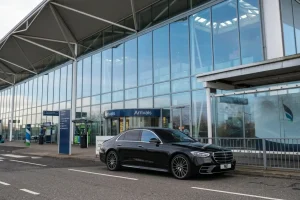
It’s 7.42am and your MD’s flight has just landed twelve minutes early. Your usual taxi app shows an eighteen-minute wait. Meanwhile, the office wants to know if the 9am with the Coventry client is still on. Nobody’s told the driver where the second stop is. You’re juggling three different booking confirmations. Two of them were made by colleagues who didn’t know the other existed. Finance is still chasing last month’s receipts, because someone expensed a black cab in cash.
None of this is a driving problem. It’s an account problem.
Your business might be booking chauffeur-driven travel more than a handful of times a month: for executives, for visiting clients, for airport runs, for conferences. Once that’s true, the question changes. It stops being “which company has a nice car” and becomes something closer to choosing a supplier. That’s a different decision, and it deserves a different process.
This guide walks through how to make that decision properly. It covers what a corporate chauffeur account changes versus booking individually. It also covers who genuinely benefits from one, the questions worth asking before you commit, and what good service looks like once you’re in.
One-off booking versus ongoing relationship
A one-off chauffeur booking is transactional. You need a car, you book a car, you pay for that journey, done. It works perfectly well for the occasional airport run or a single business chauffeur booking for a one-off client visit.
A corporate chauffeur account UK arrangement works differently. It’s a standing relationship with a provider. It covers multiple bookers, multiple passengers, and recurring routes, and it replaces a stack of receipts with one invoice. The difference shows up in the details that matter once volume increases.
Why volume changes everything
With one or two journeys a month, nobody notices the friction. At fifteen or twenty, it becomes the job.
Multiple people end up booking on the company’s behalf: an EA for the CEO, an office manager for visiting clients, a project lead for a site visit. Without an account, each of them might use a different taxi app or a different local firm, or whichever driver answered the phone first. Standards vary. Pricing varies. Nobody has a single view of what the company actually spent on ground transport last quarter.
Airport transfers are the clearest example. A one-off booking means hoping the driver checks your flight status. With an account, the provider monitors the flight as standard. The pickup time adjusts automatically, without you having to call and explain that the flight’s delayed.
Recurring routes matter too. Say the same executive travels between Birmingham and the same London office every fortnight. A provider who already knows the route and the preferred pickup point saves real time. There’s no re-explaining it to a different driver on every visit.
Where one-off bookings tend to break down
Then there’s the messier stuff: a meeting that overruns by ninety minutes, a client collected from an unfamiliar station, a conference day with four pickup points across the city. One-off bookings handle these badly. Each change means a new phone call and a new price negotiation, with no guarantee the same standard applies twice.
Booking responsibility is another quiet problem. With one-off bookings, whoever makes the call is personally accountable if something goes wrong, even if the failure was entirely the driver’s fault. An account arrangement usually spreads that responsibility more sensibly, because the relationship sits with the company rather than with whoever picked up the phone that morning.
Urgent requests expose the gap most clearly. A director whose evening meeting has just moved from 4pm to 6pm needs a car adjusted, not rebooked from scratch. Ad hoc booking channels rarely handle that gracefully, particularly outside normal office hours.
Billing is the part finance teams notice fastest. A scatter of individual card payments and cash receipts is slow to reconcile and easy to lose track of. A single monthly invoice, broken down by journey and cost centre, isn’t a luxury. It’s basic administrative sanity once volume goes up. Without it, finance ends up chasing bookers for receipts weeks later. By then, nobody remembers which client the trip was for.
None of this means every business needs an account. It means the decision is worth making deliberately rather than drifting into it, or avoiding it, by default.
How do you know if your business actually needs an account?
Here’s the honest answer: not every business does. If you book a chauffeur two or three times a year, for a specific event or an occasional VIP visit, an account probably adds overhead you don’t need. A good one-off booking, done properly, will serve you fine.
Signs tied to volume and who’s booking
An account starts to earn its keep once a few of the following apply to your business. These are roughly the signals a good provider checks for before recommending a corporate chauffeur account UK arrangement over individual bookings:
You’re booking chauffeur travel at least a handful of times a month. Below that, the admin savings from consolidated billing are marginal. Above it, the savings compound quickly.
More than one person books on the company’s behalf. Once an EA, an office manager, and a project coordinator are all sourcing transport independently, standards and pricing start to drift. An account puts everyone on the same terms.
Your finance team is currently reconciling individual receipts from cards, cash, and expense claims. If this sounds familiar, an account converts that mess into one line item a month.
Signs tied to the type of travel
You regularly move executives to and from airports. Flight delays, early landings, and terminal confusion are routine. A provider who tracks flights as part of the account, rather than as a favour, removes a recurring source of stress.
You transport clients or visiting stakeholders. First impressions matter here. A driver who already knows your company’s standards is worth more than a random booking made under time pressure.
Your travel involves multi-stop days or roadshows. A single chauffeur covering several stops in one day, rather than a new driver at each leg, saves time and repeated explanation.
You run regular conferences, hospitality events, or client entertainment. Coordinating several vehicles and pickup points to a consistent standard is genuinely difficult without a named contact at the provider’s end.
If none of that describes you, and your bookings are occasional and low-volume, it’s entirely reasonable to keep booking one journey at a time. Setting up an account you rarely use just adds a supplier relationship to manage for no real benefit. Honesty about this matters more than a sales pitch either way.
What should you ask a chauffeur company before signing up?
If you’ve decided an account makes sense, the next step is comparing providers properly. Most companies will tell you about their cars. Fewer will happily answer these ten questions in detail. How they answer tells you more than the fleet photos do.
1. Who actually manages the account day to day?
Why it matters: A generic booking inbox is not the same as a named contact who knows your company, your regular routes, and your preferences.
A good answer names a specific person or small team, explains how to reach them outside normal booking channels, and describes what happens if that person is unavailable.
Warning sign: vague answers about “our team,” with no clarity on who actually picks up the phone when something goes wrong.
2. How does monthly invoicing actually work?
Honestly, I’d ask about the invoice before asking about the car. Finance problems tend to appear after the journey, not during it.
Why it matters: A single VAT invoice covering all journeys is the whole point of consolidated billing. If it’s not itemised by date, route, and passenger, your finance team is back to detective work.
A good answer describes a clear billing cycle and itemised journey-level detail. Ideally there’s cost-code tagging too, so you can allocate spend to the right department.
Warning sign: “we’ll sort it out at the end of the month,” with no real structure behind that sentence.
3. Are the rates fixed, variable, or negotiated per journey?
Why it matters: Surge pricing and out-of-hours supplements are common complaints in this industry. If pricing isn’t agreed upfront, your budget forecasting becomes guesswork.
A good answer explains fixed or pre-agreed rates for standard routes. It also tells you upfront what they charge for anything outside that, such as extra stops.
Warning sign: reluctance to put pricing structure in writing before you’ve signed anything.
4. What happens when a meeting runs late?
Why it matters: Meetings overrun constantly. The question is whether that becomes your problem, or the provider’s problem to manage.
A good answer explains how they brief drivers to expect flexibility. It also covers what a reasonable waiting allowance looks like, and how they charge beyond it.
Warning sign: a policy that treats every minute of overrun as a fresh booking, with a fresh charge and no notice given.
5. Do you monitor flights, or do I need to call if a flight changes?
Why it matters: This is the single biggest difference between a casual taxi booking and a proper corporate arrangement. Flight delays and early arrivals happen on a large share of journeys.
A good answer confirms flight tracking is standard, not an optional extra, and that the pickup time adjusts automatically.
Warning sign: “just call us if anything changes.” That puts the monitoring burden back on you.
6. Who actually drives the vehicles — employed chauffeurs or a subcontracted network?
Why it matters: Standards are much easier to guarantee with directly managed, licensed drivers. A loosely coordinated network of subcontractors tends to vary in quality.
A good answer explains the licensing, such as a private hire licence and enhanced DBS checks where relevant. It also describes how they vet and train drivers, whether employed directly or through a closely managed partner network.
Warning sign: no clear answer on licensing, or an admission that “it depends who’s available.”
7. What vehicles are available, and can you match the vehicle to the passenger or group?
Why it matters: A single executive travelling alone has different needs to a team of five. So does a client who needs extra luggage space.
A good answer describes a fleet with genuine variety. Think saloon options like a Mercedes E-Class for individual travel, something more senior like an S-Class for board-level journeys, and a larger MPV such as a V-Class for groups. It also confirms actual availability, rather than “we’ll try to find something.”
Warning sign: a single vehicle type offered regardless of the brief.
8. Can multiple employees book under the same account?
Why it matters: If only one person in your business can place bookings, the account becomes a bottleneck rather than a convenience.
A good answer confirms multiple authorised bookers. Each can have their own preferences and travel history recorded, without re-explaining company details every time.
Warning sign: a single login or a single authorised contact, with no flexibility.
9. What happens if something actually goes wrong — a no-show, a delay, a mix-up?
Why it matters: Every provider will tell you they’re reliable. Fewer will tell you clearly what happens when reliability fails, which happens occasionally to everyone.
A good answer describes an escalation process. It covers who you contact, how quickly, and what recourse exists, such as a replacement vehicle or a credit.
Warning sign: an assumption that this scenario doesn’t need discussing, because “it won’t happen.”
10. What support exists for urgent or last-minute bookings?
Why it matters: Business travel doesn’t stay within office hours. Last-minute changes are routine, not exceptional.
A good answer confirms genuine 24/7 support with a real person answering, not just an automated form with no urgent-request option.
Warning sign: support hours that don’t match your actual travel patterns, particularly early mornings and weekends.
If a provider answers most of these clearly, in writing, before you’ve committed to anything, that’s a strong signal. Vague reassurance instead of specifics is useful information too.
How does the true cost compare — chauffeur, taxi, train and self-drive?
Pricing in this industry varies by route, vehicle class, time of day, and number of stops. It also varies by waiting time and airport surcharges. Any provider quoting a single flat number for “a chauffeur,” without asking these questions first, isn’t giving you a real price.
Typical example, purely to illustrate the shape of the comparison rather than exact figures: a single Birmingham city-centre-to-airport transfer in a standard executive saloon usually costs more than a taxi for the same route. It’s often less than people assume, though, once you factor in the taxi rank wait, the driver not knowing your building’s access, and the lack of any flight monitoring.
Weighing money, time and admin together
The real comparison isn’t journey price alone. It’s money, time, stress, and administration together:
- A taxi is usually cheapest for a single, well-defined journey with no flight risk. For a straightforward point-to-point trip with no client involved, it can be entirely sensible.
- The train genuinely wins for many city-to-city journeys, particularly on well-served routes. If the whole trip is one leg with no onward stops, don’t assume a chauffeur is automatically better. Sometimes it isn’t.
- An hourly or full-day chauffeur hire suits multi-stop days without the commitment of a full account. Several meetings, one driver, one vehicle, booked as a single block.
- Self-drive can look cheaper on paper. It rarely accounts for parking costs at city-centre venues, or the executive’s time lost to driving rather than working.
- A corporate chauffeur account UK arrangement earns its cost back through admin time saved and one invoice instead of many. It also reduces the risk of a delayed pickup reflecting badly on whoever arranged it.
None of these options is universally best. A business travelling between well-connected cities on predictable schedules might do better on trains for most journeys, reserving chauffeur travel for airports and client collections. A business with unpredictable, multi-stop, executive-heavy travel gets more value from an account instead.
The cost that never appears on an invoice
There’s also a cost that never shows up on any invoice: the time your EA or office manager spends sourcing and chasing bookings every time a journey comes up. If that person spends an hour a week on it, that’s a real cost, even though it never appears as a line item. An account removes most of that overhead. The comparison and negotiation happen once, at setup, rather than every time someone needs a car.
It’s worth being honest about the other side too. An account with low usage can end up costing more, in the sense that you’ve committed administrative attention to a relationship you don’t use enough to justify. If your travel is genuinely occasional, a well-chosen one-off provider may simply be the more sensible option, at least for now.
If your company is already booking several executive journeys each month, across different people and routes, it may be worth comparing corporate account options. That beats re-negotiating the basics every time you book.
A realistic Birmingham business day, worked through
Take a generic but realistic scenario. A Birmingham-based professional services firm has a senior client arriving at Birmingham Airport at 8am. Two meetings follow, across Birmingham and Coventry. Then there’s a return flight from Birmingham at 6pm.
Booked individually, this typically means three separate arrangements. An airport pickup, possibly with a driver who’s never met the client. A mid-morning transfer to Coventry, booked and priced separately. Then a return airport drop later that afternoon. If any meeting overruns, someone has to scramble to adjust or rebook the next leg. If the flight lands early, the airport pickup driver may already have left.
Hourly chauffeur hire solves the coordination problem without needing a full account. One vehicle and one chauffeur cover the whole day as a single block. They move between the airport, Birmingham, and Coventry as the schedule actually unfolds. The hourly and full-day chauffeur hire model exists specifically for days shaped like this one.
A corporate account adds two further things on top. The booking sits on one invoice instead of being separately expensed. And the same standard applies automatically next time, without re-briefing a new provider from scratch.
The small details that make the day work
The right vehicle matters here too. A single senior client with luggage suits a Mercedes E-Class comfortably. If the visit had involved a small delegation instead, a Mercedes V-Class keeps the group together in one vehicle, rather than splitting across two cars.
Keeping one chauffeur with the passenger for the whole day has a quieter benefit too. By the second leg, the driver already knows the client’s name and schedule. That removes a small but real source of friction from a day that’s already tightly timed.
Luggage is easy to overlook until it becomes a problem. A client arriving for a multi-day trip often brings more bags than a standard saloon comfortably fits alongside a second passenger. A good account manager asks about this at the time of booking, rather than leaving you to discover it kerbside at the airport.
The same logic extends to privacy. If part of the day involves sensitive discussion in the car, a driver who’s used to corporate clients understands the conversation isn’t for them, without being told. That’s harder to guarantee with a different driver on every leg.
What does good corporate chauffeur service actually feel like?
Set aside marketing language for a moment. In practice, good service on a corporate account tends to feel organised and predictable, in fairly specific ways:
Booking confirmations arrive clearly and promptly, with the driver, vehicle, and pickup details spelled out rather than left vague.
Drivers are punctual and professionally presented, and know the route rather than relying entirely on a satnav in unfamiliar areas.
Flight monitoring happens automatically on airport bookings, without you needing to call and check someone’s actually watching it.
Meet and greet is standard at airports, with a driver waiting inside arrivals rather than expecting passengers to find their own way to a car park.
Communication is proactive, particularly when something changes: a delay, a different pickup point, a late-running meeting. It doesn’t wait for you to chase it.
Vehicles are clean and well-presented as a baseline, not something you have to specify each time.
Drivers are discreet around confidential conversations or sensitive client matters, without needing to be told.
Vehicle choice is genuinely available, matched to passenger numbers and the occasion, rather than whatever’s free that day.
The provider handles changes with reasonable flexibility, particularly around overrunning meetings. Each one isn’t treated as a fresh transaction.
Billing arrives on schedule and matches what was actually booked, with no surprises that need explaining after the fact.
Account management feels like a relationship, not a support ticket queue. Someone remembers your regular routes and preferences without being reminded every time.
None of this requires marketing language to describe. It’s mostly about a provider doing the unglamorous parts consistently.
Where does National Executive Transfers fit into this decision?
National Executive Transfers operates from a base at Birmingham Airport and covers journeys across the UK from there. That’s a reasonable position for businesses whose travel touches the Midlands regularly, whether that’s airport transfers, meetings across Birmingham and Coventry, or longer city-to-city routes.
The corporate account setup covers most of the points raised throughout this guide. There’s a dedicated account manager and consolidated monthly VAT invoicing with journey-level detail. Rates are fixed and agreed before travel, rather than variable. Flight monitoring and meet-and-greet come as standard on airport bookings, not as an add-on.
The fleet includes the Mercedes E-Class for individual executive travel and the Mercedes S-Class for board-level journeys. For group transport up to seven passengers, there’s the Mercedes V-Class. Between them, they cover the scenarios discussed above, from a single client collection to a full team moving together for a conference.
Multiple employees can book under a single account. That matters if your EA, office manager, and travel coordinator are all currently arranging transport separately. Hourly and full-day hire is also available, giving the coordination benefits of a single chauffeur for a multi-stop day without committing to a full account straight away. It’s a sensible way to test the standard before deciding.
None of this means National Executive Transfers is automatically the right fit for every business reading this. The questions and criteria above apply here as much as anywhere else. You can check the specifics directly, rather than taking them on trust.
Things to consider before choosing a provider
- Named account management, not a generic inbox
- Clear, itemised monthly invoicing
- Fixed or pre-agreed pricing structure
- Genuine flight monitoring on airport bookings
- Licensed, vetted chauffeurs with consistent standards
- Vehicle variety matched to passenger numbers
- Multiple authorised bookers on one account
- A clear process for when something goes wrong
If your business is already arranging several executive or client journeys most months, it’s worth a direct conversation about whether an account fits. You can open a corporate account with National Executive Transfers and talk through your actual routes and volumes. That tends to be more useful than comparing brochures alone.
Frequently Asked Questions
It depends on volume, not company size. A small business booking regular airport transfers for two directors can get real value from an account. A larger business that only books occasionally may not. Frequency and number of bookers matter more than headcount.
A normal booking is a single transaction: one journey, one price, one payment. An account is an ongoing arrangement covering multiple journeys, multiple bookers, and one consolidated invoice, usually with fixed pricing agreed in advance.
Yes, with most providers. This is one of the main practical benefits — an EA, an office manager, and other staff can all book under the same account without duplicating setup or negotiating pricing separately each time.
Most established providers do, typically as a single VAT invoice per billing period, ideally broken down by journey, date, route, and passenger so finance teams can reconcile it against cost centres.
Not always, and be wary of anyone claiming it is across the board. For a single simple journey, a taxi is often cheaper. Where a chauffeur account tends to win is in total value across multiple journeys: consistent standards, less admin time, and no surprise charges — not necessarily the lowest price on any one trip.
Yes, this is one of the most common uses. Flight monitoring and adjusted pickup times should be a standard part of the account, not something you have to arrange separately each time.
A standard executive saloon such as a Mercedes E-Class suits most individual business travel. Reserve a larger saloon like an S-Class for board-level or VIP journeys, and an MPV such as a V-Class when moving a group of up to seven together.
Yes, providers typically arrange this as part of hourly or full-day hire, or as a multi-stop booking under a corporate account. The same driver and vehicle cover the whole day rather than separate bookings for each leg.
Typically: expected booking volume and frequency, the number of people who'll need to book, common routes or airports used, any specific vehicle requirements, and your preferred billing arrangement (monthly VAT invoice, cost-code tagging, and so on).
Ask both the same set of specific questions — account management, invoicing detail, pricing structure, flight monitoring, driver licensing, and what happens when something goes wrong — and compare the clarity of their answers, not just their fleet photos or general claims.