Flying for the first time from London City Airport is genuinely one of the easier introductions to flying you could ask for. It is small, it is close to central London, and a lot of the confusion that comes with bigger airports simply does not apply here. That does not mean there is nothing to know, though. A few things about this particular airport are different enough from what you might expect that they are worth explaining properly.
This guide walks you through your entire day. That means everything from what to sort out before you leave home to what actually happens once you are in the air. You will learn how check in and security work here, and what the single terminal actually looks like. You will also find out why the plane might feel a little different on the way up and down than you expect. Real detail, specific to London City, not generic advice recycled from a guide written about somewhere else entirely.
Before You Leave Home
A little preparation goes a long way, and none of it takes very long.
Check in online if you can
Most airlines flying from London City let you check in online, usually from 24 to 48 hours before departure. Doing this in advance means you can often go straight to bag drop. Or, if you have no bag to check, straight through security instead of queueing at a check in desk first.
Download your boarding pass to your phone, or print it if you prefer paper. Either works fine here. It is still worth checking your specific airline’s own rules, though, since some charge a fee if you turn up without one ready.
Check your bag allowance properly
Every airline sets its own limits on hand luggage and checked bags. London City’s aircraft, which we will come back to shortly, are smaller than what you might be used to on other routes. This sometimes means slightly tighter rules on cabin bags than you would find on a longer haul flight elsewhere.
Check your exact allowance before you pack rather than assuming. Our UK hand luggage size and weight guide breaks this down properly by airline.
Know the liquids rule
Liquids in your hand luggage need to sit in containers of 100ml or less, all packed together in one clear resealable bag. This catches a lot of first time flyers out. A full size bottle of shampoo or a large bottle of water will get stopped at the security tray.
Our UK liquids rules guide explains this properly, including what actually counts as a liquid.
Domestic or international, know which one applies
London City mostly serves short European routes. A handful of UK domestic flights, such as Edinburgh, also operate from here. If you are flying domestically, you will not go through passport control on either end, though staff may still ask for photo ID. If you are flying internationally, keep your passport somewhere easy to reach, since you will need it more than once during your journey.
Pack a few extras for comfort
Beyond your main bag, a handful of small things make the flight itself more comfortable. Bring headphones, since most aircraft still have some form of entertainment system. Pack a snack, particularly on a short flight where food service can be limited. Fill a water bottle after security rather than trying to bring one through. If you take regular medication, keep it in your hand luggage rather than your checked bag, just in case.
Check what documents you actually need
Beyond your passport, it is worth checking whether your specific trip needs anything else. Some European destinations have introduced additional entry requirements in recent years. It is easy to miss these if you have not travelled there before. Our guide to what documents you need before your airport transfer covers this properly, so nothing catches you out at check in.
Getting to London City Airport
This is one of the genuine advantages of flying from here. It is worth knowing about even if you end up choosing a different way to travel.
The DLR is genuinely excellent here
London City sits right on the Docklands Light Railway network, with its own station connected directly to the terminal. This makes it one of the easiest London airports to reach by public transport, with quick, frequent trains through to Bank, Canary Wharf, and Stratford. For a solo traveller with hand luggage only, this is often the simplest option available.
If someone is driving you
Whoever drops you off needs to know one important thing. London City introduced charges for both drop off and pick up in 2026, and treats the two zones separately. Getting this wrong is an easy, avoidable mistake. Our London City Airport parking versus chauffeur guide covers the real costs of driving yourself compared with booking a transfer.
How early to actually arrive
Because London City is small and its processes move quickly, this matters for planning. You generally do not need the same buffer you might build in for a much larger airport. Our guide to how early to arrive at London City Airport gives you a proper answer based on your actual flight, rather than a generic rule that assumes every airport works the same way.
One Terminal, Genuinely Simple
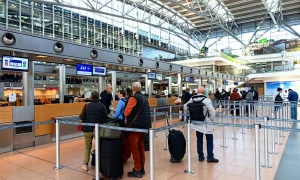
Here is some good news for a first flight specifically. London City has a single terminal building. That means no confusion about which one you need, unlike bigger airports where getting this wrong costs you real time. Everything, from check in to your gate, sits inside one compact space.
Look for the departure boards near the entrance once you arrive. These show your flight number, your check in desk if you need one, and later your gate.
Check-in and Bag Drop
If you already checked in online and have no bag to drop, you can usually head straight toward security. If you do need to check a bag, find your airline’s desk and join that specific queue.
Bring your booking confirmation and some form of photo ID, even for a flight within the UK, since staff occasionally ask to see it. At the desk, your bag gets weighed and tagged, and you will be handed a small part of that tag. Keep it safe. You may need it later if your bag does not turn up with you.
Going Through Security
This is the part that makes most first-time flyers nervous, so let’s cover it properly.
What to take out of your bag
Before the scanner, you will need to remove certain items and place them in a tray. This usually includes laptops and larger electronics, along with your liquids bag. Some checkpoints also ask that belts or jackets be removed. Keep an eye on what the person ahead of you is doing if you are unsure.
Walking through the scanner
You will pass through a body scanner or occasionally a metal detector. This is a completely routine, everyday check. If something triggers an alert, a security officer will simply ask you to step aside for a quick check. This happens to a huge number of ordinary travellers every single day, so there is genuinely nothing to worry about.
Getting your things back
Once your tray comes through, collect everything from the other side. Move away from the immediate area before repacking your bag, rather than blocking the space behind you.
Our UK airport security rules guide covers the full list of what you can and cannot bring through, in more detail than we can fit here.
After Security
Once you are through, you are airside, meaning you are now in the part of the airport only ticketed passengers can access.
One honest thing worth knowing. London City does not currently have a lounge inside its main terminal. A new one is confirmed to be under construction, though, expected to open by early 2027. Two paid lounges exist elsewhere at the airport’s separate Private Jet Centre, but they involve a short shuttle and some planning around your timing. Our complete guide to London City Airport lounges explains exactly how that works, and whether it is worth it for your trip.
For most passengers on a short flight, the main terminal itself has a reasonable choice of cafes and seating. That is often all a quick trip actually needs.
Finding Your Gate
Given how compact London City is, you will not face the long walks that come with bigger airports. Gate information usually appears on the departure boards well before boarding starts. It is worth keeping an eye on it rather than assuming your gate will not change.
Boarding the Plane
Boarding typically starts around 20 to 30 minutes before departure, sometimes split into groups depending on your airline. There is no need to rush to the front unless your specific group has been called. Your seat is already reserved, so waiting your turn is perfectly fine.
Have your boarding pass ready as you approach the gate, along with your passport if you are flying internationally.
What If Your Flight Is Delayed or Cancelled
This happens sometimes, and knowing what to expect takes most of the stress out of it. Check the departure boards or your airline’s app for the latest information rather than guessing or asking other passengers.
Depending on the length and cause of the delay, you may be entitled to compensation or assistance from the airline. Our guide to flight delay rights at UK airports explains exactly what you may be owed and how to claim it.
A Few Things Worth Knowing About the Flight Itself
This is where London City genuinely differs from most other airports. It is worth explaining properly rather than leaving you to wonder about it mid flight.
Why the plane feels different on the way up and down
London City has one of the shortest runways used by scheduled commercial flights in Europe, at just over 1,500 metres. Because of this, and because the airport sits in a densely built up part of London, aircraft fly a steep approach here. Planes typically descend at around 5.5 degrees, compared with roughly 3 degrees at most other airports.
In practical terms, this means the descent into London City can feel noticeably steeper than flights you may have taken elsewhere. The same applies to the climb after takeoff. This is entirely normal, expected, and something every aircraft using this airport is specifically certified to do. It is not a sign of anything unusual happening. If anything, it is one of the more interesting parts of flying from here.
The aircraft may be smaller than you expect
Because of the short runway and the steep approach requirement, London City cannot accept the larger aircraft used at bigger airports. Instead, you will most likely fly on an Embraer E190 or a similar regional jet. These smaller aircraft make up the large majority of flights here. This is completely normal for this airport and does not reflect anything about the safety or quality of your flight.
One practical note if you are flying with British Airways CityFlyer specifically. Their Embraer E190 fleet does not currently have onboard Wi-Fi. If staying connected during the flight matters to you, download anything you want to watch or read before you board.
During the Flight
Most routes from London City are short, typically under two hours, given the airport’s focus on European business destinations. Keep your seatbelt fastened whenever the sign is on, and do not hesitate to ask cabin crew if anything is unclear. That is genuinely what they are there for.
If your ears feel blocked or pop slightly during the climb or descent, that is simply air pressure changing, and swallowing or yawning usually helps. It is completely normal and nothing to worry about.
Landing and Getting Off
Stay seated until the seatbelt sign turns off and the aircraft has fully stopped. Standing early does not get you off any faster, since everyone still needs to leave in order.
If you checked a bag, follow the signs to baggage reclaim. If your bag does not appear, report it immediately at your airline’s desk. Do not leave the airport and hope it catches up with you later.
A Realistic First Flight, Start to Finish
Say your flight leaves London City at 9am. You checked in online the night before, so you arrive around 7:30am with just a small cabin bag. You walk straight past the check in desks and reach security within a few minutes.
Security takes perhaps ten minutes on an ordinary morning. You are through by 7:50am, with your gate appearing on the board a short while later. You grab a coffee, watch the board, and walk to your gate in good time. Boarding starts around 8:30am, and by 8:55am you are seated, feeling the aircraft’s steeper than usual climb as it takes off toward Europe. The whole airport experience, door to gate, has taken well under an hour and a half.
Accessibility and Extra Help
If you need assistance at London City, book this through your airline in advance rather than arranging it on the day. This covers mobility, sight, hearing, or anything else you might need. Most airlines ask for at least 48 hours notice, and earlier is always better if you can manage it.
A Few Honest Tips
Wear shoes that come off easily, since you may be asked to remove them at security. Fumbling with laces in a queue is nobody’s idea of a good time.
Keep your passport, boarding pass, and any travel documents together somewhere easy to reach, rather than buried at the bottom of your bag.
Do not panic if something feels confusing. Airport staff answer the same questions dozens of times a day, and they would rather help than watch you struggle through it alone.
Related Articles
If this is your first trip through London City, these guides cover the details that pair well with this one.
A Complete Guide to London City Airport (LCY)
First Time Flying From a UK Airport
London City Airport Lounges: Complete Guide
London City Airport Parking vs Chauffeur
UK Hand Luggage Size and Weight Rules
Getting to London City Airport with NET
Your first flight already brings enough new things to think about. The journey to the airport does not need to be one of them.
With National Executive Transfers, your driver collects you from home, your office, or wherever your journey starts, and takes you straight to London City’s terminal door. Your flight gets tracked from the moment you book. If anything changes, your pickup adjusts with it, rather than leaving you to work it out yourself.
There is no drop off charge to calculate, no parking to arrange, and no walk from a car park with your bags. Your price is agreed before you travel, fixed regardless of traffic or timing on the day. Whether you are catching your very first flight or your hundredth, one part of the journey stays exactly as simple as it should be.
There’s enough to think about on your first flight without worrying how you’ll get there. Book a London City Airport chauffeur transfer and let your driver handle the rest, tracking your flight, waiting if plans change, and getting you to the terminal calm, unhurried, and exactly on time.
Frequently Asked Questions
Yes, genuinely. Its single terminal, quick processes, and central location make it one of the more straightforward airports to fly from for the first time.
The airport has a short runway and requires a steep approach of around 5.5 degrees, compared with roughly 3 degrees elsewhere. This is completely normal and something every aircraft using the airport is specifically certified for.
Most likely a smaller regional jet such as an Embraer E190, since the airport's short runway rules out larger aircraft. This is standard for this airport and not a safety concern.
This depends on your airline. British Airways CityFlyer's Embraer E190 fleet does not currently offer onboard Wi-Fi. Download anything you want to use in advance if this matters to you.
Not currently inside the main terminal, though a new one is confirmed for early 2027. Two paid lounges exist at the airport's separate Private Jet Centre in the meantime.
The DLR connects directly to the terminal and is one of the quickest, simplest options for a solo traveller with hand luggage only. Driving is straightforward too, provided you understand the drop off and pick up charges in advance.
Given how compact the airport is, you generally need less time than at a larger airport. Check our full guide for advice based on your specific flight and airline.