A missed pickup before a flight, or no one waiting after one, causes a different kind of problem for a business traveller than it does for someone on holiday. A delayed transfer can mean a missed meeting, not just an inconvenient wait. This guide covers how to plan reliable airport transfers around London’s five main airports, and how to compare chauffeur transfers against taxis and public transport for business travel specifically.
Why Business Travellers Need Reliable London Airport Transfers
Business trips usually run on a schedule set by something else: a meeting time, a flight slot, a client’s availability. That leaves little room to absorb a transport failure. A confirmed pickup, agreed in advance with a fixed price, removes one of the more unpredictable parts of a trip, though it doesn’t remove the risk of traffic or airport delays entirely. Planning around realistic timing, rather than assuming everything goes to plan, matters more for business travel than for a flexible personal trip.
Which London Airports Do Business Travellers Use?
London has five main airports, and the right one depends entirely on which route your flight uses, not on general reputation.
Heathrow carries the widest range of long-haul business destinations and is the default choice for many international routes. Gatwick covers a mix of European and long-haul routes, sometimes at lower fares than Heathrow on comparable journeys. London City sits closest to the City and Canary Wharf, and its quick turnaround suits short European business hops. Stansted and Luton both serve mainly budget European short-haul routes, useful if your specific flight departs from one of them.
Journey times from central London vary by airport and traffic conditions. Treat any figure as approximate rather than fixed. A pre-booked transfer accounts for your specific route and time of day, rather than working from a generic estimate that ignores current conditions.
How London Airport Transfers Work for Business Travellers
You book with your flight number, terminal, and destination. A price gets agreed before you travel. A confirmed operator tracks your flight, so the pickup adjusts automatically if it lands early or late. On arrival, your driver waits inside the terminal with a name board. On departure, your chauffeur plans the pickup time around your check-in requirements rather than a fixed clock time.
Airport Transfer vs Taxi for Business Travel
A taxi or app-based ride offers flexibility without advance booking, which suits an unplanned trip. For business travel specifically, that flexibility comes with risks: driver cancellations at short notice, demand-based pricing during busy periods, and no flight tracking if your schedule changes. A pre-booked transfer removes those specific risks in exchange for committing to a confirmed time and vehicle in advance, which suits a fixed meeting time better than a flexible personal trip.
Airport Chauffeur vs Public Transport
The Elizabeth line, the Heathrow Express, and other rail links can be genuinely competitive on speed and cost for a solo traveller with light luggage and a destination near a direct stop. They’re less practical for a group, heavier luggage, or a destination the trains don’t reach directly. For a business trip involving a laptop bag, printed materials, or a need to work during the journey, a private car removes the need to manage a station and a connection.
Airport Chauffeur vs Self-Driving
Driving yourself into London means navigating unfamiliar roads, managing London’s Congestion Charge and ULEZ where applicable, and finding parking near your destination, which is expensive and often needs booking ahead. A chauffeur removes all three, at the cost of not having your own car in the city for the rest of the day.
Can You Book Multi-Stop Business Airport Transfers?
Some business days involve more than one stop: an airport arrival followed by a hotel drop-off, then an office visit, or a client meeting before a return to the airport. A chauffeur booking can include multiple stops in one day. Confirm the full itinerary in advance, rather than adding stops on the day itself, so your driver can plan realistic timing between each one.
What Happens If Your Flight Is Delayed?
A confirmed operator tracks your flight from departure, so a delay or early landing adjusts your pickup automatically. This isn’t universal across every provider, so confirm it’s included before you book. For a significant delay of several hours, a genuine 24-hour service should be reachable to rearrange the pickup without penalty.
Airport Transfers for Meetings, Offices and Hotels
For a meeting or an office visit straight from the airport, a confirmed pickup time removes one variable from a day that already has a fixed appointment attached. So does a driver who plans around current traffic conditions. For hotel arrivals, confirming the exact entrance in advance avoids confusion at larger hotels with more than one access point. This matters most after a long flight, when navigating an unfamiliar building is the last thing you want to manage.
Business Transfers for Conferences and Exhibitions
Airport transfers to a conference or exhibition venue follow the same booking process as any other business journey: pickup, destination, and a fixed price agreed in advance. For events with several attendees arriving separately, coordinating pickup times as a group, rather than as unrelated individual bookings, tends to simplify arrival logistics on the day.
Choosing the Right Vehicle for Business Travel
Vehicle choice depends on passengers and luggage. A standard saloon suits a solo traveller or a pair with normal luggage. A larger vehicle makes more sense for a team travelling together, or for anyone carrying more than a case each. For client collections or occasions where the arrival itself matters, a higher-specification vehicle can be worth the difference, though this is a matter of occasion rather than necessity for most routine business trips.
How Much Do London Business Airport Transfers Cost?
There’s no single fixed price, since the fare depends on the airport, your exact destination, vehicle type, time of day, and whether the route crosses the Congestion Charge or ULEZ zone. A confirmed operator should build these charges into your quoted fare rather than adding them afterwards. For business travel specifically, cost is often weighed against reliability and the time saved not managing a station connection, rather than against the cheapest headline figure alone.
What Should You Check Before Booking?
Confirm your exact airport and terminal, since getting this wrong on a booking costs real time on the day. Give your actual flight number, not just a scheduled time, so the operator can track it. Confirm passenger and luggage numbers so the right vehicle gets booked. Also ask what happens if your flight is delayed or your meeting overruns. Check whether the quoted price is genuinely fixed, including any road charges, and confirm the operator holds a valid private hire licence with DBS-checked drivers.
Booking for Travel Managers and Executive Assistants
Booking on behalf of someone else is a normal part of arranging business travel, and the process works the same way regardless of who’s doing the booking. Share flight numbers, passenger names, and destinations when you have them, and update these later if the schedule changes. For businesses booking this kind of travel regularly, a corporate account brings fixed pricing across journeys and a single point of contact for scheduling. This removes the need to renegotiate terms for every individual booking.
Why Consider National Executive Transfers?
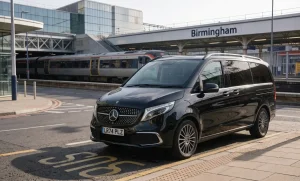
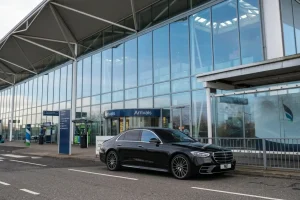
National Executive Transfers covers all five major London airports from a Birmingham base, with a fixed price agreed before you travel and flight monitoring included on airport bookings as standard. Every driver holds a valid private hire licence and has passed an enhanced DBS check. The fleet includes the Mercedes E-Class for solo or paired travel and the Mercedes V-Class for teams needing more space.
For businesses booking regularly, our corporate chauffeur account page covers fixed pricing and invoicing options. For a specific airport route, see our dedicated guides: Heathrow, Gatwick, Luton, Stansted, and London City.
Planning Ahead
The right transfer option for a London airport journey depends on three things. Which airport your flight uses, how much you’re carrying, and how much a delay would actually cost you against a fixed schedule. For most business trips with a meeting time attached, a confirmed pickup earns its cost in removed uncertainty. For a flexible, lightly-loaded solo trip, public transport remains a reasonable choice.
Frequently Asked Questions
It depends on your route and schedule. A pre-booked chauffeur suits fixed meeting times, groups, and heavier luggage. Public transport can offer better value for a solo traveller with light luggage and a flexible schedule.
It depends on the airport, destination, vehicle, and time of day. Request a quote for your specific route rather than relying on a general estimate.
Yes. Any office address in London can be given as your destination when you book.
Yes. Confirm the full itinerary in advance so the driver can plan realistic timing between stops.
A confirmed operator tracks your flight and adjusts your pickup automatically. Confirm this is included before booking, since not every provider offers it as standard.
It depends entirely on which airport your specific flight uses. Heathrow carries the widest range of long-haul routes, while London City suits short European hops from a City or Canary Wharf base.
For a solo traveller heading to Paddington specifically, the Express can be quicker and cheaper. For a different destination, a group, or heavier luggage, a chauffeur avoids the need for a further connection.
Yes, either as a single larger vehicle for a group travelling together, or as coordinated separate bookings for employees arriving at different times.
Book as soon as your travel plans are confirmed, particularly for early departures or busy periods when availability tightens.
Yes. Confirm both stops when you book, so the driver can plan the day's timing properly rather than treating it as a single fixed trip.