Most “best things to do in Birmingham” lists are the same five attractions reshuffled into a different order, no prices, no hours, no sense of how anything connects geographically. That’s not much use if you’re actually trying to plan a day. So here’s a proper one: what to book, what it costs right now, how long things actually take, and how the city fits together if you’re trying to see more than one thing without losing half a day to buses and queues.
A quick fact for context, because it explains a lot about why Birmingham feels the way it does: the city has more miles of canal than Venice, and more Michelin stars than anywhere in the UK outside London. It built its name on chocolate and metalwork and somehow ended up with both a world-class aquarium tunnel and a Tolkien-inspired bog on the same bus route. Make of that what you will.
The short version, if you’re in a hurry
Cadbury World for chocolate and families (from £18, give it three hours). The Museum & Art Gallery if you want something free and genuinely good (allow two hours, donations welcome). A canal walk from Gas Street Basin to Brindleyplace costs nothing and takes an hour if you don’t stop for coffee, longer if you do. Thinktank is the move on a wet afternoon. Evenings belong to Symphony Hall or the Hippodrome. For food, it’s either a Balti in the Balti Triangle or a tasting menu at Opheem, depending on your budget and how hungry you are. And if you’ve got a spare day, Stratford-upon-Avon or the Black Country Living Museum are both worth the trip out.
Now the long version.
1. Cadbury World
Everyone’s heard of this one before they land, and it earns it. Fourteen zones tracing cocoa’s journey from Aztec jungle to chocolate bar, a 4D cinema bit that’s more fun than it sounds, and free samples handed out more or less constantly. The Bournville Experience zone, which covers the Cadbury family’s social history, surprised me, it’s genuinely interesting rather than the filler you’d expect between the rides.
Book online and you’re paying around £18. Turn up on the day and it jumps to roughly £28. Hours are Monday to Thursday 10am–4.30pm, Friday to Sunday 9am–5.30pm, longer in school holidays. You cannot just show up without a ticket, this is one of the few places in the city that will genuinely turn you away.
Give it three hours. If your slot is between 1.30 and 2.30pm, get there 45 minutes early so you can squeeze in the 4D experience and the play area first. It’s in Bournville, about four miles south of the centre, fifteen minutes by car. There’s no taxi rank outside and the bus connection eats the better part of an hour each way, so most people either drive, take the train to Bournville station and walk fifteen minutes, or book a chauffeur straight to the door.
2. Birmingham Museum & Art Gallery
Free, central, and worth knowing exactly what’s open before you go, because the building’s been mid-renovation for a while and roughly 70% of it is accessible right now. The good news first: the Round Room is back, the Industrial Gallery has a new “Made in Birmingham” display, and the Staffordshire Hoard gallery (the largest haul of Anglo-Saxon gold ever found, dug up not far from here in 2009) is open and worth the trip on its own. The bit that catches people out is that the art galleries on level 2 and the ancient history collections on level 3, so the Pre-Raphaelite paintings, the Egyptian material, are still closed. If that’s specifically why you’re going, check the museum’s site first.
Open Wednesday to Sunday, 10am–5pm, daily during Birmingham school holidays. Two hours is plenty for what’s currently on show, more if there’s a temporary exhibition running in the Gas Hall (those sometimes carry a separate charge).
3. The canals
Thirty-five miles of navigable canal inside the city, more than Venice has, which is a fact every Brummie will tell you unprompted within about ten minutes of meeting you. Unlike Venice, you can walk almost all of it for free.
Start at Gas Street Basin and follow the towpath to Brindleyplace, about fifteen minutes past converted Victorian warehouses, decent street art, and a few canalside bars worth stopping at. Brindleyplace itself makes a good lunch spot, and the Ikon Gallery is right there if you want more art on top of the museum. Keep going and you’ll hit the Mailbox, or loop back toward the centre instead.
If walking isn’t your thing, narrowboat cruises run from both Gas Street Basin and Brindleyplace, usually 45 minutes to an hour, somewhere around £10–£15 a head. Weekday mornings are quiet. Weekends get busy, especially with anything on at the ICC or Arena Birmingham nearby.
4. Library of Birmingham
The largest public library in Europe, and almost certainly the most photographed modern building in the city thanks to that gold-and-silver circular facade. What most visitors miss entirely: the rooftop secret garden is free and gives you one of the best skyline views going, especially right before sunset.
Inside there’s the Shakespeare Memorial Room, an entire Victorian library physically relocated into the new building, plus rotating exhibitions and the working library itself. Open most days, last entry around 4.45pm, though it’s worth checking current hours since they shift seasonally. Free entry throughout. Pairs naturally with Centenary Square outside, home to the Hall of Memory, and it’s a short walk from Symphony Hall if you want to chain the two together.
5. Symphony Hall and the Hippodrome
Symphony Hall is generally considered one of the best-sounding concert venues in Europe, home turf for the City of Birmingham Symphony Orchestra, with a programme that swings between classical, jazz, and the odd comedy night. Walk a few minutes and you’re at the Hippodrome, the busiest single theatre in the UK outside London, home to Birmingham Royal Ballet and a regular stop for West End tours like The Lion King and Matilda.
Prices swing wildly by show, anywhere from around £20 to well over £100 for a premium seat at something big, so check listings directly. If you’re entertaining clients here, it’s worth knowing a chauffeur waiting outside beats standing in a taxi queue with two hundred other people the second the curtain drops. It’s the kind of small detail that actually matters on a business trip.
6. The Jewellery Quarter
Still a working district, not a museum piece dressed up for tourists. A genuine share of all the jewellery made in the UK still comes out of workshops on streets like Vyse Street and Frederick Street, many of them family businesses going back generations. The Museum of the Jewellery Quarter sits inside a former working factory and runs live demonstrations of techniques that have barely changed in a hundred years. You can commission a custom piece here too, though price and turnaround depend entirely on the workshop.
A short walk away is the Black Sabbath Bridge, a quiet pedestrian crossing turned minor pilgrimage site for the band’s fans, formed in Birmingham in the late sixties. An hour covers a decent walk-through; half a day if you start browsing workshops seriously. Museum entry is under £10, guided tours of the area run £10–£15.
7. National SEA LIFE Centre
The UK’s only fully transparent 360-degree ocean tunnel lives here at Brindleyplace, and it’s genuinely a bit special walking through it with blacktip reef sharks and a giant green turtle moving above and around you. There are over 2,000 creatures across 18 zones, including the UK’s first sea otters, rescued from Alaska, and a colony of Gentoo penguins that seem to know exactly when visitors are watching.
Ticket prices move around depending on the date, generally somewhere from £15 to £20 if booked online, noticeably more at the door. Combo tickets with Cadbury World, Warwick Castle, or the nearby LEGOLAND Discovery Centre are worth a look if you’re doing more than one Merlin attraction. Hours sit broadly around 9.30am to 6pm but shift by day of the week, so check the live calendar before you commit to a time. Two hours is about right.
8. Thinktank
Four floors, over 200 hands-on exhibits, and somehow a genuine Spitfire and a remarkably well-preserved Ichthyosaur fossil under the same roof. MiniBrum, the child-scale city built into one floor, tends to be the thing kids remember most. The 4K planetarium is the only one in the West Midlands and books out fast on weekends and school holidays, so reserve your slot when you buy tickets rather than hoping for the best on arrival.
Tickets run roughly £9.50 to £15.75 depending on date and how you book, members and under-3s free. Open Wednesday to Sunday, 10am–5pm, daily in school holidays. There’s also a £3 last-half-hour rate if you only want a quick look before closing. Budget two to three hours for a proper visit.
9. Aston Hall
A Jacobean mansion from the early 1600s, one of the best-preserved of its kind anywhere in the country. The Great Hall and the original plasterwork in the State Apartments do a good job of putting you in a wealthy 17th-century household, and the gardens are kept in period planting style. Reenactment days run through the year, with costumed staff demonstrating life on both sides of the household, family and servants alike.
Entry charges vary by season and whatever’s on, generally modest. Ninety minutes covers the house comfortably, longer if you land on a reenactment day.
10. Where to eat: from Michelin stars to the Balti Triangle
Birmingham currently holds more Michelin stars than any UK city outside London, which still surprises people who haven’t visited in a few years. Opheem reworks Indian flavours into a tasting menu format and has the star to prove it. Adam’s runs a more classically European tasting menu a few streets over. Carters of Moseley, slightly out of the centre, holds its own against both.
For something less formal, the Colmore Business District has a growing cluster of decent newer openings, and the traditional pub scene is still strong if you’d rather have proper British food with a pint. But the Balti Triangle, spread across Sparkhill, Moseley, and Balsall Heath, is the city’s most distinctive food experience by a wide margin: dozens of family-run Balti houses, mostly bring-your-own, serving curry cooked and brought to the table in the metal pan it’s named for. Expect to pay £10–£20 a head there. Tasting menus at the Michelin places run considerably higher, often £80–£150 before drinks, and you’ll need to book ahead.
11. Cannon Hill Park
Birmingham is greener than its industrial reputation suggests, and Cannon Hill Park is the proof. It’s home to the Midlands Arts Centre, a solid spot for independent film and contemporary art, plus lakes, woodland, and play areas. Good for a slower afternoon, particularly if you’ve got kids who need to run around after a morning of museums. Free to enter; MAC events are ticketed separately.
12. The Tolkien Trail
Tolkien grew up in the Birmingham suburb of Sarehole, and the area around Moseley Bog and Sarehole Mill is widely believed to have shaped the Shire’s landscapes in his books. The trail itself is genuinely atmospheric, semi-wild woodland that feels much further from the city centre than it actually is. Sarehole Mill, a working watermill turned small museum, makes a nice stop along the route. Free to walk, small charge for the mill. Worth doing even if you’ve never read a word of Tolkien, honestly, it’s just a good quiet walk.
13. Birmingham Cathedral
Built between 1709 and 1715, this is one of the finest Baroque churches in England, and it holds four stained glass windows by Edward Burne-Jones, a Birmingham native, taken down for safekeeping during the Second World War and restored afterward. Free entry, guided tours weekdays at 11am and 2pm with a suggested £2 donation. The churchyard sits quietly in the middle of the business district, a decent spot to sit for ten minutes between meetings.
14. Shopping
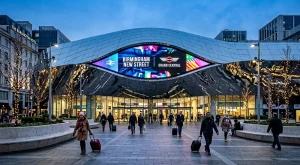
The Bullring and Grand Central remain the city’s retail centre, with Selfridges’ bronze-disc building still one of the most recognisable shapes on the skyline. Both have leaned harder into leisure alongside retail in recent years, more dining, more things to actually do rather than just buy. For something less corporate, the Jewellery Quarter has independent jewellers and antique dealers instead of chain stores, and Digbeth’s Custard Factory area has a growing cluster of vintage shops and street food worth a wander.
15. Digbeth at night
Digbeth has quietly become the city’s creative and nightlife centre. The Glee Club has hosted comedians from Michael McIntyre to Jack Dee in an intimate room, and the bars and independent venues around the Custard Factory keep multiplying. NQ64 does retro arcade games with cocktails if you want something a bit different from a standard night out. This is also where a lot of Birmingham’s smaller live music venues are clustered, hosting touring acts most weeks that never make it onto the big arena bills.
16. Day trips
Birmingham’s location makes it a genuinely good base for getting out of the city for a day. Stratford-upon-Avon, Shakespeare’s birthplace, is about 40 minutes by road and pairs naturally with Warwick Castle nearby, a proper medieval fortress with towers and dungeons that can easily eat a full day on its own. The Black Country Living Museum, a short trip out, recreates roughly 300 years of Black Country life and has become something of a pilgrimage for Peaky Blinders fans, even though the show wasn’t always filmed there. The Cotswolds are also within reach for a full day out if you want honey-coloured villages and rolling hills as a complete change of pace.
If you’ve got more time, London, Oxford, and the Peak District are all a comfortable couple of hours by road from Birmingham, which makes the city a decent base for a longer UK trip rather than just a single stop.
Getting around while you’re sightseeing
Most of the central attractions, the museum, the library, the canals, Symphony Hall, the Jewellery Quarter, sit within twenty minutes’ walk of each other, and the city centre genuinely is walkable. The Midland Metro tram covers some of the outer areas, buses cover the rest.
Where it gets trickier is anything slightly outside the centre. Cadbury World, the Black Country Living Museum, Aston Hall, all of them mean a longer public transport trip or a taxi. If you’re trying to fit in more than two attractions in a day, or you’re on a business trip with a tight window between meetings, a chauffeur service in Birmingham takes the guesswork out of it entirely, no bus timetables, no parking search at Cadbury World, no risk of missing a pre-booked slot because traffic ran long. Flying in directly? A Birmingham Airport transfer straight into the centre saves you the first hour of the trip before you’ve even started.
Best time of year to come
Spring and early autumn tend to hit the sweet spot between decent weather and manageable crowds. Summer, especially late July through early September, is when Cadbury World and SEA LIFE get genuinely busy, though most attractions extend their hours to match. December brings one of the largest German Christmas Markets outside Germany itself, plus ice rinks and seasonal events around the centre, but hotel prices climb accordingly. If your trip lines up with something specific at the NEC or a major exhibition at the museum, check those dates early, since they can move both crowd levels and hotel availability across the whole city.
Exploring Birmingham, or flying in and need a lift straight into the city? National Executive Transfers runs a Mercedes chauffeur fleet out of Birmingham Airport, with licensed drivers who actually know the city rather than just following the sat nav. Get a quote, or have a look at our Birmingham city guide for more on the city’s history and food scene.
Frequently Asked Questions
Cadbury World, by a distance, over half a million visitors a year. For free attractions, that title goes to the Museum & Art Gallery.
No, not quite. About 70% of the building is accessible, including the Round Room, the Staffordshire Hoard gallery, and the Birmingham History Galleries. The art galleries on level 2 and the ancient history collections on level 3 are still closed for renovation work, so if those specifically are why you're going, check the museum's website before you travel.
Two to three covers the central attractions properly, with a spare day for a trip out to Stratford or the Black Country Living Museum. If you've only got one day, pick two or three things and do them properly rather than rushing six.
Yes, easily. Cadbury World, SEA LIFE, and Thinktank are all built with families specifically in mind, and Cannon Hill Park gives you a free, low-key option when everyone needs a break from museums.
A stretch covering parts of Sparkhill, Moseley, and Balsall Heath, known for its concentration of family-run Balti houses serving curry in the metal pan it's named after. Best-value food experience in the city, full stop.
Not in the centre, it's walkable and well served by trams and buses. Further out, Cadbury World or Aston Hall, a taxi, chauffeur, or careful planning around public transport will save you real time.
He grew up in Sarehole, on what's now the edge of the city, and the area around Moseley Bog and Sarehole Mill is generally thought to have inspired the Shire.
If you're trying to cover ground outside the centre, going to an evening show, or working around a tight business schedule, yes, it removes most of the friction: no parking, no waiting on connections, no taxi queues after a show lets out.