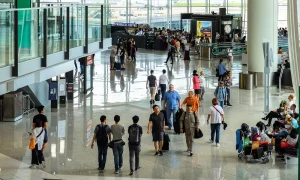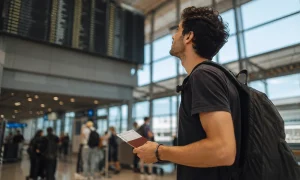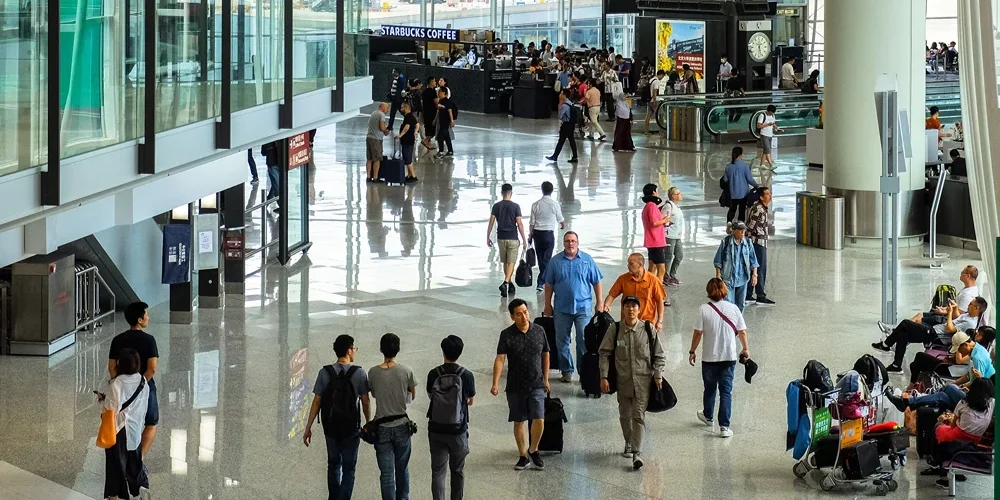
You round the corner into the terminal and the security queue is already snaking back past the check-in desks, forty minutes before your flight even opens for boarding. Everyone else in that queue had the same half-term week off school. Nobody planned this together, and yet somehow you all arrived at once.
That’s the reality of flying during October half term. It’s worth understanding properly before you’re standing in that queue yourself. This guide covers which UK airports are likely to feel the pressure hardest this year. It explains why the crowding happens the way it does, and how to plan the whole journey, not just the bit inside the terminal. With the right planning, autumn half term airport chaos becomes something you’ve prepared for rather than something that catches you out.
Why does October half term turn UK airports into something different?
In England, Wales and Northern Ireland, most schools break up for October half term the week of Monday 26 to Friday 30 October 2026. Northern Ireland’s own Halloween break falls on the Thursday and Friday specifically. Scotland’s October break generally runs earlier, often around 12 to 16 October. This varies significantly by council, though, with some starting as early as the first week of the month.
Confirmed versus expected
The dates above reflect confirmed or widely published local authority calendars for the week itself. Exact daily passenger numbers for 2026 aren’t published in advance. Any figure claiming to know precisely how busy a specific day will be should be treated with caution. What’s reasonable is expecting the same broad pattern that’s shown up consistently in previous years.
Your own school’s dates may differ slightly
Local authorities set the general framework, but individual academies, free schools and independent schools can shift their own calendars by a few days either side, and INSET days sometimes extend a break at one end. If your travel plans depend on an exact date, check your own child’s school calendar directly rather than relying solely on the general council-published week.
Why this creates such a specific pressure point
Unlike the long summer break, October half term compresses almost the entire demand for a week’s holiday into a single week. Families can spread summer departures across six or seven weeks instead. Airports and airlines schedule for average demand across the year, not for a week where a huge proportion of UK families try to travel simultaneously.
The historical pattern is genuinely striking
This isn’t a one-off. In October 2024, Stansted recorded the busiest single day in its entire history during the half-term period, with more than 107,000 passengers passing through in 24 hours. Heathrow had its busiest October on record the same year, driven substantially by the half-term surge. These are historical facts, not 2026 forecasts, but they show a consistent pattern that’s reasonable to expect will repeat in some form this year.
Why every seat matters more than usual
During half term, flights genuinely fill up. There’s very little spare capacity anywhere in the system to absorb a delay, a diversion, or a bit of bad weather. A single disrupted rotation earlier in the day can ripple through the entire afternoon’s schedule, because there’s no slack left to reroute passengers onto a half-empty later flight.
Which UK airports are likely to feel busiest this half term?
None of these figures are 2026-specific forecasts. They’re based on published passenger patterns and each airport’s usual scale, which gives a reasonable steer on where the pressure is likely to concentrate.
Heathrow
As the UK’s largest airport by a wide margin, historically handling over 80 million passengers a year, Heathrow carries the heaviest absolute volume of half-term traffic. Its scale works in your favour in one sense, since it’s built for high throughput. The size also brings more terminals, more walking, and more complexity if something does go wrong. Anyone travelling through Heathrow this half term should expect queues that build noticeably through the morning departure banks, particularly in the days immediately after schools break up.
Gatwick
Gatwick’s own published guidance already flags half term as a specific pressure point. Security queues that would normally take twenty minutes can stretch well beyond an hour. As a single-runway airport handling a genuinely enormous volume of leisure traffic, Gatwick tends to feel the half-term surge acutely. This is particularly true at the start and end of the break.
Manchester
Manchester is the busiest airport outside London. Its own data shows school half terms in February, May and October running significantly busier than normal. Terminal 1 closed in late 2025. All passengers now move through Terminal 2 and Terminal 3, which concentrates the same overall demand into fewer physical spaces.
Stansted and Luton
Both airports carry a heavy proportion of short-haul leisure and budget-carrier traffic. This is exactly the kind of travel that spikes hardest during a school holiday week. Stansted’s own record-breaking October day in 2024 illustrates how quickly a normally busy but manageable airport can tip into genuine congestion. Luton follows a similar pattern, with its own mix of package holiday and city-break traffic concentrating heavily during exactly this week.
Birmingham
Birmingham Airport handled a record 13.66 million passengers in 2025. 2026 is expected to push close to 14 million. Unlike the London airports, Birmingham operates a single terminal. Every passenger, regardless of airline, funnels through the same check-in area and the same security lanes. This single-terminal design means the pressure is more concentrated during a busy period, not more spread out. Our Birmingham Airport arrival timing guide covers this in detail.
Edinburgh, Bristol and the regional airports
Regional airports like Edinburgh and Bristol handle a smaller absolute volume than the major hubs. They can still feel genuinely stretched during half term. Their facilities are sized for typical demand, not a compressed national surge. Anyone flying from a regional airport shouldn’t assume smaller automatically means quieter this particular week.
East Midlands and Liverpool
Smaller regional airports like East Midlands and Liverpool see a real half-term uplift too, particularly on routes to European city breaks and family package holidays. Absolute passenger numbers stay lower than the major hubs. The proportional jump during this specific week can still catch a facility built for a quieter typical day off guard.
What actually causes the queues once you’re through the doors?
Understanding the actual mechanics helps you judge where your own time is most at risk.
Check-in and bag drop
Airlines that still require desk check-in see their queues lengthen fastest during half term. The same applies to bag drop for passengers who’ve checked in online but are carrying hold luggage. More travellers than usual are checking bags for a proper holiday rather than a light business trip.
Security
This is usually where the visible chaos concentrates. More passengers arriving in the same compressed window means more lanes needed simultaneously. Airports can only staff and open so many lanes at once, even when they know a busy period is coming.
The walk to the gate
Security clearing doesn’t mean you’ve arrived. Larger airports can involve a genuine walk, sometimes fifteen minutes or more, before you reach your actual gate. This is easy to forget when mentally budgeting your morning.
Gate closure timing
Gates typically close a set window before departure, often 15 to 20 minutes, and this doesn’t move just because the airport is busy. If anything, a crowded gate area during half term makes it easier to lose track of time.
Passport control for international travel
If you’re flying outside the UK, you’ll clear passport control after security, and this is a separate queue that gets busier during half term too. UK and Irish passport holders typically use a faster dedicated lane. Other nationalities can face a longer wait, particularly during the compressed demand of a school holiday week.
Baggage reclaim on arrival
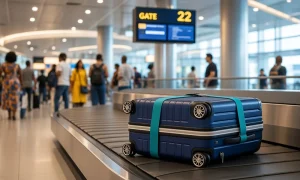
Arriving passengers face their own version of the same problem. More flights landing in a compressed window means more bags moving through the same carousels, and baggage reclaim can genuinely take considerably longer than usual during half term, particularly at the busier hubs.
How should you get to the airport without adding to the chaos yourself?
The airport itself is only half the journey. Roads and public transport around it change shape during half term too. It’s easy to plan for the terminal while forgetting about everything that happens before you get there.
Public transport
Rail and coach links into major airports often run a reasonably normal timetable during school holidays. Stations and platforms can feel considerably busier, though, particularly with families managing luggage and children through ticket barriers. This suits a traveller with light luggage and a comfortable time buffer.
Driving yourself
Roads around airports and city centres genuinely change character during school holidays. Commuter traffic drops, which can actually make some routes faster. Leisure traffic, particularly around half term getaway weekends, can build in the opposite direction on routes leading directly to the airport. Parking then becomes its own queue, on top of whatever you find inside the terminal.
Taxi or private hire
A taxi or app-based private hire works well for a straightforward journey, but demand for these services spikes during exactly the same windows as airport congestion itself. Expect longer wait times at peak half-term departure hours, and pricing that isn’t fixed in advance.
A pre-booked chauffeur
A chauffeur transfer removes the parking search and the taxi-availability gamble entirely. A fixed price is agreed before you travel, and a driver factors in the likely road conditions in advance. This genuinely matters more during a period like half term than on an ordinary Tuesday. So many of the variables that normally sort themselves out become less predictable precisely when demand peaks.
If you already know your flight time, it can be worth arranging the transfer before the week itself gets busy. Leaving the booking to the morning of departure means competing with everyone else trying to do the same thing.
School holiday road patterns matter here too
Fewer commuters on the road during half term genuinely does change traffic patterns, but it isn’t a uniform improvement. Routes near shopping centres, family attractions, and the airport’s own approach roads can see the opposite effect, particularly on the Saturday either side of the break itself.
Terminal drop-off versus parking
If someone’s dropping you at the terminal rather than you parking yourself, most UK airports now charge for drop-off zones, and these get genuinely congested during half term as more cars try to use the same limited kerb space in a short window. A pre-booked transfer avoids this entirely, since the driver knows exactly where to pull in and doesn’t need to circle looking for space.
How early should you actually leave home?
Airport arrival time and leaving-home time are two genuinely different numbers, and conflating them is where most people’s morning goes wrong.
Work backwards from your flight, not forwards from habit
Start with your actual departure time. Add your airport’s own recommended arrival buffer next, which each of NET’s airport-specific guides covers in detail for Birmingham, Manchester and Gatwick. From there, add your realistic road or rail journey time to the airport, including a genuine allowance for half-term traffic rather than a normal-day estimate.
Early morning flights
A flight departing before 8am generally needs the earliest and most cautious planning of the day. You’re arriving during the airport’s own peak queue window, and you have the least flexibility if anything runs even slightly late.
Mid-morning and afternoon flights
These generally sit in a more forgiving window, though half term compresses this less than you’d hope. The mid-morning surge, once the early flights have cleared, can still be considerable.
Evening flights
Evening departures often benefit from the day’s earlier queues having eased. Half-term evening flights can still be genuinely busy, though, particularly on the final day of the school break as everyone heads home at once.
Short-haul versus long-haul
Long-haul flights typically carry their own earlier check-in and bag-drop requirements. Always check your specific airline and airport’s current guidance rather than assuming a single rule applies across every route, since requirements genuinely do vary.
Connecting flights need extra caution
If your half-term trip involves a connection rather than a direct flight, build in a genuinely realistic buffer between legs. A tight connection that’s fine on a quiet day becomes considerably riskier when the first leg is more likely to run late during a genuinely busy travel week.
What should families, business travellers and older passengers prepare differently?
Half-term travel isn’t the same experience for every kind of passenger, and preparation genuinely differs.
Families with children
Pack entertainment, snacks and a change of clothes in hand luggage specifically for the queuing time itself, not just the flight. A half-term security queue with a tired toddler is a different proposition to the same queue with an adult travelling alone. Building in extra patience time, not just extra minutes, genuinely helps.
Business travellers
If you’re travelling for work during half term, the same congestion applies regardless of your ticket type. Build in a genuinely realistic buffer rather than assuming business travel somehow moves faster through a busy terminal. Consider whether a pre-booked transfer removes enough uncertainty to justify the cost for a trip you can’t afford to be late for.
Older or less mobile passengers
Longer walks to the gate, busier queues, and less predictable waiting times all matter more if mobility or stamina is a genuine concern. Requesting assistance in advance through your airline, rather than on the day, tends to work more smoothly during the airport’s busiest weeks.
Large or awkward luggage
Half term often means holiday luggage rather than a single carry-on. A crowded terminal makes manoeuvring a full trolley considerably harder. A vehicle genuinely large enough for your luggage removes one entire category of stress before you’ve even reached the check-in desk.
Overseas visitors unfamiliar with UK airports
If you’re visiting the UK during half term rather than departing from it, the same congestion applies to your arrival experience too. An unfamiliar terminal layout, combined with a genuinely busy immigration queue, can turn a straightforward arrival into a confusing one. Arranging a pre-booked pickup with meet and greet removes the need to navigate an unfamiliar building while jet-lagged and disoriented.
Weather adds an extra variable
October weather is genuinely changeable across the UK. A wet, windy morning changes the road journey to the airport as much as it changes conditions on the runway. Fog and de-icing requirements can also affect very early departures later in the month. Check the forecast for your specific travel day rather than assuming autumn weather stays consistent across the whole half-term week.
Is a private airport transfer worth it during half term?
Not automatically, and it’s worth being honest about that. A private transfer isn’t the automatic answer to autumn half term airport chaos for every single traveller, even though it solves several genuine problems at once.
When public transport or driving genuinely make more sense
If you’re travelling solo, with light luggage, and have a comfortable time buffer, public transport or driving yourself remains perfectly sensible during half term. Just build in the extra time this guide has already covered.
When a private transfer earns its cost
The calculation changes for a family managing children and full holiday luggage. It also changes for an early departure where a missed connection genuinely isn’t an option. Anyone who’s already anxious about half-term crowds adding driving and parking stress on top falls into this group too.
A typical cost comparison
Typical example, to illustrate the shape of the comparison rather than exact figures: a week of airport parking often costs a similar amount to a return chauffeur transfer. This is once you add the actual drive there and back. Factor in the time spent finding a space in a busier-than-usual car park, and the two options move closer together on genuine value, not just headline price.
What flight monitoring actually adds during half term
A chauffeur company that tracks your flight number adjusts your pickup automatically if your return flight is delayed. This matters considerably more during a week where delays ripple further through an already-full system. You’re not left checking arrivals boards and hoping someone’s still coming.
Meet and greet, specifically for this week
Being met inside arrivals removes a genuine source of stress for anyone arriving tired after a half-term getaway, particularly with children in tow. This matters more than finding your own way to a pickup point in an unfamiliar or unusually crowded terminal.
What should you do if things go wrong anyway?
Even with good planning, half term carries genuine disruption risk, and it’s worth knowing what to actually do.
If your flight is delayed
Check your airline’s own app or website directly rather than relying on the departures board alone, since mobile updates often land faster. If you’ve booked a chauffeur, most reputable providers monitor this automatically, so you shouldn’t need to update them yourself.
If your flight is cancelled
A cancellation during half term carries more knock-on risk than at a quieter time of year, since rebooking onto an alternative flight competes against every other affected passenger trying to do the same thing. Check your airline’s rebooking options immediately rather than waiting in a phone queue, since many airlines now handle this through their app faster than by phone.
Travel insurance is worth checking before you go
A policy that covers delay and cancellation costs matters more during a period with genuinely elevated disruption risk. Check what your policy actually covers, including any excess or minimum delay threshold, before you travel rather than discovering the details after something’s already gone wrong.
If your return journey needs to shift
Contact your transfer provider as soon as you know your revised time, rather than waiting until you’ve landed. Most companies would rather know early than be caught by surprise at the pickup point.
Things to consider before leaving for the airport
- Your actual departure time, not just when the airport opens
- Current half-term buffer guidance for your specific airport
- Whether your route into the airport is affected by half-term road patterns
- Whether parking is pre-booked, if you’re driving
- How much luggage you’re bringing, and whether your vehicle genuinely fits it
- Your flight number, given to any transfer provider in advance
- Your return journey, planned before you leave rather than assumed
- Current weather and travel disruption for your specific date
If your trip involves an early departure, a full car of luggage, or a schedule you can’t afford to get wrong, arrange your transport in advance. Doing this before the half-term rush itself begins avoids competing with everyone else for the same booking slots.
Where National Executive Transfers fits into this
National Executive Transfers is based at Birmingham Airport, with professional drivers running a Mercedes-Benz fleet across airport, business and family journeys throughout the UK. Flight monitoring and meet and greet come as standard on airport transfers, adjusting automatically if your flight lands early, late, or is delayed altogether.
The fleet includes the Mercedes E-Class for a solo traveller or pair, and the Mercedes V-Class for a family or group with genuine holiday luggage to manage. For business travellers with a flight to catch and no room in the schedule for uncertainty, the same flight-tracking and fixed-price approach applies. It works whether the journey is a single passenger or a small group.
If your half-term trip involves more than one stop
A half-term trip sometimes involves collecting an overseas relative from the airport and then taking them somewhere else entirely, rather than a single point-to-point journey. Hourly or full-day hire suits this kind of day better than booking several separate transfers, since the same driver and vehicle can stay with you throughout rather than starting each leg from scratch.
None of this means a private transfer is the right choice for every half-term journey. For a light, flexible trip with time to spare, public transport or driving yourself remains genuinely sensible. Where a pre-booked transfer earns its place is exactly the situation this guide has covered. That means a family with full luggage, an early or high-stakes departure. It also covers a passenger who’d rather not add parking and traffic uncertainty to an already busy travel week.
If you’re planning a trip through Birmingham Airport this half term, it’s worth checking your specific airport’s current delay patterns. Our UK airport delays comparison covers this in detail, whether you’re comparing options or already know where you’re flying from. Get in touch to arrange your half-term airport transfer before the busiest dates fill up.
Frequently Asked Questions
This varies by airport, but expect to add 30 to 45 minutes beyond a normal day's recommended arrival time, particularly for an early morning departure. Check your specific airport's current half-term guidance for an accurate figure.
Heathrow carries the largest absolute volume, while Gatwick, Stansted, Manchester and Birmingham have all historically shown sharp increases during the October half-term week specifically, based on published passenger patterns rather than a fixed 2026 forecast.
Yes. Birmingham handled a record 13.66 million passengers in 2025, and its single-terminal layout means every passenger moves through the same check-in and security areas, concentrating half-term pressure rather than spreading it out.
It depends on your situation. For a family with full luggage, an early departure, or a schedule you can't afford to disrupt, a pre-booked transfer genuinely reduces uncertainty. For a light, flexible trip, public transport or driving often works just as well.
Yes, provided you give your flight number when booking. This lets the provider adjust your pickup automatically if your flight is early, late, or delayed, rather than leaving you to update them manually.
Check your airline's app directly for the most current update. If you've booked a transfer with flight monitoring, most providers adjust automatically without you needing to contact them.
It depends on the length of your trip and how you value your time. A week of parking often costs a similar amount to a return transfer once you include the actual drive to and from the airport, so the comparison is closer than the headline prices suggest.
Yes, ideally before the week itself, since demand for taxis and private hire spikes during exactly the same period as airport congestion.
Yes. Larger vehicles suit a family travelling with full holiday luggage, removing the need to manage bags and children through a crowded car park or public transport connection.
Yes, particularly during half term, since an early pickup removes the added uncertainty of finding parking or a taxi during the airport's busiest queue window of the day.