Flying for the first time is a strange feeling. Part of you is excited. Part of you is quietly worried too. You might get something wrong, hold up a queue, or miss something obvious that everyone else seems to already know. That feeling is completely normal, and almost everyone who flies regularly once felt exactly the same way on their first trip.
Here is the good news. Nothing about flying from Manchester Airport is actually complicated once someone explains it properly, in the right order, using plain words instead of airport jargon. That is exactly what this guide does.
We will walk through your entire day, from the moment you leave home to the moment you land. Along the way, you will learn what to sort out before you travel, including your bag allowance and the liquids rule that catches so many first-timers out. You will see exactly what happens at check in. You will also learn what security actually feels like, step by step, rather than as a vague warning to “get there early.” Boarding groups are explained too, along with what to expect during the flight itself. That includes the parts nobody warns you about, like your ears popping, and what happens the moment you land. We will also cover what to do if your flight is delayed, what to pack for comfort, and where to get help if you need it.
By the end, you will know precisely what your day looks like, and none of it will feel like a mystery anymore. Every detail here is specific to Manchester Airport, not generic advice copied from somewhere else.
Sort These Things Out Before You Leave Home
A little bit of preparation goes a long way, and most of it takes only a few minutes.
Check in online
Most airlines let you check in online, usually starting 24 to 48 hours before your flight. Doing this saves you time at the airport. You can go straight to bag drop, or straight to security if you have no bag to check.
Download your boarding pass to your phone. Or print it at home if you would rather have a paper copy. Either works fine at Manchester. It is still worth checking your specific airline’s rules, though, since a few budget airlines charge a fee if you do not have a boarding pass ready.
Know your terminal
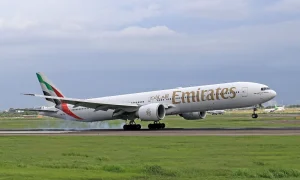
Manchester Airport has two terminals now, not three. Terminal 1 closed for good in 2025, and its old space became part of an expanded Terminal 3. Ryanair now flies from Terminal 3. Nearly every other airline, including easyJet, Jet2, TUI and Emirates, flies from Terminal 2.
Check your booking confirmation or your airline’s app to see which terminal you need. Turning up at the wrong one wastes time you do not want to lose on your first flight.
Check your bag allowance
Every airline has its own rules on hand luggage and checked bags. The limits vary more than you would expect. Ryanair’s free bag, for example, is smaller than easyJet’s, and neither matches what British Airways or Emirates include as standard.
Check your exact allowance before you pack, not after. Our UK hand luggage size and weight guide breaks this down by airline, so you know exactly what you can bring for free.
Know the liquids rule
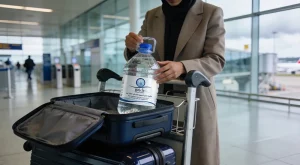
You can carry liquids in your hand luggage. Each container needs to be 100ml or less, though, and they all need to fit inside one clear resealable bag.
This trips up a lot of first time flyers. A full size shampoo bottle or a large bottle of water will get stopped at security.
Our UK liquids rules guide explains this properly, including what counts as a liquid in the first place. It is more than just drinks.
What to pack for comfort
Beyond your main bag, a few small things make the actual flight itself more comfortable, especially if you are nervous.
Pack headphones, since most planes still have a screen or entertainment system that works with them. Bring a book, a phone loaded with something to watch, or anything else that keeps your mind busy. Pack a bottle of water to fill up after security, since you cannot take a full one through the checkpoint. A snack helps too, particularly on a short flight where the food service may be limited or chargeable. If you take any regular medication, keep it in your hand luggage rather than your checked bag, in case your case is delayed.
Check your travel documents properly
Beyond your passport or ID, it is worth checking whether you need anything else for your specific trip. If you are travelling internationally, some destinations require additional entry permissions arranged before you fly. Our guide to what documents you need before your airport transfer covers this in more detail, so you are not caught out at check in.
How to Actually Get to Manchester Airport
For a first flight, how you get to the airport matters as much as anything covered later in this guide. You do not want your first experience of flying to start with a stressful drive or a parking hunt. A rushed goodbye at the door does not help either.
You have a few realistic options, and it helps to know them before you decide.
| Option | Best for | Worth knowing |
|---|---|---|
| Someone drops you off | Travelling light, with support available | Separate charged zones for drop off and pick up |
| Driving and parking yourself | Full control over timing | Book ahead, since walk up prices cost more |
| Train or Metrolink tram | Solo travellers with hand luggage only | Runs directly into the terminal, no parking to think about |
| Pre-booked chauffeur service | A calm, stress-free first flight | Fixed price, flight tracked, door to door |
Being dropped off
If someone is driving you, they need to know one key thing. Manchester has a separate drop-off zone and pick-up zone, and it charges for both. Getting this wrong is one of the most common mistakes drivers make, so it is worth them reading up before the day. Our guide to Manchester Airport drop off and pick up charges explains exactly what to expect if someone is bringing you.
Driving and parking yourself
If you are driving yourself, decide on parking in advance rather than on the day. Booking ahead is almost always cheaper than turning up and paying on arrival, and it guarantees you a space during busy periods. Our Manchester Airport parking versus chauffeur guide compares the real costs of both options side by side.
Train and Metrolink tram
Manchester Airport has its own train station and a Metrolink tram stop, both connecting directly into the terminal. This works well if you are travelling alone with hand luggage only, since there is no car to park and no charge to think about. It gets harder with a lot of luggage, young children, or an early morning flight, since services run less often at those times.
Chauffeur service
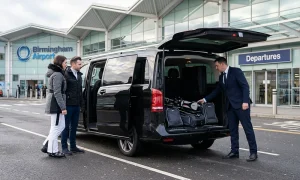
For a first flight specifically, this option removes almost every source of stress covered in this guide before you even reach the terminal. A Manchester Airport chauffeur service collects you from home, tracks your flight in case anything changes, and takes you straight to the correct terminal.
Given how much Manchester’s layout has changed recently, having a driver who already knows exactly where to go is worth more than it might sound. There is no drop-off charge to work out, no parking to book, and no walk from a car park with your bags. Your price is agreed before you travel too, so there is nothing extra to budget for on the day.
Whichever way you travel, work out how early you actually need to arrive. Our guide to how early to arrive at Manchester Airport gives you a proper answer based on your flight type, not just a generic two hour rule.
Domestic Flights Versus International Flights
Not every first flight works exactly the same way, and it helps to know which type you are taking.
A domestic flight stays within the UK. You will not go through passport control at Manchester, either leaving or arriving. Airline staff may still ask for photo ID at check in or at the gate, though.
An international flight is different. After security, you may need to show your passport at a separate passport control point before you reach the gate. On arrival at your destination, you will go through border control before collecting any checked bags. If you are flying internationally for the first time, keep your passport somewhere easy to reach throughout the day, since you will need it more than once.
Arriving at the Terminal
Once you are at the right terminal, look for the departures boards near the entrance. These show your flight number, your check in desk, and later on, your gate.
If you have already checked in online and have no bag to drop, you can usually walk straight past the check in desks toward security. If you do need to drop a bag, look for your airline’s name above the check in desks. Join that specific queue rather than the nearest one, since each airline has its own line.
Check In and Bag Drop
If you have not checked in online, you will need to do this at the desk instead. Bring your booking confirmation and some form of ID, even for domestic flights. Airline staff sometimes ask to see it, so it is worth having ready rather than digging for it at the desk.
At the desk, staff will check your booking. They will weigh your bag if you are checking one in, and print a luggage tag for it. Keep the small part of that tag that gets handed back to you. You may need it later if your bag does not arrive with you.
Going Through Security
This is the part that worries most first time flyers, so let’s go through it properly.
What you need to take out
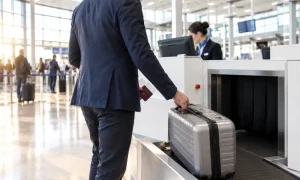
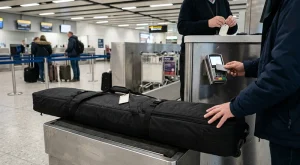
Before you reach the scanner, you will need to remove a few things from your bag. Place them in a tray, ready for the machine. This usually includes laptops and large electronics, and your liquids bag if you are carrying one. Some airports still ask you to remove belts and jackets too, so watch what the person in front of you does if you are not sure.
Going through the scanner
You will walk through a body scanner, or occasionally be asked to step through a metal detector instead. This is a normal, routine check, not something to be nervous about. If anything sets off an alert, a security officer will simply ask you to step aside for a quick, polite check. This happens to a huge number of ordinary passengers every single day.
Getting your things back
Once your tray comes through the machine, collect your things from the other side. Put your laptop and liquids back in your bag once you are clear of the immediate area, rather than blocking the exit while you repack everything.
For the complete list of what you can and cannot carry through security, our UK airport security rules guide covers it in full detail.
What Happens After Security
Once you are through, you are airside. This means you are now in the part of the airport only ticketed passengers can access. This is where the shops, cafes, and lounges are.
Manchester has plenty of both terminals to explore, from coffee shops to sit down restaurants, along with the usual duty free and high street names. If you have a longer wait, or simply want a calmer space before your flight, our Manchester Airport lounges guide explains what is available and who can use it.
Finding Your Gate
Your gate number usually appears on the departure boards somewhere between 30 minutes and an hour before your flight, though this can vary. Keep an eye on the boards, or check your airline’s app, since gates can occasionally change at short notice.
Manchester’s terminals are large, so give yourself proper time to walk to your gate once it is announced. This matters more at Terminal 2, which has expanded significantly and can involve a longer walk than you might expect. Our guides to Terminal 2 and Terminal 3 cover the layout of each in more depth.
Boarding the Plane
Boarding usually starts around 30 to 40 minutes before departure, though this varies by airline. You will often see boarding split into groups, sometimes based on seat location, sometimes based on whether you paid for priority boarding.
There is no need to rush to the front of the queue unless you are in an early boarding group. Your seat is already reserved, so waiting for your group to be called is perfectly fine. Have your boarding pass and passport, if you are flying internationally, ready to show as you approach the gate.
During the Flight
Once you are seated, cabin crew will run through the safety demonstration. It is worth actually watching it, even though it can feel repetitive to frequent flyers, since the exact layout of each aircraft is slightly different.
For most short flights from Manchester, you will be in the air for somewhere between one and three hours. Keep your seatbelt fastened when the sign is on. Feel free to ask cabin crew if you are ever unsure about anything during the flight. That is genuinely what they are there for.
What flying actually feels like
Nobody warns you about this properly, so here it is plainly. Your ears may feel blocked or pop slightly during takeoff and landing, as the air pressure changes. Swallowing, yawning, or chewing gum all help with this, and it is completely normal rather than a sign of anything wrong.
Turbulence, the bumpy feeling planes sometimes get, can feel alarming the first time you experience it. It is a routine part of flying, though, and aircraft are built to handle it comfortably. Pilots and cabin crew are entirely unbothered by it, which tells you everything you need to know about how seriously to take it.
What If Your Flight Is Delayed or Cancelled
Delays happen, and knowing what to expect takes a lot of the stress out of it if it happens to you.
Check the departure boards or your airline’s app for the latest information rather than guessing. If your flight is delayed by more than a few hours, or cancelled outright, you may be owed something. This could be compensation or assistance from the airline, depending on the reason for the disruption. Our guide to flight delay rights at UK airports explains exactly what you are owed and how to claim it.
A flight tracking app also helps here, since it often shows updates before the airport boards do. Our guide to the best flight tracker apps covers the ones worth having on your phone before you travel.
Landing and Getting Off
Once you land, stay seated until the seatbelt sign turns off and the aircraft has properly stopped. Standing up too early does not get you off the plane any faster, since everyone still needs to file off in an orderly way.
If you checked a bag, follow the signs for baggage reclaim. Screens above the carousels show which flight is on which belt. If your bag does not appear, do not simply leave the airport and hope for the best. Report it straight away at your airline’s desk in the baggage hall. Our Manchester Airport baggage and lost property guide explains exactly what to do if this happens to you.
A Typical First Flight, Start to Finish
Sometimes it helps to see the whole day laid out in order, rather than reading each step on its own.
Say your flight leaves at 10am. You arrive at Manchester around 8am, since you checked in online but are still checking a bag. You find your terminal, join the bag drop queue for your airline, and hand your case over within about ten minutes. From there, you walk to security.
Security takes perhaps fifteen minutes on a normal morning, longer if it is busy. You empty your pockets, put your laptop and liquids in a tray, and walk through the scanner. Once you collect your things, you are airside. You have a coffee, check the departure boards, and see your gate appear about forty minutes before departure.
You walk to the gate, taking your time rather than rushing. Boarding starts not long after you arrive. You board with your group, find your seat, and the flight itself is over almost before you have settled in. On the other end, you either walk straight out or wait a few minutes at the carousel for your bag. That is genuinely most of what a first flight actually involves.
Accessibility and Extra Help
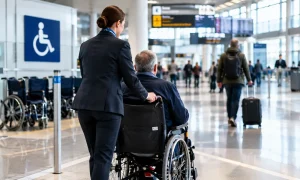
If you need any kind of assistance at Manchester Airport, book this through your airline in advance rather than turning up and asking on the day. This covers help with mobility, sight, hearing, or anything else you might need.
Airlines generally ask for at least 48 hours notice. Earlier is always better, though, if you can manage it. Once you arrive, look for staff at a dedicated assistance point. You can also ask any member of airport staff to point you in the right direction. Nobody will think it strange to ask, and it is a completely normal part of many people’s travel day.
A Few Honest Tips for First Timers
Arrive with more time than you think you need. Being early and relaxed is always better than being on time and stressed.
Wear shoes that slip on and off easily. You may be asked to remove them at security, and fiddling with laces in front of a queue is not fun.
Keep your passport, boarding pass, and any travel documents together in one place, ideally somewhere you can reach without digging through your whole bag.
Do not panic if something feels confusing. Airport staff answer basic questions all day, every day, and they would much rather help you than watch you struggle in silence.
Related Articles
If this is your first trip through Manchester, these guides cover the details that pair well with this one.
First Time Flying From a UK Airport
Manchester Airport: A Complete Guide for First-Time Travellers
How Early Should You Arrive at Manchester Airport
UK Hand Luggage Size and Weight Rules
Manchester Airport Baggage and Lost Property Guide
Start Your Journey Calmly
Your first flight already comes with enough new things to think about. The journey to the airport does not need to be one of them.
A Manchester Airport chauffeur service from National Executive Transfers picks you up from home and takes you straight to the correct terminal. Your driver knows the current layout, tracks your flight, and helps with your bags, so the only thing left to think about is the flight itself.
Frequently Asked Questions
Not always, but airlines often ask for some form of photo ID, so bring your driving licence or passport just in case.
This depends on your flight type and the time of day. Our full guide to how early to arrive at Manchester Airport gives specific advice based on your situation.
Check your booking confirmation or your airline's app. Since the 2025 changes, Ryanair uses Terminal 3, and almost every other airline uses Terminal 2.
No. All liquids need to be in containers of 100ml or less, carried together in one clear resealable bag.
Gates usually close around 20 to 30 minutes before departure, and airlines are not obliged to wait. Head to your gate as soon as it is announced, rather than leaving it until the last minute.
Completely normal, and very common. Understanding what actually happens at each stage, rather than imagining the worst, usually helps far more than people expect.